
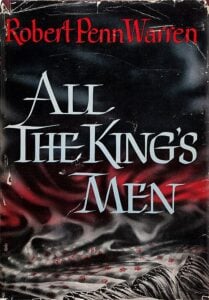
 All the King’s Men
By Robert Penn Warren.
Harcourt Brace and Company, 1946.
Reviewed by Will Fletcher.
There is a strong temptation to render Robert Penn Warren’s 1946 masterpiece All the King’s Men in a purely political valence. It all accords upon a first look: a novel about Willie Stark, a Southern demagogue, with inspiration drawn heavily from Huey Long. In fact, Warren himself knew all too well, in introducing the book a few years later for the Modern Library edition, that this register would be the main foothold for readers: the “great American political novel,” as it were. And yet, in that same introduction, he cautions the reader against such an act, imploring them that “The book, however, was never intended to be a book about politics” per se. Politics, for Warren, was merely the backdrop for a vaster and more expansive tale illustrative of the broad tapestry of human affairs.
It would be errant to argue conversely that the novel is antipolitical. Politics factor into every great tale involving the management of human society. The proper statement is that All the King’s Men is not merely a novel about politics. The irony that lies at the heart of the novel is that reading it for its political plot can obscure what makes the novel so perennial. So that the reader understands the full extent of this, Warren grants us the narrator, Jack Burden, the lynchpin of Warren’s core message.
Jack was not intended at the beginning of the project to feature prominently in the plot. It was to focus on Stark and Stark alone. And yet, to achieve his goal, something beyond what he deemed a “straight naturalistic novel,” he needed a character with a broader humanistic outlook than Stark, who remains largely fixed on his domination of an unnamed Southern state (Louisiana). The political reporter was not enough for the moral ambition Warren demanded, “so Jack Burden entered the scene” and provides an augmented set of senses by which the reader may survey his moral landscape.
Jack gradually reveals key details about his past that parallel, in some ways, the journey man takes toward nomos, “self-knowledge.” He grew up materially comfortable, but with broad questions about his familial life, and the confusion leads him to pursue graduate studies at the State university. He receives a commission for a dissertation from an advisor who recommends he study the papers of Cass Mastern, a Southern planter who becomes embroiled in a tragedy after a love affair goes wrong, with catastrophic consequences.
Jack spends years following the paper trail, using the historical process as a retreat away from his present problems. It takes him to archives, in cities he has never visited, and to meet people he will never encounter again. Cass, in his own day, saw himself as both an observer of and a participant in a great betrayal, and he dies after reckoning with the resulting guilt. However, when Jack is finally faced with the task of reckoning with the inherent tragedy of Mastern’s tale himself, as the historian is tasked with doing, he quits the dissertation and retreats into journalistic observation, writing the same story again with no self-reflection. He can be seen to be rejecting the final, most crucial step of the historical process: learning from it vis-à-vis himself.
Not only that, but he quits on history, and on the premise that it may be instructive to him in any meaningful way. Willie Stark lures him into his tutelage after Jack covers his Gubernatorial campaign, and like all his other associates, from Sadie to Sugar Boy, Burden is drawn in. The rest of the plot comes with Willie’s ever-growing ambition, and the impact that it has on the people around him.
Jack, in giving up his vocation, rejects the Greek principle of pathei mathos outlined in Aeschylus’ Agamemnon—the idea that with tragedy comes an inimitable wisdom. Be it as it may, Cass Mastern has suffered and in so doing gained wisdom, and conversely, Jack has merely observed and watched, just as he spends a majority of the novel as a fly on the wall in Stark’s affairs. He is a passenger to history, a conduit, an escort to an impending tragedy, but consequently has deep internal tensions left unresolved.
The great foe to the historian, at times, amounts to the theorist. If only we could explain away the tragedy of the past and the predicaments of the present with a category, a rule. Jack, in observing the girl he loved, Anne Stanton, becoming Stark’s mistress, flees west, something he contends “we have always done” as a species, aspiring to liberty from the things which perplex us. He develops a theory called the “Great Twitch,” which contends that things merely happen to people, a partial philosophical system that pales in comparison to his eventual realizations. It is a way to explain away any sort of moral responsibility for our actions, foregoing any burden we may have for the continuance of affairs. It can be no coincidence that the seed for the plot stemmed from an extensive vacation in Italy with his wife, reading Machiavelli and witnessing the rise of Italian Fascism; Stark’s analogy stretches far beyond the Kingfisher alone.
The Southern setting of ATKM is quite fitting, and even necessary. For as the late Richard Weaver would remark in a 1959 essay, “The South is a region that history has happened to.” Something that Jack Burden discovers as he leaves no stone unturned. The keystone to the plot is the moment that Stark, needing to get support from an old friend, Judge Irwin, asks Jack to dig up dirt from his past. We all have our skeletons—Jack knows this as a student of history—and in the process of research, History happens to Jack. Warren had his own, for he rejected his own strong views on racial segregation after bearing witness to the struggle towards civil rights in his own backyard.
When tasked with uncovering dirt on Judge Irwin, a figure from Jack’s childhood and Stark’s political career, he finds a monumental discovery that implicates himself. He uncovers the corruption Stark desires—nobody goes unprosecuted in the trials of the past—but in doing so discovers that his entire family life has been a lie. In that lie, he finds a tragic foothold to Mastern, and the plot at this point barrels ahead. He has recovered from pathos and Warren does well to illustrate the painful crawl towards mathos that completes the arc. The plot culminates in the assassination of Stark, and on his deathbed, he mutters a final lamentation to Jack that, amid all that has befallen the bunch, “it might have all been different.”
At this point, it becomes clear: Warren is giving us a lesson in being keen students of history, to learn to live in time again. Richard Weaver puts this insight in magisterial terms: “The rule of this life is to weigh and choose and abide the consequences, to suffer the effects of one’s will.” Jack, the Stantons, Irwin, and Stark all have lives that are inextricably linked to one another, and all tragic. Their community, like their native South, possesses a culture conscious that it has inherited consequences it did not entirely choose. Inheritance is the term befitting of history, and this entails both debts and goods. Weaver, in summarizing the reasons why he enjoys the Southern canon, concludes that its conception of man, both in his shining good and his devilish evil deeds, comes from observation turned into experience,
Jack, in going through his own tragedy and seeing the life he had built that enabled that paralysis, wakes up to hear the music. He perceives what Cass Mastern learned: that knowledge leads to suffering, reflection on said suffering begets understanding, and then understanding leads to acceptance of responsibility. It is all too easy to be lost in history, but Warren implores us as much as possible to see ourselves in the past. Jack learns to bear the Burden, quite literally, of his last name, and he learns to accept the responsibility, to go “out of the house and into the convulsion of the world, out of history and into history and the awful responsibility of time.”
We cannot look to history to confirm our prospective plans for what ought to be, to vindicate the abstract. Rather, we must study history frankly, so that we might learn how to live within it, to make sense of its complexities. A society that can look merely to the theatricality of its political spectacle is apt to be swindled, just as Stark gains massive influence by shedding his dry statistical sermons and becoming a populist prophet. For Jack, an uncrackable puzzle becomes a conduit for his own redemption, his acceptance of what has been. Eighty years on, we may profit by doing the same.
There is a final lesson to be learned about Warren’s novel as it pertains to a republic. Jack’s problem, the inability to make sense of history and its lessons, is also the problem of the citizen. That is, a republic requires people to act within and make sense of a mythos they themselves did not create, without complete knowledge of where their actions may take them. We must stay vigilant; the danger of the Willies of this world is that they thrive on the witnesses to governance and to history, the unattended observers.
We live in an age of convenience, one where our democratic decisions are foisted upon us in a nicely-packaged menu; we must interrogate these figures and ideas. Warren’s hutch grows stronger with time, just like the anti-Modernist ideals of the Agrarians with whom he shared an intellectual world.
Will Fletcher is currently the Program Associate at the Civitas Institute at the University of Texas at Austin. He is a graduate of the University of Florida, where he received his BA in History and European Literature.
Support the University Bookman
The Bookman is provided free of charge and without ads to all readers. Would you please consider supporting the work of the Bookman with a gift of $5? Contributions of any amount are needed and appreciated!

