
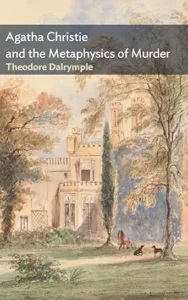
 Agatha Christie and the Metaphysics of Murder
By Theodore Dalrymple.
Criterion Books, 2026.
Paperback, 168 pages, $19.99.
Reviewed by Jeffrey Folks.
Allen Tate once wrote that the first duty of the critic is to read the work under discussion. By this, of course, he did not imply merely a cursory reading but an analysis with the utmost attention to every detail and nuance of the work or works under review. The product of this close reading was often an exhaustive treatise on single works or series of works, focusing on repeated patterns, symbols, and metaphors, and bringing one’s knowledge of the author’s entire oeuvre to bear on the reading.
Clearly, Agatha Christie and the Metaphysics of Murder is not this sort of book. To begin with, even though it does focus on a single novel chosen “at random” by Agatha Christie (They Do It With Mirrors), it selects only a small number of passages as the basis for long digressions, often based on Dalrymple’s extensive experience as a criminal psychiatrist and a teacher. These digressions make for interesting and informative reading, but they reveal less about Agatha Christie as a person or a writer and more about Dalrymple’s admittedly extensive knowledge of such issues as whether criminal behavior is innate or learned, whether criminals are of lower IQ than others, the definition of criminal insanity, the effects of divorce on criminal behavior, “the idea of self-esteem as a precondition of good behavior,” and the question of whether some individuals are truly evil, all of which are tangentially related to They Do It With Mirrors but that do not arrive at a hard-and-fast definition of Agatha Christie’s moral position, perhaps because Dalrymple may believe that she has one. As he writes of Miss Marple in They Do It With Mirrors, “every time someone…issues a grand statement about the whole of human psychology or conduct, Miss Marple demurs with a gentle half-demurral.” But does she?
Agatha Christie was an Anglican who kept copies of The Imitation of Christ and other religious works by her bedside, and her second husband was a Roman Catholic. In 1971 she signed a petition urging continued use of the traditional Catholic Mass, and in other respects, such as her apparent support of the death penalty, she was a traditionalist. One can be misled by examining a few passages from a single novel, but a reading of Christie’s entire oeuvre reveals that she found nothing to excuse murder, adultery, rape, theft, and other forms of crime. Nearly all of her books were focused on a particular moral prohibition, including lust, greed, pride, and revenge. Certainly, Dalrymple’s emphasis on Miss Marple’s compassion and understanding toward the criminal, but not “automatic exculpation,” is a fair assessment, but there is also her unwavering adherence to moral absolutes.
The entire point of moral strictures is to refute the claims of relativists who find extenuating circumstances for every sort of crime. Most of us carry wounds from childhood with us throughout our lives, but we do not and should not use them as excuses to violate moral laws. It is really a matter of whether one takes seriously the Biblical injunctions of “Thou shalt not.” Agatha Christie not only did that; she spent much of her life strongly refuting those who questioned the Commandments, as perhaps a majority of her contemporaries did. It is for this reason that Christie must be considered an important moralist.
While Dalrymple may agree with this conclusion, he sometimes appears tentative, particularly when his experience as a prison psychiatrist is brought to bear. The idea, for example, that he almost admires certain mass murderers is disturbing and certainly far afield from anything Christie wrote. In considering “the question of normality and its opposite with regard to delinquents,” Dalrymple concludes, “Who of us is normal? None of us is, is the answer.” What follows is a consideration of the possibility that all of us are mad, again an idea that, I believe, Agatha Christie would never have seriously considered. What we are are fallible human beings charged with responsibility for our actions and judgment of those of others. In refuting the idea that criminal behavior has a genetic origin, Dalrymple stresses the idea that moral choices are difficult to evaluate: “After all, most criminality involved complex behavior, the final common pathway of many influences, to say nothing of the indefinable influence of free will. However many factors you take into account, there will always be a mystery as to why some people but not others react to circumstances in a certain way.” It is certainly true that like Miss Marple we should not rush to judgment, but judgment there must be, and an emphasis on exculpatory evidence obscures the crucial fact that a crime has been committed.
Christie herself does not back away from moral absolutes. In the case of They Do It With Mirrors, all of the evil in the novel points back to Lewis Serrocold. Despite his insistence that all he has done, including murder and embezzlement, has been done in the service of a higher good, Serrocold is guilty of the most cold and evil actions (thus his name, Serrocold). Dalrymple views Serrocold as “intentionally a somewhat ridiculous figure,” but he is far worse than that. He epitomizes the vicious error, all too common in our time, to believe that the ends justify the means, so much so that tens of millions of human beings were murdered by the State in the 1930s and 1940s and millions more continued to be killed afterward, even to the present day. Agatha Christie found Lewis Serrocold to be far worse than a man who was somehow off the track because of his obsession with criminal reform: beyond the shadow of Serrocold lies a host of social reformers who have brought death and destruction to much of humanity.
In sum, there is little in her writing to suggest that Agatha Christie was anything less than a traditional moralist, one who believed that criminal acts should be punished by the law, as they almost always are at the conclusion of her stories, and that moral offences, even when not criminal, should be judged wrong as well. In those cases where the two categories of wrongdoing contradict one another, as in Murder on the Orient Express, in which an individual guilty of a terrible crime has been acquitted in a court of law but is then punished in vigilante fashion by those he has harmed, Christie applies a common-sense solution acceptable to most of her readers: that extralegal punishment, while “wrong,” can be excused because of the severity of the crime involved.
Agatha Christie has been accused of being a “middle-brow” author because she held such commonly accepted views (and because she wrote in a manner that was accessible to her readers, earning her sales of some two billion books at a time when such highbrow authors as Ezra Pound earned critical praise but sold almost nothing—according to Amazon, Pound’s Cantos rank 166,066th among books sold). Some might argue that Pound nonetheless was the greater and more influential writer, but those who do so overlook the cultural impact of Christie’s widely disseminated moral views and their role in supporting widely held opinions—and the possibility that those opinions may very well be right while most of Pound’s views decidedly are not. In this sense, Christie’s writing raises an intriguing idea, suggested by Dalrymple at several points, that popular detective fiction is of much greater importance than many believe it to be because it implicitly undermines the prevailing literary fashions of modernism and postmodernism by rejecting the notion that literature ought to be morally relativistic, antagonistic to popular tastes, and stylistically obscure.
Theodore Dalrymple has written an intriguing and thoughtful work addressing what he calls the “metaphysics of murder.” His writing brings a great deal of learning and experience, particularly of criminal psychology, to the task of evaluating Agatha Christie’s fiction. Agatha Christie and the Metaphysics of Murder is both original and engaging, and it should prove worthwhile reading for any reader of Agatha Christie or of fiction in general. His review of many aspects of criminality and punishment may serve as a starting point for further thought and discussion. In conclusion, Agatha Christie and the Metaphysics of Murder is a valuable and perceptive work that deserves to be widely read.
Jeffrey Folks is the author of many books and articles on American culture, including Heartland of the Imagination (2011).
Support the University Bookman
The Bookman is provided free of charge and without ads to all readers. Would you please consider supporting the work of the Bookman with a gift of $5? Contributions of any amount are needed and appreciated!
