
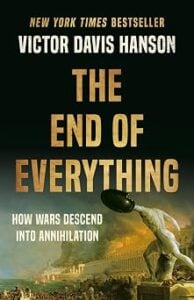
 The End of Everything: How Wars Descend Into Annihilation
By Victor Davis Hanson.
Basic Books, 2024.
Paperback, 368 pages, $22.99.
Reviewed by Henry T. Edmondson III.
Victor Davis Hanson has a knack for crafting alluring titles for serious books. There is Fields Without Dreams (1996), a eulogy for the death of the family farm; Who Killed Homer: The Demise of Classical Education and the Recovery of Greek Wisdom (2001), an indictment of academic classicists for undermining their own discipline; Mexifornia (2003), about the loss of political vision and responsibility in the Golden State; and Carnage and Culture: Landmark Battles in the Rise to Western Power (2001), an insightful discussion of the correlation between liberal values and military success.
More recently, he has published The End of Everything: How Wars Descend into Annihilation (2024), a title sure to incite anxiety for many. After all, most everyone has a lurid attraction to the end of the world, the apocalypse, and the post-apocalypse. It’s a sure winner for novels (The Road), a TV series (The Walking Dead), and movies (Bird Box). The cataclysm may be environmental, disease-driven, economic, political, or religious. Most scenarios, if not all, are implausible—but who cares? They are titillating.
The apocalyptic conflicts covered in Hanson’s The End of Everything are plausible, not because they are cleverly hypothetical, but because the events he chronicles have already occurred; yet the text could not be more relevant. Indeed, the relevance of this text is thick enough to cut with a knife. In the preface, Hanson notes,
[S]ince the publication of The End of Everything . . . the world has already descended into a far more frightening place. What has made global affairs so terrifying is the specter of theater-wide conflicts breaking out simultaneously across the globe, and steadily escalating to Armageddon. For the first time since the 1962 Cuban Missile Crisis, journalists, politicians, and military leaders have begun publicly voicing fears of an all-destroying nuclear war or of theater conflicts involving millions.
In addition, the “large-scale use of drones and artificial-intelligence-directed munitions—have begun redefining the rules of war in the twenty-first century, making destruction even easier.”
The four case studies begin with the tragic expurgation of the city-state of Thebes, which, as many know, is the frequent setting of the Greek tragedies of Aeschylus, Sophocles, and Euripides. Next is the catastrophe of Carthage in the Third Punic War, home of Hannibal and Punic civilization, a collapse so complete that, as Hanson tells us, historians sometimes call it “the first genocide.” Next is the fall of Constantinople and the collapse of Byzantium. Finally, Hansen recounts the disappearance of the massive and sanguinary Aztec Empire at the hands of conquistador Hernán Cortés.
In December of 335 BC, the Thebans made a bad bet that Alexander the Great would indulge their revolt against the Macedonians. The city’s patron god was Herakles; his club was emblazoned on the Theban shield, but he was unable to protect his patrons from catastrophe.
On the one hand, Thebes was the most hallowed of the city-states, the mythical home of Panhellenic heroes and gods like Herakles and the god Dionysus. The most renowned of Greece’s tragic archetypes—Antigone, Cadmus, Oedipus, Pentheus, Teiresias, and Semele—were synonymous with Theban lore. The city and its environs had produced some of the greatest names in Greek poetry, such as Hesiod and Pindar, and their repute apparently remained dear to Alexander and the Macedonians.
Nonetheless, Alexander brought a massive force against the recalcitrant Thebans to ensure that no other city-states would follow their example. As was the case with Carthage, Constantinople, and Tenochtitlan, not only was material Thebes dismantled and destroyed, but “the idea of ethnically, linguistically, and politically distinct ‘Thebans’ living there, for all practical purposes, ceased to exist.” In a word, Thebes—concrete and abstract—was obliterated.
The End of Everything thesis adeptly explains the broad sweep of each of the four disastrous conflicts. At the same time, the book provides deep detail. For example, when the Ottoman Turks, led by Sultan Mehmet II, came against Constantinople, their weaponry, the “bombard,” is difficult to imagine.
Known to the Byzantines as a “monster” (teras), the bombard was some twenty-four feet long and two and a half feet in diameter. It was forged of expensive bronze. The monster required two hundred men, thirty wagons yoked to sixty oxen, and nearly three months to transport it the 150 miles to Constantinople. When properly loaded and operated, the barrel reportedly could shoot a twelve-hundred-pound stone ball a mile.
Such artillery was needed if the Turks would be able to overcome the renowned three-and-a half mile long, inner and outer Theodosian walls that wrapped the city.
The final chapter of the book explores the possible common variables among all four extinguished civilizations. Hansen asks, “What were the general strategic errors or political miscalculations they shared? And what can we learn from their catastrophes, given that obliteration of a capital and extinction of a civilization is not how most wars end?” He suggests one possibility is that each civilization counted on help that never came. Another, as might be expected, the vanquished were afflicted with remarkable naivete. Hansen demonstrates that, at times, there is no rational explanation for the downfall of civilizations—irrationality trumped any reasonable explanation.
At times realism was trumped by expectations of divine intervention. Even after the obliteration of Constantinople, the Byzantine remnant over-interpreted their collapse as a sign of God’s pleasure, or a consequence of God’s wrath:
In the immediate decades that followed the fall of Constantinople and its empire, Orthodox Christians viewed the disaster not as due to a failure to accept last-minute, pragmatic accords with Rome to unify against the Ottomans, but rather as an expression of God’s displeasure at the supposed laxity and decadence that had rendered them so vulnerable to extinction.
Similarly, the Aztecs’ judgment was clouded by their assurance of divine will as “Aztec Tenochtitlán, like its doomed predecessors, believed that its complex defenses, martial prowess, efforts to mollify, bribe, and bully the intruders—and its sense of divine right and demonstrable power—would ensure its eternal existence.”
Sheer stupidity can never be discounted. With Carthage under siege, the de facto commander of Carthage gave the Romans all the motivation they needed to continue the siege and offer no mercy:
When sunrise came, Hasdrubal collected all the Roman prisoners in his possession, and brought them atop the walls. In full view of their Roman comrades, he had their eyes, tongues, tendons, and private parts torn out with iron hooks. On some he cut out the soles of their feet. On others he chopped off their fingers. And some more he skinned alive. Any who were still breathing after these tortures he threw down from the top of the walls.
Likewise, the Aztecs, while Tenochtitlan was under siege, took their captured Spaniards up the reported 114 steps to the top of their dreadful temple where, in full view of their fellow soldiers, they conducted their ritualistic vivisections as they tore out the Spaniards’ hearts while still alive. It’s hard to imagine a greater motivational push to eradicate the enemy.
Of all of Hanson’s books, Carnage and Culture: Landmark Battles in the Rise to Western Power is the most like The End of Everything. In both books, a strong thesis is supported by thorough treatment of chronologically arranged case studies. In Carnage and Culture, there are nine studies ranging from Salamis (480 BC) to the Tet Offensive (1968). The Aztecs and the fall of Tenochtitlan appear in both books.
One must wonder to what extent the thesis of Carnage and Culture is still as compelling as it was when published. Are its principles still as valid as they once were in light of conflicts over the last three decades? Most importantly, both books give the reader a wide-angle lens as well as a macro lens to understand and analyze world events. There is no better way to learn history. Hanson makes a strong case for the relevance of this most recent book:
If some readers had imagined that the case studies in The End of Everything were ancient history—irrelevant premodern violence from the age before the Enlightenment and current peaceful globalization—the past year’s events should have reminded them that the annihilations of the Thebans, Carthaginians, Byzantines, and Aztecs are still very relevant today.
Henry T. Edmondson III is Carl Vinson Professor of Political Science and Public Administration at Georgia College and State University.
Support the University Bookman
The Bookman is provided free of charge and without ads to all readers. Would you please consider supporting the work of the Bookman with a gift of $5? Contributions of any amount are needed and appreciated!
