
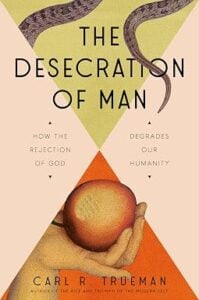
 The Desecration of Man: How the Rejection of God Degrades our Humanity
By Carl R. Trueman.
Sentinel, 2026.
Hardcover, 256 pages, $29.
Reviewed by R. J. Snell.
In his almost canonical book, A Secular Age, Charles Taylor explores the genealogy of the “immanent frame,” the default assumption of the contemporary Westerner hostile to a more than merely human source of meaning. Immanence takes priority and frames the limits of reality, with transcendence defined merely in relief, as non-immanence, thus conveying a sense of the unreal, the imaginary.
In his account, Taylor explores the backstory of “disenchantment,” that steady evacuation of a world of myth, magic, and sacraments until the things and stories of the world lose any sense of being charged with the power or presence of gods or demons, powers or principalities. Candles are merely wax and wick lacking power to keep the devil at bay; holy water is nothing more than water; the evil eye or a hex cannot cause harm. Disenchantment is part and parcel of modern science, for if things are simply themselves rather than repositories for unnatural forces of the beyond, we can get busy understanding and harnessing those natural forces to the betterment of our estate and goals for this world—free from the terrors of the unknown and uncontrollable.
Modernity allows for our freedom and our projects by fundamentally altering the conditions of belief, Taylor suggests, making faith optional, and evacuates sources of meaning once central to the lives of individuals, societies, and nations. People experience a loss of meaning and it becomes difficult to believe in God. Consequently, it is unsurprising to note the rise of a new sort of apologetics beginning not with the old arguments for God’s existence but with a mood or sensibility trying to make the world weird again, to reenchant the world. If the world is weird, then, with apologies to Hamlet, there might be more things on earth than dreamt by our reductive philosophy, and perhaps more in heaven as well.
Rod Dreher’s work is a good example of this approach. In his Living in Wonder: Finding Mystery and Meaning in a Secular Age (2024), Dreher, prescient in his capacity to read and popularize the currents of the social mood, begins with a telling line, “the world is not what we think it is,” before turning to an account of UFOs and the paranormal, suggesting, hinting, this all might be demonic activity. If so, if we start with the weirdness of UFOs and demons, then we learn “to open our eyes to the reality of the world of spirit and how it interacts with matter.” The world is weird, full of spirits, and thus we might be able to believe in God.
I’ve long thought this approach a serious mistake, in part because I’m not convinced it demonstrates an enchanted world so much as a mood of enchantment. Feeling grandiosity is rather different than a thing hosting the grandeur of God, as C. S. Lewis noted in The Abolition of Man. Rather than articulating how a transcendent God might be known in and through the natural order, or how God is present within the mundanity of immanence, the strategy asks us to feel as if things are so utterly beyond rationality that belief in God is once again possible. Not for me, thanks.
A similar hesitation is robustly explored by Carl R. Trueman in his new book, The Desecration of Man: How the Rejection of God Degrades our Humanity. He begins with a succinct summary of the disenchantment thesis, providing a “once upon a time in the West” story now stripped of “magic and mystery.” His response is stark and direct: “I find this interpretation of our culture to be inadequate.”
Trueman realizes the rationalism of modernity leads to disenchantment, but he reminds us—as did Taylor in an often-overlooked section of A Secular Age—that we have not observed the decline of religion in our age so much as the expansion, even explosion, of varieties of religious experience, including some very bespoke self-inventions. The “weird and the wonderful” have not disappeared but went mainstream as woo-woo.
Rather than disenchantment, Trueman suggests “desecration” as his diagnostic. Modern society “glories in transgression, and transgression is exhilarating.” We aren’t simply trapped in the secular cage, we defaced and profaned things once thought sacred and enjoyed it; in fact, our dominant cultural activity is vandalizing altars (both figuratively and literally). The solution is not reenchantment but consecration, although we no longer desire to do so.
The West once thought humans were created in the divine image and carried that image within themselves. Consequently, we viewed humans as exceptional, more than advanced animals, as persons possessing dignity, as teleological, with capacities for perfection that revealed obligations and duties to ourselves and others, and as embodied. Having rejected God, man was rejected as well, instead asserting ourselves as “autonomous, unencumbered self-creators.” This new image lies “at the heart of the anthropological chaos of our day.” The attitude intentionally strips away limits and intrinsic purpose as offensive to freedom, encumbrances to be smashed and defiled. Our technological power reinforces this effort, and the natural is thought merely something to transform, transgress, and transition. Our social imaginary turns from gratitude to a need to desecrate the very image of God.
The body can be controlled or altered as we deem fit, art thumbs its nose at beauty, sex is either a matter of indifference or worship of our transgression, gender is manipulable, pornography is expressive individualism, babies mechanical products to make at our whim and pleasure (including in the lab), abortion a rejection of encumbrance, and death a technical glitch to transcend. Much of the book explores the ways in which a rejection of natural limits coupled with our technological mastery allows endless self-creation. Such are not the desperate efforts of the disenchanted to find meaning but acts of exhilarated destructiveness, even hate of the created order. They are desecrations.
Trueman’s rejection of the enchanting shapes his critiques of “nihilism repackaged,” by which he means those begrudging admissions from Richard Dawkins and others, sometimes atheists, about the historical or social usefulness of Christianity. God doesn’t exist, one might say, while granting that Christianity helped shape liberal democracy or science. Similarly nihilistic, albeit in quite a different key, is aesthetical religion—Trueman especially targets Roger Scruton—avoiding the hard problem of “Christianity as truth.” A poetic longing for the sacred delights in the sublime and beautiful but not dogmatic claims; Trueman deems this a form of nihilism, however pleasant.
Enchantment won’t do. Humanity needs reconsecration rather than reenchantment and this requires the “truth of Christianity” to reshape our basic intuitions and the social imaginary about limits and obligations, and how human ends relate to the human body, to others, and to society.
If there is a weakness to the book, it is the relative brevity of the final pages in which Trueman explains his proposals for reconsecration. He stresses cognitive notions such as truth, dogma, creed, and intuitions, while at the same time suggesting the need for imagination and institutional practices. As he puts it, three dimensions of Christianity are necessary: “creed, cult, and code.” Creed is a set of beliefs, truth claims; cult refers to worship practices through rituals such as liturgy, preaching, and sacraments, all embodied; code are those moral claims and practices expected of the faithful. All of this is correct, it seems to me, and Trueman’s account is nuanced and generous enough to allow a proper ecumenism, what C. S. Lewis called “Mere Christianity.” At the same time, Trueman would help his reader by saying more explicitly what forms or content he thinks necessary for creed, cult, and code.
If Taylor is correct, the disenchantment of the immanent frame is the default position of the modern person, whether a religious believer or not. We start with the ingrained intuition of immanence and then perhaps acknowledge something divine, transcendent. If that is the case, then a fully orthodox person, one who earnestly and honestly recites the Creed or has memorized either the Baltimore or Westminster Shorter catechisms would struggle to reconsecrate the world, however much they believed. For decades, a highly sophisticated school within Evangelical Protestantism—the students of James Sire and his worldview theory—attempted to salvage belief and imagination, but systematically arranging belief and the assumptions and entailments which follow, even when those entailments concern matters of cult and code, failed to preserve the imagination needed for consecration.
Similarly with cult. Trueman discusses prayer, singing, and so on, but other nuanced reflections on the same, including some motivated by Charles Taylor, attempted “cultural liturgies”—I have in mind the trilogy of James K. A. Smith—but were powerless to stop the drift to mere aesthetics or, as in the case of Smith himself, into a rejection of historical Christian codes concerning marriage and the body. And highly nuanced articulations of Christian morality, including that of the schools of natural law—where I would place myself—didn’t seem adequate to shaping imagination.
Trueman would likely respond that it requires all three together—creed, cult, and code—rather than isolated strands attempting the work of the whole, and also that Christianity is not a technique or “hack” to guarantee consecration; there is no guarantee any of this will succeed. That would be a reasonable and quite true response, but I would continue to think the relevant focal point with respect to enchantment and consecration is sacramentology. It is in sacraments—and Christians obviously do not all agree about this—that creed, cult, and code unite, either in a real and actual consecration whereby transcendence and immanence unite, or not, and this seems to matter enormously.
Imagination and intuition are all to the good, but imagination about consecration does not thereby consecrate. Neither does recognizing the vital need for consecration to save anthropology from its cultured despisers. Either God works to consecrate those embodied elements which then consecrate us, or we are left with the attempt to imagine ourselves as consecrated but still ultimately within the immanent frame immune to the presence of the genuinely transcendent. Or so I continue to think.
Carl Trueman has given us another serious book, one of several he has produced in recent years. He is one of our most important cultural critics, our Augusto Del Noce or Philip Rieff, and The Desecration of Man is a powerful book of diagnosis and with helpful and true prescriptions for recovery. In the end, however, I remain convinced the medicine needed is just slightly stronger than Trueman allows, namely, the real presence. One cannot but imagine what Flannery O’Connor would say.
R. J. Snell is director of academic programs and editor-in-chief of Public Discourse at the Witherspoon Institute in Princeton, NJ. His most recent book is Lost in the Chaos: Immanence, Despair, Hope.
Support the University Bookman
The Bookman is provided free of charge and without ads to all readers. Would you please consider supporting the work of the Bookman with a gift of $5? Contributions of any amount are needed and appreciated!

