
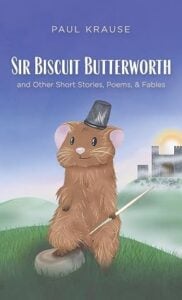
 Sir Biscuit Butterworth and Other Short Stories, Poems, and Fables
By Paul Krause.
Resource Publications, 2026.
Paperback, 66 pages, $9.
Reviewed by Auguste Meyrat.
These days, turning kids into readers during the formative years of elementary school is a real challenge. Besides the inundation of woke propaganda in children’s literature, there is now the inundation of graphic fiction (i.e., picture books, comics, graphic novels) which discourages the development of fluency and imagination.
Normally, books consisting primarily of images were reserved for younger readers still learning to apply the rules of phonics. Once children mastered this skill, they would graduate to texts with only a minimal number of illustrations or none at all. It was understood that younger readers needed to build up their vocabulary, comprehend the text, and conceive of the story’s details in their minds instead of having them visibly rendered on a page for them. This, in turn, put more pressure on children’s writers to compose vivid yet concise prose that could adequately represent the story while holding the attention of a younger audience.
But with the popularization of graphic fiction, both the reading and writing of text-based fiction for young readers have diminished. Most children will prefer reading Dog Man, Captain Underpants, or Wimpy Kid, which are admittedly funny and easy to consume but are also far less demanding. Moreover, they are usually crass, unimaginative, and disposable—the literary equivalent of candy.
As for fiction that does not depend on funny illustrations, most of it inevitably panders to children’s immaturity and tends to share the same disposable quality as graphic novels. Insofar as they require children to cultivate their literacy, they are better options, but they rarely explore deeper concepts or show much verbal artistry. In general, they are prosaic and predictable.
Once again, writer Paul Krause has risen to the occasion with another slim and elegant book that surpasses most of today’s children’s literature. After writing his delightful novella The Incredible Adventure of Passer the Sparrow (which I reviewed here), he has now come out with Sir Biscuit Butterworth and Other Short Stories, Poems, & Fables. As before, Krause cherishes the childhood innocence and simplicity of his readers without dumbing down his text or appealing to their more puerile instincts. Instead, he manages to charm readers while elevating their imaginations and deepening their understanding of the world.
As the title suggests, the book’s main short stories recount the exploits of Sir Biscuit Butterworth, a gallant and intrepid hamster who goes on adventures with different companions like Willy Whiskers, Timmy Two Times, and Slendertail (two mice and a fox, respectively) and faces off against fearsome foes like Count Conrad the Cat and Fluffula the Vampire Rabbit.
Although most of the stories take place in and around a farmhouse and center on decidedly humble animals with otherwise pedestrian goals of stealing a cookie and finding out who is rummaging through the carrot patch, Krause relates these accounts with grandiloquent exaltation. He makes it clear that no character or setting is too small or common to be truly epic.
In addition to the tales of Sir Biscuit, the book also includes the tales of other humble yet heroic animals like Geronimo the Mighty Mouse, Vulpes the Courageous White Fox, Sunny the Swan, and Tucker the Dog. Finally, Krause concludes with a short message encouraging readers to go on reading more stories and sharing stories of their own with others. These additional stories provide a salutary change of pace and tone that gives the whole collection more weight and range.
While most of the short stories exhibit a lighter, swashbuckling style, the three fables at the end (with Vulpes, Sunny, and Tucker) tread deeper, darker waters, exploring the themes of age, death, and sacrifice. Accordingly, Krause handles these narratives with care, introducing younger readers to these heavy truths, assigning them appropriate weight and attention without becoming overbearing. Still, parents and dog lovers might understandably tear up a bit when they read these stories aloud.
As with my review of Passer the Sparrow, I made sure to ask my children’s opinions of Sir Biscuit Butterworth to see if Krause succeeded in winning over his target audience. He did. My eldest, who has since moved on to more young adult literature, appreciated these stories along with the brief appearance of Passer’s son, Junior. My younger two, who are currently transitioning from picture books to more text-based books, also had positive feedback. Predictably, my son liked the action while my daughter, a great fan of rodents, immediately fell in love with Sir Biscuit and his companions.
In all likelihood, my children will enjoy reading through the book many more times even as they grow older. The language and style are vivid and elegant all throughout, and the stories have a timeless quality that works on multiple levels. It is a pleasant throwback to the early classics of yesteryear and a great addition to any family’s home library.
Auguste Meyrat is an English teacher and freelance writer in the Dallas area. He is the founding editor of The Everyman, a senior contributor to The Federalist, and has written for essays for The American Mind, The Stream, Religion and Liberty, The Blaze, and elsewhere. He is also the host of “The Everyman Commentary Podcast.”
Support the University Bookman
The Bookman is provided free of charge and without ads to all readers. Would you please consider supporting the work of the Bookman with a gift of $5? Contributions of any amount are needed and appreciated!


