
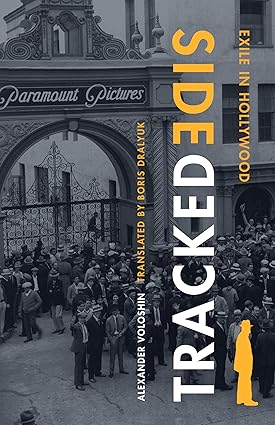
 Sidetracked: Exile in Hollywood
By Alexander Voloshin. Translated by Boris Dralyuk.
Paul Dry Books, 2026.
Paperback, 98 pages, $17.95.
Reviewed by Nadya Williams.
When my oldest son was little, every Saturday morning I would bundle him into the car for the hour and a half drive from our small town in Georgia to a northern suburb of Atlanta. Our destination? Russian School. It was a project of Russian-speaking immigrants in the Atlanta area who, like me, wanted their children to retain their language. So the school offered classes from early morning to late afternoon every Saturday, using rigorous Russian language and literature curricula to teach children to read and write in what had been their parents’ mother tongue. Classes in singing, chess, and logic rounded out the more literary offerings. One May 9, Victory Day, the kids sang and presented flowers to a small group of local Russian veterans of the Great Patriotic War.
Nostalgia unquestionably captivates all émigrés. There you may be, decades gone from the old country, and glad of it. Yet still you long for the taste of familiar foods, the sight of those Russian birch trees, and the sound of the language you never have the opportunity to speak outside the home. I was not quite ten when my family emigrated, and my children have never visited Russia. Yet still, nostalgia grows more acute with the years—indeed, it hit particularly hard the year I turned forty. An immigrant’s midlife crisis, it seems, involves deep dives into family history and wonderings over a life that could have been, had people on the other side of the world gotten their act together a bit more competently over the previous century or two.
For immigrant and talented poet and translator Boris Dralyuk, this interest in other émigré experiences has resulted in a multitude of books—the newest of them a previously untranslated mock epic by a Russian immigrant to Hollywood a century ago: Alexander Voloshin’s Sidetracked: Exile in Hollywood.
Born around 1884 in Ukraine, Voloshin fought on the losing side during the Russian Revolution and wisely fled to save his life. By 1923, he was in New York City—meaning he was nearly forty years old when his American life began. Then in 1926, he arrived in Los Angeles, where he would spend the rest of his life. It was an unusual decision. Dralyuk notes that only about 5,000 of the nearly two million refugees from the old Russian Empire ended up in LA. Still, they made their cultural print on the city—their influence is, in fact, the subject of Dralyuk’s own poetry collection, My Hollywood.
Like other immigrants, Voloshin worked as a waiter, dabbled as a film extra throughout the ‘20s and ‘30s, and finished his career as a taxi driver—like so many other white émigrés in America and Paris alike. And, of course, he wrote. Sidetracked is a poetic memoir of sorts, combining brief memories of the past, including the war that followed the Russian Revolution, with his experiences of the decidedly inglorious present.
I think I’ll lay out, if I may,
A common extra’s “working day…”
So opens one segment of the poem. Details of an ordinary day follow. He drinks coffee, reads the newspaper (ah, the banality of keeping up with the news still), and then feels overwhelming despair over all the bills that keep coming his way. There is only one thing to do in response. “He washes… Slips in his false teeth…” then calls the studio to see if he might be able to snag some work on this day. No luck, however, so he concludes the day by going to the theater to watch a film for which he did work as an extra, only to discover that his bits did not make it into the film proper after all. All the work for meager pay—and no glory, as he had ended up on the cutting room floor.
To be an immigrant, he reflects, is to be a victim of fate many times over. Exiled from his country first, then exiled in myriad small ways all over again, even in such demeaning ways as this. All his life is but exile—the anchor to LA ever uncertain, and his financial precarity a sharp contrast with the good life he remembers in the old country.
In another particularly poignant chapter in the poem, the narrator mournfully reflects on celebrating Christmas:
How can I celebrate the theme
of Christmas when my home is gone?
It is 1953 as the nearly seventy-year-old Voloshin completes this book—meaning, he had been in America for thirty years. And yet, the loneliness of the émigré life is unrelenting, bitter, and especially acute during the holidays. So he recalls the glorious Christmases past that he had observed in Russia, painting it as the idealized land of brotherly love, beautifully decked trees, and all the fancy foods imaginable, from black caviar to sturgeon pies. Perhaps “Brothers will once again embrace,” he muses, even as he knows better. His generation of men was first scattered and now is dying of old age. But some bravado still seems necessary somehow, even if only for humor, for show. “We’re Russians—we won’t come to harm!” confidently he declares in the poem’s closing line. But didn’t the suffering of his entire generation show that the contrary is true?
Dralyuk’s translation is characteristically masterful—retaining the witty flavor and sparkle of the original, giving the reader a glimpse of the man who wrote this poetry while hurting deeply within, never ceasing to miss his homeland, even while knowing that the country he misses does not exist anymore. But there is additional sadness to this poem, Dralyuk reminds, as we consider Russia’s latest invasion of Ukraine, now past its fourth anniversary. Such stories of immigrants, driven from home by a brutal regime, are part of the region’s present no less than its past.
Indeed, Dralyuk has been the English-language translator for the works of Andrey Kurkov, a leading Ukrainian novelist and memoirist, whose own writing on the latest invasion is essential reading. And for Kurkov, too, the past and the present inextricably coexist—as in the Kyiv mysteries series, featuring policeman Samson Kolechko, investigating crimes in Kyiv right after the revolution. Yet there is such beauty to these novels, which consider the effects of war on human nature, calling evil by name, yet trying to show hope in the midst of it still.
Like Voloshin a century ago, in the face of suffering, writers still write. And some, like Kurkov, never leave.
Nadya Williams is interim director of the MFA in Creative Writing at Ashland University. She is books editor at Mere Orthodoxy and the author of Cultural Christians in the Early Church (Zondervan Academic, 2023), Mothers, Children, and the Body Politic (IVP Academic, 2024), and the forthcoming Christians Reading Classics (Zondervan Academic, November 2025).
Support the University Bookman
The Bookman is provided free of charge and without ads to all readers. Would you please consider supporting the work of the Bookman with a gift of $5? Contributions of any amount are needed and appreciated!
