
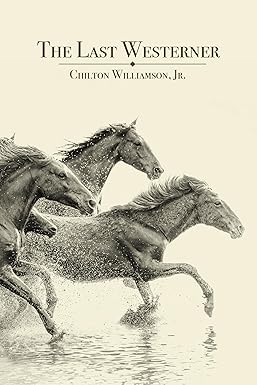
 The Last Westerner
By Chilton Williamson Jr.
St. Augustine’s Press, 2025.
Paperback, 386 pages, $19.95.
Reviewed by Patrick J. Walsh.
Apparently, there are still cavaliers and men who believe in love between men and women. Chilton Williamson’s new novel, The Last Westerner is a testament to it.
Prefacing his latest volume of nonfiction is a quote from the French poet and troubadour Chretien de Troyes, a 12th-century poet and author of the Arthurian legend Lancelot. “He fares well who obeys the commands of love and whatever he does is pardonable, but he is the coward who does not dare.”
Chilton Williamson is an American writer who lives in Laramie, Wyoming. He has published thirteen books, including six novels, several works of narrative nonfiction, and several works on history, politics, and the American West.
His new book is an exciting chivalric adventure and romance, while also being a contemporary American novel set in the Southwest USA. Exceptionally well written, its straightforward crafting is an encouragement to the reader who eagerly returns to its pages.
It narrates the journey of Jeb Stuart Ryder, a kind of modern knight troubadour on an errand in the wilderness. His task is to recover a stolen prize-winning show horse owned by a widowed rancher named Jody James, with whom he has recently become enamored.
Ryder is a 51-year-old retired range detective, a man who holds to a code of chivalry and senses a sacred salvific dimension in women. He learned from his father that “love isn’t a game to be played, it’s simply the most important thing there is.” Jeb Stuart knows that love, at times, may be difficult, but it makes things possible.
Jeb Stuart refuses to become a cynic in our so-called age of progress. With droll humor, he quips that in our time, “love has grown hateful and hate is elevated to a form of love, chivalry is considered oppression and valor, something that earns you five million bucks a year working for the Denver Broncos.”
Jeb is an aficionado of horses and women. He loves the natural world and possesses an understanding of the opposite sex that most men lack. His observations are accurate and profound —“women have an intuition that men lack, almost a sixth sense that tells them often more than they want to know.”
Images of beautiful women recur everywhere in the book. Sometimes spotted in the distance, in the clouds, sometimes in a vision of the magical “desert witch.” Even the stolen horse can sense the mystical beauty of women. Women offer hope and consolation for men on their journey through time.
Cortez, the horse Stuart seeks to recover, is a Peruvian Paso. The journey begins in Southeastern Utah, travels through the heat of deserts, pouring rain, cold nights, jagged lightning, deadly snakes, and rugged mountains—through Western New Mexico, Eastern Arizona, finally ending in Mexico three months and one thousand miles later.
Stuart’s journey is not merely geographic. The reader experiences not only the current declining state of Western civilization alluded to throughout the book, but also traverses other cultures: remnants of the American West, cultures of various Native American tribes, and those of the Mexican West.
Jeb Stuart’s companion in the quest is a 16-year-old boy by the name of John-Wayne Bilagody, a Navajo boy caught between adolescence and manhood, but who also inhabits a position between his own traditional native culture and an ever-encroaching modernity. The name “John Wayne” shows the influence of Hollywood even on those living on the reservations. Stuart serves as a father figure to John Wayne, teaching him to respect women and instructing him on the ways of the world.
The Last Westerner contains broad, inclusive strokes with finely observed details of outdoor life written by someone with intimate experience of the terrain from one who has ridden over it himself. I am not a westerner, but Williamson brings the terrain and the weather to life. The book would make a wonderful film. John Ford or Sergio Leone would have appreciated its cinematic quality.
Throughout the volume, there are many examples of the author’s enthusiasm for nature. Take, for instance, the following passage:
The clouds swelled deep into the blue sky, their shining heads traveling high above the gray undersides, and they had closed up considerably. Now the desert too was moving, crawling with the dark cloud shadow. We crested a ridge broken by outcrops of rock and followed along the ridgeline on a northeasterly heading. The country tilting away on every side gradually assumed a dominant pitch sloping vaguely towards the river which appeared in segments, blue, brown, and green, beneath the line of red bluffs ahead eight or ten miles. The wind dried the lathered horses who needed to be pushed now between frequent halts to glass the country around.
The author understands that good prose is a teacher of beauty that can civilize mankind. When men are not kept in mind of beauty, they become lower than the beasts, as is too often the case in our consumer culture. Jeb Stuart can also tell the difference between a man and an animal that is too often blurred today by a warped sentimentality. A recent television ad encourages us to adopt an elephant, and another to cry over sick dogs. But never are we encouraged to take responsibility as God’s ordained stewards of nature.
Jeb Stuart scoffs at such confusion. He describes a man in the book with “eyes as bright as an animal’s, full of a soft animal sadness, but also the cheerfulness that human beings alone among the animals possesses.”
Williamson’s book is refreshingly real. It does not ignore the dark side of disordered modernity. There is no gratuitous nihilism I find in some modern American authors. I paraphrase Chesterton, who once said of nihilism, that there’s nothing to be done with nothing, and that’s the end of it.
Fiction has always involved a relationship between the inner lives of people and the external order of society. Yet today society and shared reality known through all centuries have all but collapsed. Some novelists, like James Joyce, reacted to this dilemma by retreating into their own heads, engaging in an abstraction of reality, which is a cul-de-sac for both the reader and the writer.
I believe Williamson writes in this vein of romance as Hawthorne understood it. Hawthorne said he wrote romance and defined it as better able to explore the “truth of the human heart.” Flannery O’Connor claimed that her style of writing, “grotesque,” was a direct descendant of Hawthorne’s. “When Hawthorne said that he wrote romances, he was attempting in effect to keep for fiction some of the freedom from social determinism and to steer it in the direction of poetry.” Williamson’s evocative prose also steers in the direction of poetry and allows for a more spiritual examination of reality.
When Jeb Stewart finally tracks down the horse after many mishaps and exchanges of hands, he returns to his lover as promised. But Jody James is disappointed in the horse as it has lost a great deal of weight from its time running feral and free further west. Cortez is no longer the show horse he was, and Jody’s show with Jeb has reached the final curtain. In Jeb’s absence, she has taken up with another lover and has played the role of Guinevere to his King Arthur. She tells him that he was “only an experiment, a test drive around the block.”
Jeb has the wit to quote from that other chivalric figure, Don Quixote, the knight of “the woeful countenance,” saying, “From your form I thought you were an angel, from your acts I know you are a woman.”
But it’s not the end of love for Jeb. Unknown to Jody James, Jeb Stewart has met a lovely woman in his travels of Mexican and English descent, blooming in the desert. When he met Carmen Dominguez, something “happened.” “Women are wonderful,” says Jeb Stuart. “And where us men are concerned they just have to happen.” The reader understands Carmen is a woman capable of that higher love Jeb Stuart seeks.
Jeb Stuart believes “in a code of behavior that no one seems to believe in anymore.” He has a need periodically to return to the wilderness. He is not cosmopolitan, nor does he aspire to be one. He’s parochial and has the courage of his own opinions. He goes about his own business. While out riding, if he spots a broken fence on the range or a busted gate, he mends it. Though the world is disordered, he sets his and other’s lands in order.
Jeb Stuart is the last Westerner, perhaps a remnant. But he is also a nucleus because he dares to love, which always holds out the possibility of a new beginning.
Patrick J. Walsh is a writer in Quincy, Massachusetts.
Support the University Bookman
The Bookman is provided free of charge and without ads to all readers. Would you please consider supporting the work of the Bookman with a gift of $5? Contributions of any amount are needed and appreciated!

