
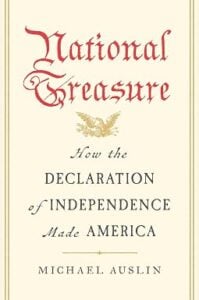
 National Treasure: How the Declaration of Independence Made America
By Michael Auslin.
Simon & Schuster, 2026.
Hardcover, 368 pages, $30.
Reviewed by Matt Riffe.
In a year in which the Declaration of Independence is front and center, it is easy to overlook Michael Auslin’s new work as just another book on the Declaration. After all, there is already a litany of books and articles which have streamed endlessly into the American consciousness in the past year, or so it seems.
Then there is the title.
Picking up Auslin’s National Treasure: How the Declaration of Independence Made America, one almost groans at the prospect of multiple references to the 2004 movie starring Nicholas Cage.
Yet, Auslin’s scholarly work is much more than a play on words on the blockbuster movie. It is a fresh take on the Declaration of Independence and its culture. It does what Michael Kammen’s A Machine That Would Go of Itself: The Constitution in American Culture (1986) and more recently, Aziz Rana’s Constitutional Bind (2024), have done for the Constitution, albeit in significantly fewer pages. At the start, Auslin makes a clear distinction between the United States’s two founding documents: If the Constitution tells us how to live together as one nation, the Declaration of Independence tells us how we should want to live.
Auslin’s National Treasure can be best described as interweaving three distinct lives of the Declaration of Independence: first, as America’s most revered relic; second, as a symbol of our most deeply held principles; and, finally, as it continues to play an ever-present part of American culture. The book’s central thesis is to tell the story of how these three lives of the Declaration came together to create one nation.
Auslin is successful in providing a refreshing history on America’s foundational text. In one sense, he follows the traditional playbook of providing a narrative history of how the Declaration of Independence’s ideals were handed down to each generation and used as evidence for the United States to live out the true meaning of its creed. In another sense, Auslin offers a rich account of the commercial entrepreneurship of the Declaration and the culture it created. He also provides a history behind the science in the preservation of the engrossed Declaration.
Auslin’s writing is lively. For instance, the reader will most likely gasp as Auslin recounts what most likely happened to the copy of the Declaration of Independence that was authenticated by John Hancock on July 4, 1776. Sent to printer John Dunlap to be reproduced for the masses, this copy of the Declaration was undoubtedly cut up into sections and given to different typesetters, a common practice in the printing press to speed up production. Thus, the original Declaration of Independence, Auslin argues, not only “disappeared from history the moment it left” Independence Hall, but was also stripped and discarded.
It is evident that the War of 1812 was a watershed moment for the culture of the Declaration of Independence. Stemming from the invasion of Washington, D.C., by British troops, the mystique of the Declaration of Independence became firmly established. In 1869, the popular historian Benson J. Lossing claimed that First Lady Dolley Madison saved the Declaration along with the portrait of George Washington as the nation’s capital burned. In reality, the saving of the Declaration fell on Stephen Pleasonton, a State Department official, who during the evacuation, proceeded to stuff the Declaration of Independence, the Constitution, and other landmark American documents into lien bags he fashioned himself. Auslin states that if there was ever a time when the Declaration was crushed and mangled during its many travels, this was the moment.
Spirited entrepreneurs also took advantage of the patriotism that followed the War of 1812. Men like Benjamin Owen Tyler, a calligrapher, and John Binns, a journal editor, began selling reproductions of the Declaration in 1818 and 1819, respectively. Thus began, according to Auslin, a “marriage of civic education with commercial ambition, celebrating the Declaration and at the same time turning it into a commodity.” It also ushered a new life for the parchment that “Americans could see, buy, and connect with on a personal level.”
Americans were not just fascinated by the Declaration of Independence. Beginning with John Sanderson’s first volume of his Biography of the Signers to the Declaration of Independence, the 1820s “inaugurated an enduring and profitable cottage industry of books on the history of the Declaration” and its signers that still exists today.
The commercial success of the Declaration of Independence and the Fourth of July reached an apex with the Centennial of the United States in 1876. Auslin states the Centennial was the “first great commercial anniversary in American history.” An entrepreneurial spirit saw an influx of Declaration-related items hit the market. Most notably, cotton and silk handkerchiefs were imprinted with Jefferson’s famous words, including one where the Declaration was printed in English, French, and German, so a “man can blow his nose in three different languages.” Auslin argues the commercial success that stemmed from the Centennial turned the Declaration from a remote and abstract symbol of America to a document that had a constant and personal relationship with the American people.
The Declaration as an abstract symbol, however, has its own well-documented history. Used as a tool to further liberty and equality, the Declaration became a driving force for change, particularly in the nineteenth century when many movements used the foundational text to their advantage.
Beginning with the social reformer Robert Owen of Indiana, Auslin notes how labor groups and socialists imitated the Declaration while “attacking capitalism and criticizing workplace conditions and wage rates” in the first half of the nineteenth century. Auslin cites at least six of these imitations that appeared by 1845, including by the Working Man’s Party of New York in 1829, the Boston Trades Union in 1834, and New York’s Equal Rights Advocates and Anti-Monopolists in 1836.
The temperance movement also got into the act. In 1841, “A Second Declaration of Independence, A Temperance Address” was printed in which it mimicked Jefferson’s famous phrases, “We hold these truths to be self-evident; that all men are created temperate; that they are endowed by their Creator with certain natural and innocent desires; that among these are the appetite for COLD WATER and the pursuit of happiness!”
Most well-known, however, is the Declaration’s success in linking the abolitionist movement with the women’s suffrage movement. Auslin notes that William Lloyd Garrison wrote the 1833 platform of the American Anti-Slavery Society and named it, “A Declaration of Sentiments,” which Elizabeth Cady Stanton used in her own campaign for women’s rights fifteen years later.
The strongest and most poignant example of the Declaration’s power as a symbol is perhaps the section detailing the document’s role as a philosophical weapon in the fight against communism during the Cold War.
With the war raging on in Korea, President Harry Truman stated that “the principles of the Declaration of Independence are the right principles,” and the document served as a “beacon guiding not just the United States, but countries around the world.” Yet, at the same time, Truman also worried about both the complete ignorance and the veneration of America’s foundational texts. It was his hope that the Declaration and the Constitution would not become “idols whose worship would be a grim mockery of the true faith.” Truman warned that American freedom would be lost “if the time ever comes when these documents are regarded not as the supreme expression of our profound belief, but merely as curiosities in glass cases.”
In that spirit, perhaps no greater event brought the Declaration of Independence and America’s other landmark documents to the American people than the Freedom Train. Auslin argues the Freedom Train of 1947-1949 would become one of the “most patriotic campaigns during the early cold War.” Around three and a half million people boarded the Freedom Train from September 17, 1947, to January 22, 1949. It traveled 37,000 miles and visited over three hundred cities in all forty-eight states. In all, an estimated fifty million people, nearly one-third of the country’s population, participated in some form of Freedom Train activity. But the irony or hypocrisy of the Freedom Train was evident when it skipped Birmingham, Alabama, and Memphis, Tennessee, because both cities insisted on racially segregated entrances. Beyond the two-facedness of the situation, the argument that the United States could lead the good fight against communism in the name of freedom while segregation existed so clearly in the country was obviously hypocritical.
What truly makes National Treasure a special read is the focus on the preservation of the parchment. Auslin contends the science behind the preservation of the Declaration is just as important as its intellectual and political history. This is because its physical state “connects us in a tangible way with our common past and our shared principles.”
By the 1820s, there was a concern that Thomas Jefferson’s famous words were fading into history. President John Quincy Adams took the first significant step in preserving the Declaration when he hired engraver William Stone to create a facsimile of the engrossed Declaration. During the Centennial year, Congress formed a blue-ribbon commission to find “such means…to restore the writings…of the Declaration of Independence.” Auslin calls this moment a turning point for the preservation of the Declaration as the commission adopted a conservative approach and ended up rejecting options that would have permanently altered the parchment.
Twentieth century science played a role in the preservation of the classic parchment, when, in the early 1950s, both the Declaration and the Constitution were returned to the Library of Congress in new viewing cases. These new cases included specially designed laminated glass with a filler of yellow-orange acetate film produced by the Eastman Kodak Corporation to block light radiation.
The beginning of the twenty-first century saw the preservation of the Declaration take different forms. First, in the 1990s, the National Archives began to monitor the conditions of the document and its case with a space-age detection technology designed by NASA’s Jet Propulsion Laboratory. Scanning 125 one-inch squares of the Declaration, the National Archives concluded by 1996, according to Auslin, that the document was holding up, but the case was not. Thus, two months before the 9/11 attacks, America’s foundational texts were sent to College Park, Maryland, known as Archives II, to be fitted into their new cases. By September 17, 2003, the renovated Rotunda in the National Archives reopened to the public where the Declaration became “more accessible, trading power for an unexpected intimacy” with the American people.
Finally, much like the movie namesake, National Treasure: How the Declaration of Independence Made America has an element of archival mystery regarding the Declaration’s whereabouts during the Civil War. Setting up his findings, Auslin tells the reader that “every history of the Declaration of Independence without exception states definitively that the engrossed parchment was kept in the Patent Office, hung on public display from 1841 through 1876.” Yet, thanks to archival detective work done by Auslin, it appears the Declaration was moved to the State Department’s library, next to the White House, after the Union Army defeat at Bull Run in July 1861. By 1869, after a brief stay in the Washington City Orphan Asylum, the Declaration returned to the Patent Office.
As its citizens ring in America’s 250th anniversary, in the words of John Adams, with “Pomp and Parade, with Shews, Games, Sports, Guns, Bells, Bonfires and Illuminations,” Michael Auslin’s National Treasure is a fine addition to bookshelves.
It serves us with a reminder that the Declaration is America’s most sacred relic, a symbol of our founding principles, and a text that continues to play a quintessential part in American culture. The Declaration of Independence binds us together and makes us one nation. It unites us in a still-radical experiment in republican self-government—and perhaps, most importantly—it remains both aspirational and eternal for future generations.
Matt Riffe is the Executive Assistant to the President for the Jack Miller Center, a national educational venture to advance the history, ideas, and documents of the American political tradition.
Support the University Bookman
The Bookman is provided free of charge and without ads to all readers. Would you please consider supporting the work of the Bookman with a gift of $5? Contributions of any amount are needed and appreciated!


