 On the Altar: A History of Sacrifice from the Sacred to the Secular
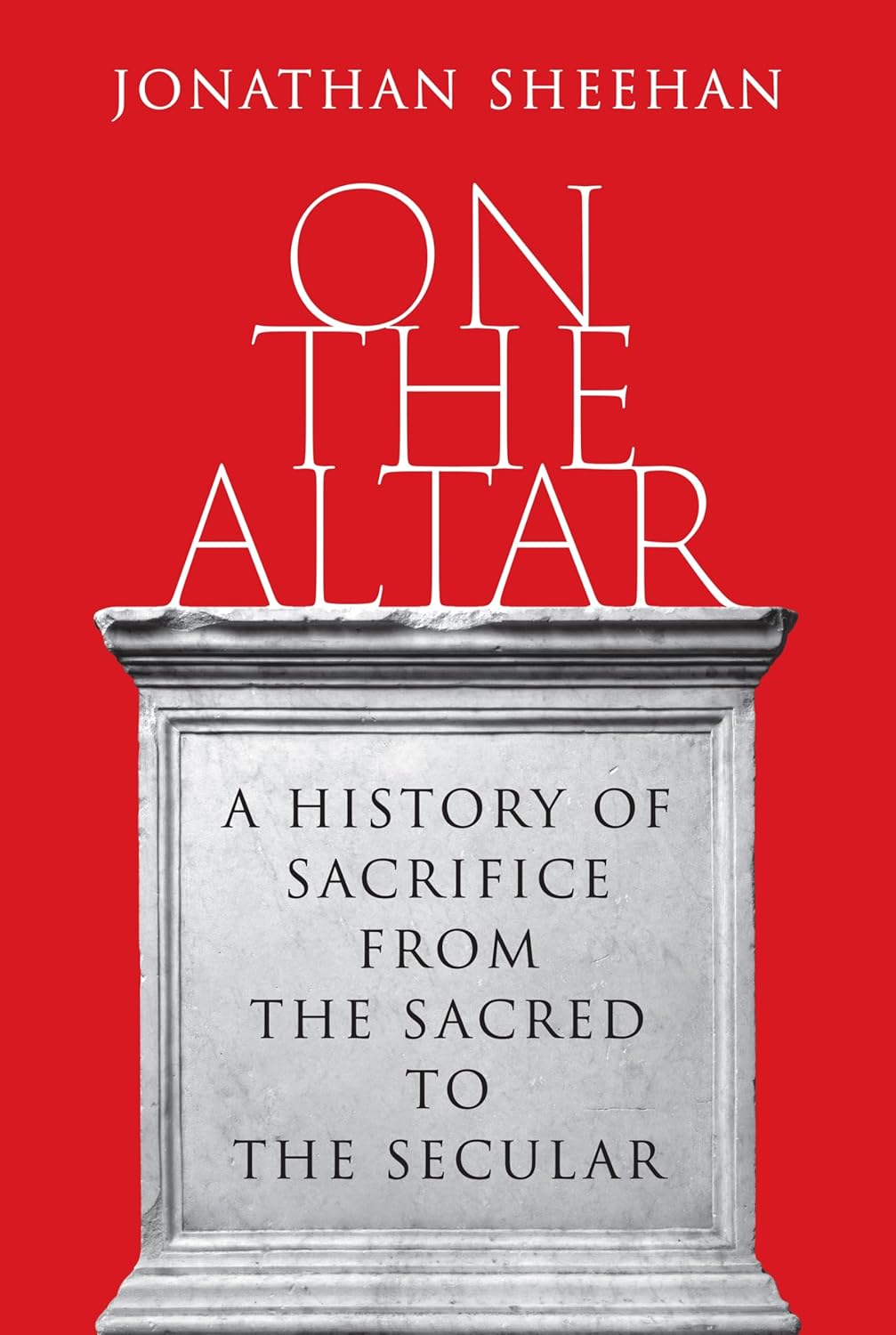
By Jonathan Sheehan.
Princeton University Press, 2026.
Hardcover, 608 pages, $39.95.
Reviewed by Jesse Russell.
In the twenty-first century, several works have arisen chronicling the influence of Christianity on the modern secular world. One of the most prominent and controversial of these works is Tom Holland’s recent Dominion, which chronicles the persistence of Christian moral teaching even and especially among seemingly anti-Christian secular movements. Holland’s work, along with others such as Brad Gregory’s The Unintended Reformation, have largely overturned the radical Whiggish notion of history in which the past five hundred years have been an evolution away from Christian tyranny and superstition. There is an increasingly prevailing notion that Christianity has shaped and molded not only Western, but wider global culture for the good (however reluctant some may be to admit this).
In his recent work, On the Altar: A History of Sacrifice from the Sacred to the Secular, The University of California’s Jonathan Sheehan chronicles the development of the notion of sacrifice in the West—with some segues into wider global culture. Sheehan begins his work with a rumination on Wallace Stevens’ haunting 1915 poem, “Sunday Morning,” in which an anonymous American woman enjoys coffee and oranges on Sunday morning instead of going to church. While she has a soporific, twentieth-century Epicurean morning, there remains, even in this “pagan” poem, the haunting power of Christ’s Passion in the background, and, as Wallace writes, “Over the seas, to silent Palestine / Dominion of the blood and sepulchre.” Christ’s passion, death, and resurrection is something that might be detested by some, but it is always in the background. There is something within the human heart that craves sacrifice.
In On the Altar, Professor Sheehan explores the development of the idea of sacrifice from its early roots in the pre-Christian classical world. Sacrifice is an integral part of human life, although it takes many variant forms, ranging from simple grain sacrifices to human sacrifices and elaborate rituals spanning days. As Sheehan notes, when Christianity arrived in the Mediterranean world, it was both a new religion that distinguished itself from paganism and Judaism, but it also was an old religion that viewed itself as the proper heir of the Old Testament and the answer to the longing of the gentile nations. Christianity was, further, like other religions, in that it was centered on sacrifice, while, at the same time, Christianity rejected pagan sacrifice. As Sheehan argues, Christians weren’t the only ones to reject pagan sacrifice. The Greek historian Plutarch condemned barbarian pagan sacrifice as being a facet of superstition. Educated pagans, such as the philosopher Porphyry, likewise attacked Christian Eucharist as a superstitious blood rite, and Christians were further condemned for their refusal to participate in some ancestral customs.
Christians, such as Clement of Alexandria and Justin Martyr, retorted that the gods worshiped by pagans were not true gods, and the pagans were themselves atheists in as much as they rejected the true God. Christians likewise countered that it was not them, but the pagans who performed acts of human sacrifice and infanticide. Certainly, Christians did not lack for examples of often ridiculous and always horrific examples of pagan sacrifice. This pagan sacrifice was likewise condemned not only by Plutarch, but by figures such as Cicero and even the anti-Christian Porphyry. Christian sacrifice was a meal, a koinonia, and drew from Old Testament as opposed to pagan notions of sacrifice. As Rene Girard famously documented in his 1989 The Scapegoat, Christianity introduced the notion of a self-sacrifice rooted in love and self-gift in atonement for sin. This notion of sacrifice triumphed in the West, but it became ground for contention during the Reformation as various dissenting movements gained strength.
After the Reformation, there was a general confusion about the nature of human sacrifice. Moreover, there was a tremendous accumulation of knowledge about not only Christianity but of the pagan world as well that accelerated as the Early Modern period transitioned into the expansive and encyclopedic Enlightenment. Perched from this transcendental perspective, some Europeans began to wonder if all sacrifices were, in fact, part of one story. At the same time, various Christianity movements arose that rejected the (over-)intellectualism of the world after the invention of the printing press. Moreover, as Sheehan notes, “[s]acrifice slipped the symbolic chains of Christianity, then, and began to roam free.” Both Christian and classic depictions of sacrifice were utilized in the formation of notions of citizenship and nationalism.
Sheehan depicts Baruch Spinoza as one of the key figures who helped separate faith and reason in the Enlightenment as well as one of the pioneers of a historical-critical method of reading scripture and the histories of Judaism and Christianity. For Spinoza, sacrifice was fundamentally a human activity that the ancient peoples of the Bible picked up from pagans. The critiques by Spinoza and other Enlightenment rationalist figures had their effect on thought and behavior, but they did not have the last say. While some radical rationalists attempted to disprove Christianity, there were a number of religious movements such as Methodism and Moravianism that reshaped the spirituality of Christian sacrifice. This paradox between radical secularism and intense religious devotion would be one of the ironic marks of the modern and then postmodern period.
The twenty-first century has been referred to as a time of “liquid modernity.” Life in the digital age (an age that is rapidly shifting into the age of AI) is liquid because everything seems to be in a state of flux and shift. Laws and morals seem to shift on a day to day basis. What was once evil is now good, and the landscape of both the online as well as real world seems to shift constantly. One of the biggest slippery elements of contemporary life is religious faith. On one hand, it seems that Christianity is rapidly fading from the West. New ideas and ancient philosophies reborn have come to dominate much of intellectual discourse. Many have been turned away by scandals in the Church. There also seems to be tremendous division and confusion as traditionalists battle progressives for the soul of Christianity. At the same time, there has been an uptick in conversions and baptisms in some Western countries. Many feel as though the popular internet philosophies of Jungianism, Stoicism, and evolutionary biology are inadequate, and there is a deep hunger for authentic mysticism. Jonathan Sheehan’s On the Altar provides a rich and expansive history of the phenomenon of sacrifice, exploring variant forms of sacrifice in a host of religions and secular movements. The biggest question that remains, however, is whether there is a right and fitting form of sacrifice, and maybe that form has been with us all along.
Jesse Russell has written for publications such as Catholic World Report, The Claremont Review of Books Digital, and Front Porch Republic.
Support the University Bookman
The Bookman is provided free of charge and without ads to all readers. Would you please consider supporting the work of the Bookman with a gift of $5? Contributions of any amount are needed and appreciated!

