
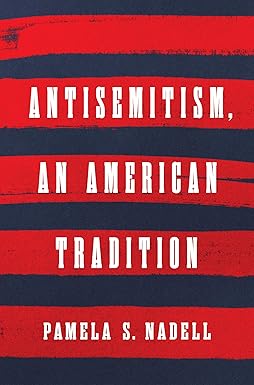
 Antisemitism, an American Tradition
By Pamela S. Nadell.
W. W. Norton, 2025.
Hardcover, 352 Pages, $31.99.
Reviewed by Elan Kluger.
Every political movement has a philosophy of history and recent American politics has offered quite the olio. Barack Obama’s “Hope” was one more instantiation of the Whiggish dogmatic belief in progress; MAGA is oriented to “again”; the 1619 project recasts American history as anti-Black, with the implication that only Black people can redeem this fallen country. Pamela Nadell’s new book Antisemitism, an American Tradition is the yield of her own politically mobilizing philosophy of history. For Nadell, the history of American Jewry is replete with instances of sometimes brutal, sometimes inconvenient antisemitism. The suggestion to Jews is clear enough: be vigilant, America is not your true home. But is this history what the moment needs?
Nadell’s narrative begins close enough to 1619, in 1653. Peter Stuyvesant, founder of New Amsterdam, wrote a letter demanding that that “deceitful race,—such hateful enemies and blasphemers of the name of Christ,—be not allowed further to infect and trouble this new colony.” He hoped that the new world would facilitate a fresh start, without Jews. Just as America was “stamped from the beginning,” in Ibram X. Kendi’s phrase, with anti-black racism, so, Nadell suggests, America was stamped with antisemitism. With that letter, Stuvyesant “launched the American tradition of antisemitism.”
Nadell reveals the character of this tradition through her narrative. In Stuyvesant’s case, antisemitism failed. The Dutch East India Company, acting under pressure from the Dutch Jewish community, reported to him that banning Jews did not fall under his purview. New Amsterdam, now known as New York, is now the largest Jewish city, and Stuvyesant himself is the namesake of that famed selective enrollment public high school which has provided many Jews upward mobility. In another point of failed antisemitism, General Ulysses Grant issued on December 17, 1862, “General Orders, No. 11,” which banned Jews from the Southern territories he conquered during the Civil War. Public outcry was enormous and Grant cancelled his plans, and in penance appointed several Jews to his presidential cabinet four years later. The lesson of both Grant and Stuvyesant is simple—the antisemites are out to get us, but we can win if we respond.
However, most of the “American tradition of antisemitism” proffers little hopefulness. Nadell documents the 1915 story of Leo Frank, a factory superintendent in Atlanta, falsely accused of murder by a black janitor and lynched by a mob before his trial. In response, Jews created the national Anti-Defamation League (ADL), the still extant antisemitism fighting behemoth, but “Atlanta Jews even stymied attempts to revisit Frank’s conviction when new evidence surfaced,” Nadell writes. They cowered in fear in the face of antisemitism.
Nadell’s litany of horrors then switches to the Midwest, with the familiar stories of Henry Ford and Father Coughlin, then to the KKK and the famous neo-Nazi march in Skokie, Illinois, of 1977. These incidents are as evil as they are isolated. Instead, more of the “American tradition of antisemitism” seems like the “Seligman affair.” Joseph Seligman, a Jewish banker, attempted to stay with his family in the Grand Union Hotel in Saratoga Springs. Although he had stayed before, they rebuffed him as the owner had instituted a “no Israelites” policy, in an effort to attract more WASPs. Press coverage and threats of legal action did nothing to change the policy of the hotel. A violation of civil rights? Yes. But Nadell has to stretch to imply this has anything to do with a tradition of antisemitism. She writes, “Joseph Seligman died in 1880 at the age of sixty, less than three years after he was turned out of the Grand Union Hotel.” Without stating outright, Nadell implies that the incident drew blood.
But it didn’t—public life raises blood pressure, we all know, but that doesn’t make banning people from hotels anything symbolic of a tradition or comparable to the tragedy of Leo Frank. Rather, getting banned from hotels or country clubs is simply a mild inconvenience. It indicates that most Americans did not treat Jews as fully, socially equal. And of course they weren’t. Judaism was and remains today a religion and a people that do not easily fit the categories of American secular life. Nadell wants to deny this and writes that “philosemitism—liking Jews, admiring Jews, loving Jews—can slide into prejudice.” Nadell suggests that treating Jews in a way that is not identically like the way you treat every other group is inherently antisemitic. But in denying Jews particular characteristics, and therefore closing Jews off from praise or blame, Nadell negates Judaism entirely. America should tolerate Jews, of course, but to try to end all social antisemitism or philosemitism would be to try to end Judaism and turn all members of that community into run-of-the-mill Christians.
Nadell only hints at this strange theory of antisemitism. To fully explicate it, one could continue to take up examples from Nadell’s history and examine what they indicate. But to do too much of this would replicate her narrative just as much as it would replicate Wikipedia. Antisemitism, an American Tradition is chock full of potted anecdote after potted anecdote. At the book’s end, we have no sense of what exactly this “tradition” is or even what it means for there to be a tradition. All we know is that there were anecdotes of antisemitism in America in the past and in the present. There is no intellectual architecture defining a tradition or its contours.
Nadell declares at the beginning of her history that “antisemitism is the word that readers know signifies Jew hatred. Scholars, of course, argue heatedly about defining Jew hate. After all, making arguments and proving them is at the heart of what we scholars do. Nevertheless…I bypass those arguments. Instead, as readers will discover, the many episodes of anti-Jewish animus discussed in this book speak for themselves.” The problem is that these incidents don’t speak for themselves and we can only speculate. For example, she writes of someone whose roommates declared, “It’s not because you’re Jewish that we don’t like you.” What if they weren’t lying?
Most of the anecdotes are so unsurprising and dryly recorded that one wonders what the book is for, really. The likely answer is that the book is about current debates on Israel. “I did not begin writing this book on October 8,” Nadell admits. Perhaps not, but it certainly amplified her project. She writes of the many recent horrific instances of antisemitism that have cropped up regarding Israel’s recent war, such as the 2024 vandalizing of a Cincinnati Jewish cemetery. And she compares it to a similar event in 1800. Nadell’s final words in the book are “the more things have changed, the more they have stayed the same. Antisemitism remains now and for the foreseeable future an American tradition.” For Nadell, the anti-Zionism of today is just like the antisemitism of 200 years ago.
With that, Nadell finally unveils her philosophy of history. It is neither unique nor particularly scholarly. Indeed, the closest comparison would be the old-fashioned Zionist historians of the 1950s and 1960s. Occasioned by the recent memory of the Holocaust, they wrote justifiably lachrymose histories of European Jewry. History was for them a record of antisemitism. That is Nadell’s strange sense of American history. There would then be an easy solution: every American Jew ought to move to Israel. In writing a 1619 project for the Jews, Nadell fails in making Jews just as American as Black Americans. Instead, she implies the need for a new exodus. But does Nadell really believe that? Her own life and public comments do not indicate that.
So we return to the question, why this book and why now? We can declare with certainty that it is never the right time for lazily written histories and now is no exception. More importantly, as American Jews face a country divided about what to say and what to do about an Israel that acts without regard for diasporic desire, what is not needed is more shrill complaints about antisemitism. Instead, we must interrogate our relationship to Israel, and build new models of engagement: with Christians, with Israelis, and with ourselves.
This book does none of that and like most supposed “anti-theoretical” histories, Nadell substitutes an explanation of what antisemitism is and how to chart it with a tacit theory that antisemitism always exists and always makes life miserable. For those reasons, Antisemitism: An American Tradition is a book best left unread.
Elan Kluger is an editor at The New Critic.
Support the University Bookman
The Bookman is provided free of charge and without ads to all readers. Would you please consider supporting the work of the Bookman with a gift of $5? Contributions of any amount are needed and appreciated!

