
William F. Buckley Jr.: The Maker of a Movement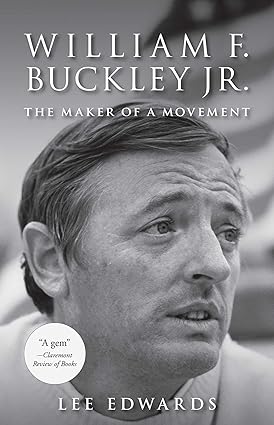
By Lee Edwards.
ISI Books, 2010/2019.
Paperback, 224 pages, $16.95.
Reviewed by Nicholas Mosvick.
Last December, the venerable scholar of the conservative movement and the human force behind the Victims of Communism Memorial Foundation, Lee Edwards, died of cancer at the age of 92. Edwards left a praiseworthy legacy of not just notable scholarship, on everything from the history of the institution he worked at for decades, the Heritage Foundation, to the earliest political biography of Ronald Reagan in 1967, but of a deep Catholic faith of which his earnest modesty and decency reflected. It was that faith, which he adopted after his time in Paris and his witness of the Hungarian Revolution in 1956, which led him to commit a lifetime of work against the satanic, destructive force of Communism.
Dr. Edwards also had a deep well of patience and wisdom for the next generation, something that the author had the great fortune to experience. That capacity for mentorship and friendship was also a key quality of one of the subjects of Edwards’s many biographies of conservative leaders, William F. Buckley Jr. Yet, as Edwards shows, Buckley’s political and journalistic projects were themselves a product of a set of intellectual roots that made up Buckley’s own “fusionism” and led him to build a movement and magazine that reflected the various constituencies of American conservatism.
In his 2010 William F. Buckley Jr.: The Maker of a Movement, Edwards begins with the end—Buckley’s funeral in April 2008 at New York’s St. Patrick Cathedral. There, Father George W. Rutler, the principal celebrant and a longtime friend to Buckley, explained to the mourners that Buckley had learned at his father Will Sr.’s dinner table that the most important things in life were “God, truth, and beauty” and that thus, Buckley’s categories were not Right and Left but right and wrong. Buckley, Edwards argues, fulfilled that sense of mission, most famously displayed in the first issue of National Review, by deploying what Michael Barone called “the power of ideas and words.”
Edwards, in his preface, does not ignore the critics of Buckley, particularly among paleoconservatives who have long seen Buckley as too willing to embrace a large central government and to enable the wicked designs of the neoconservatives. Edwards quotes Paul Gottfried, who believes Buckley wrongly “handed over American conservatism to neoconservative adventurers from the Left” by making neoconservatism the “only permissible form of thinking on the right.”
In a moment of internecine battles and schisms on the Right over the essential questions of what are we aiming to conserve and who, therefore, is properly a conservative, Edwards gives a fair and plausible answer to this persistent conservative question. Buckley provides it not by a thorough adoption of neoconservatism, but by coming from the multiple streams of American conservatism that were prominent in Bill’s youth and in 1955 when he founded National Review. The proverbial “big tent,” in other words, remains a tenable solution so long as the tent remains substantively expansive.
In many ways, Edwards’s short biography is really an intellectual history of the modern American conservative movement told through the auspices of its most notable figurehead. By examining the major individual intellectual influences in Buckley’s life, Edwards is able to organically put together the various strands and ideas that became known as “fusionism” without a lengthy or pedantic philosophical explanation. Those principle strands were traditionalism, radical individualism or libertarianism, realism, and anti-Communism, represented by Buckley’s mentors in Willmoore Kendall, Albert Jay Nock, James Burnham, and Whittaker Chambers.
This is sensible given the subject. Buckley himself never offered such an explanation of “fusionism”—he tended to leave such matters to the likes of Frank Meyer, M. Stanton Evans, and William Rickenbacker. Buckley, rather, was a popularizer and a synthesizer who never wrote a single volume explaining his political philosophy—he preferred action and coalition building to the careful exhibition of Russell Kirk.
The first major figure Edwards presents us with is Albert Jay Nock, the minister-turned-libertarian anarchist whose most notable treatise was his 1935 Our Enemy, The State. Nock became known to Buckley as a young man through his father, William Buckley Sr. Buckley Sr. had made his first fortune as an oilman in Mexico before the Revolutionaries usurped the fruit of his labors. Bill’s father never forgot the evils of socialism and imparted that distrust of the state and the scientism of modern liberalism to his children. Nock was a friend of Will Buckley who regularly came to dinners at the Buckley estate, Great Elm, and eventually young Bill Buckley grew curious about Mr. Nock enough to read Our Enemy, The State and his final book, Memoirs of a Superfluous Man. Nock not only brought forth an abiding criticism of the welfare state and Franklin Roosevelt, but the notion of a “Remnant” of elites who would bring forth a new, free society.
In Nock, Bill not only imbibed a certain radical individualism—one that, for Nock, bordered upon anarchism—but reflected the lessons of his father’s hardened disgust for Communism and socialism. Buckley’s conservatism was, as Edwards frequently reminds the reader, congenital. As Edwards eloquently puts it, “The dominant personality of the family was ‘Father—Will Buckley, who loved America, trusted the free market, and hated Communism with equal passion.” Buckley and his nine siblings were brought up with not only Will’s politics, but, through a “small army of private tutors,” training in art, piano, speech, apologetics, horse-riding, tennis, and sailing. Buckley attributed his “deep and permanent involvement in Catholic Christianity” to his mother Aloise, whom he wrote to when he was sixteen that the “greatest contribution you have given me is your faith.”
After his time in the military during World War II, where he graduated from Officer Candidate School and ironically was assigned to the army honor guard that stood by as the body of President Roosevelt was carried to a train bound for DC, Buckley matriculated at Yale in the fall of 1946. There, he met his second major intellectual influence, the “Wild Don” Willmoore Kendall. Kendall, in Edward’s analysis, represents the traditional conservative strain of Buckley’s thought and the rejection of laissez-faire politics and academic freedom that would inform a principal argument in God and Man at Yale. So too would Kendall’s rejection of the idea of the “open society” in favor of a “public orthodoxy” that all polities have a “right to defend against anyone who would fundamentally change it,” which Buckley would incorporate into the analysis of both God and Man and his second book written with his best friend from Yale and brother-in-law L. Brent Bozell Jr., McCarthy and His Enemies.
Through Kendall, Buckley was also introduced to his third intellectual mentor, James Burnham. Buckley was posted with the CIA in Mexico after graduation, a position that Buckley got through the suggestion of Kendall, who introduced Buckley to the CIA consultant Burnham. Buckley recalled that Kendall idolized Burnham, discussing him in his Yale classes as if he were “describing Wotan.” Edwards argues that Burnham represented the strain of “reapolitik” in Buckley’s thinking, both on politics and foreign policy, as his “pragmatism would profoundly shape Buckley, his magazine, and ultimately the conservative movement he led.” Buckley would later write that Burnham was, until his set of strokes in the late 1970s, the “dominant intellectual influence” upon the National Review.
The fourth seminal influence on Buckley’s thinking was Whittaker Chambers, the most prominent American defector from Communism and the hero of the postwar Right who had testified against the Soviet spy, Alger Hiss. Edwards argues that along with Burnham, Chambers moved Buckley towards a realism that made the magazine and movement more effective, a “dialectical” politics in which small gains would often prevail over the “ideal” impulses. Along with Burnham and Kendall, Chambers also confirmed Buckley’s belief that “Communism was the overriding issue, and challenge, confronting America” and that the linkage of liberalism and Communism justified Buckley’s “ready condemnation of the Left in every available forum.” Though the four men differed significantly in temperament and philosophy, Edwards notes that they had certain striking similarities in their faith and intellectual bona fides.
Edwards is careful to remind the reader of exactly where American conservatism stood prior to November 1955. He argues that in that time, in order for the conservative movement to be a significant force in American politics, it had to be philosophically united. This was because, as Edwards argues, “Throughout the 1950s, traditionalists and libertarians snapped and snarled at each other in National Review and elsewhere. Traditionalist Russell Kirk was accused of being hostile to individualism and laissez-faire economics, while libertarian F.A. Hayek was faulted for defending freedom on strictly utilitarian grounds rather than according to ‘the absolute transcendent values upon which its strength is founded.'” Kirk was, to be clear, a robust critic of libertarianism and defended economic freedom properly understood, not Manchesterian liberalism or laissez-fairism—as traditional conservatives then and now generally do—and utilitarianism, Kirk understood, always was a force hostile to the conservative sensibility and ontological view.
Yet, Buckley’s force of personality and charm papered over this philosophical dilemma and irreconcilable tension, in the view of Buckley’s brother-in-law Bozell, to make for an effective movement. The “snapping and snarling” between the camps was part of what made Buckley’s NR distinct, as it served as the institution where the principal debates on the American Right took place. Edwards does not leave the final word of the discontents of fusionism, either, noting that for NR Senior Editor Frank Meyer, there was a “true consensus of principle” whereby he could synthesize the “disparate elements of conservatism” because the core of conservatism was the freedom of the person. Buckley’s writing did not withhold an answer, even if he was more elusive than Meyer. In his essay, “Notes Toward an Empirical Definition of Conservatism,” Buckley argued that National Review always stood for a “general consensus on the proper balance between freedom, order, justice, and tradition.” Buckley put forward similar sentiments earlier in his third book, Up From Liberalism, a desire to maintain strong personal freedom and liberty alongside the maintenance of authority and the moral order. When he sought Burnham, Kirk, and Chambers to be his inaugural editors in 1954, Buckley did so precisely because he did not want ideologues but men of “experience and wisdom who shared his vision of a conservative counterestablishment.”
Edwards points out that Buckley and mainstream conservatives did “warmly” welcome the neoconservatives, starting with Irving Kristol, into the big tent, with Buckley declaring that Krisol was “writing more sense in the public interest these days than anybody I can think of.” Edwards argues that Buckley saw in the neoconservatives, including his later friend Daniel Patrick Moynihan and the social scientist Nathan Glazer, a set of thinkers with “formidable brain power” and “ready access to the mass media, attributes which would serve the conservative movement well.”
He notes that as National Review entered the 1970s, many grumbled that Buckley had become too much of a celebrity and too indifferent to the magazine and conservative movement, charges Edwards says had little merit given Buckley’s intense workload between Firing Line, his syndicated column, his dozens of lectures on campuses every year, and his continued editorial involvement in NR. Edwards adds that in this time, Buckley produced perhaps his most impressive policy work, the oft-overlooked Four Reforms: A Guide for the Seventies.
As Edwards correctly observes, Four Reforms, at a crisp 128 pages, saw Buckley take on four still persistent problems in America—education, crime, welfare, and taxes—just as he had during his campaign for Mayor of New York in 1965. Buckley’s tax proposals bore the influence of Nock and Buckley’s friend, Milton Friedman, as he argued for the elimination of the progressive income tax in favor of a flat tax of 15 percent on all income. Notably, Buckley’s thoughts on education policy, as they had in the mayoral race, were stunningly prescient, as he argued in favor of a voucher system and a constitutional amendment to both incorporate Brown v. Board of Education and forbid the denial of “any relief authorized by any legislature for children attending non-public schools.” The latter, offering protection to parochial private schools, is as salient now as the argument for vouchers. What Edwards misses, however, is that Buckley’s proposed amendment was less a codification of Brown than a means of broadly striking back against the excesses of the Warren Court, particularly their treatment of religious liberty in education and the general assertion of judicial supremacy. As Buckley puts it in Four Reforms, by the 1960s under the “Warren Revolution,” the Supreme Court had become a “secular moral authority.”
Edwards does well to also show that Buckley, contrary to today’s competing caricature of a wizened, genial, and inoffensive stodgy WASP, made his start by “flaying” the Left. Edwards argues that while Buckley had the goals of defeating communism, pushing the Republican Party to the right and building up a “prudential conservative movement,” he also had an additional goal for himself and the magazine—to keep “impaling liberals.” Buckley’s syndicated column was a “milestone in Buckley’s career” and he used the perch immediately to make Presidents Kennedy and Johnson frequent targets while also continuing to take on liberals across the country, debating the likes of Norman Mailer and Arthur Schlesinger.
Maker of a Movement does not elude the one aspect of Buckley’s legacy most charged during today’s renewed schisms on the American Right—Buckley’s purges. As Dan McCarthy has ably shown, the most common perceptions about Buckley’s purges—both their frequency and the extent of those purges—tend to be overdrawn by those on the Right today using it as a cudgel against their “New Right” enemies. Of the Birchers episode of the 1960s, Edwards briefly sketches the context of the fight. With conservative politics ascendent and Barry Goldwater looking like a potential genuinely conservative candidate for the 1964 presidential election, the John Birch Society was a concern because of its founder and leader, Robert Welch, whose ideas Buckley called “wild” and irrational. Buckley worried Welch’s extremism would damage the cause of anti-Communism with his “false counsels” and went forward over the objections of Meyer, Bozell, fellow editor William Rickenbacker, and publisher William Rusher, who thought that the magazine should focus its fire on Communists and liberals not fellow conservatives. It is notable, as well, that Edwards shows that Welch and the Birchers were not the first extremists that Buckley read out of the movement. In the late 1950s, the Randians were likewise expelled for Ayn Rand’s “desiccated philosophy’s conclusive incompatibility with the conservative’s emphasis on transcendence, intellectual and moral” and her tone of a “hard, schematic, implacable, unyielding dogmatism that is in itself intrinsically objectionable.”
Edwards writes of the early 1990s episode with Pat Buchanan and the longtime NR senior editor Joseph Sobran and the issue of anti-Semitism with real grace. He notes that for Buckley, the man who “led the conservative movement out of the wilderness and into a position of intellectual and political prominence could not remain silent about an issue that might materially damage American conservatism” because anti-Semitism was, put simply, morally wrong. At the same time, Buckley refused the demand of Norman Podhoretz to excommunicate Buchanan and Sobran from the conservative movement, instead arguing that Buchanan and Sobran were not anti-Semitic in any normal sense of the word but anti-Israel in their foreign policy views. While Sobran initially blasted Buckley, writing that the Buckley conservatism he had grown up loving and had followed, a “politics appropriate to the tradition of Aquinas, Dante, Shakespeare, and Dr. Johnson,” had been replaced by neoconservatism, he reconciled with Buckley at the end of their lives as they both faced deadly illnesses. Sobran wrote a late column, “The Real Bill Buckley,” recounting Buckley’s generosity and charity, saying that what drove them apart was trivial politics and that Buckley was a man with a “great heart eager to spread joy, and ready to share grief….I learned a lot of things from Bill Buckley, but the best thing he taught me was how to be a Christian.”
As the title of the third chapter in Maker of a Movement “Cruising Speed”—an allusion to Bill’s 1971 journal of a week in his life—suggests, the pinnacle of Buckley’s success came in the late 1960s and early 1970s. The movement had experienced “spectacular political growth” with Goldwater’s nomination and Ronald Reagan’s election as governor of California, with the “omnipresent” Buckley central to these successes. Buckley was the “hands-on editor, bestselling author, incisive columnist, rapier-witted television host, unparalleled debater, and not-so quixotic candidate for mayor of the most liberal city in America—New York City.”
In Edwards’s view, Buckley’s run for mayor was anything but a joke. Following the assessment of former NR editor John O’Sullivan, he believes that Buckley only let it appear a lark, covering for a serious effort to make a conservative program possible. Buckley may have failed to achieve the “big book,” his aborted attempt in the 1960s planned as “The Revolt Against the Masses,” but his mayoral run, his books, his time on Firing Line, and his public speaking all showcased his commitment to bringing effective conservative policies to America.
In his sections on Reagan and Goldwater, Edwards is sometimes too forgiving of the men he admired so much and, in the case of Goldwater, worked for. Goldwater, it might be said, is a testament to the feebleness of fusionism. The man who seemed set for the conservative moment in 1964 not only lost in a landslide to Johnson while kicking out Buckley, Bozell, and Rusher from his inner circle under the influence of William Baroody, but twenty years later, ended his political career embracing the thoroughly libertarian causes of gay marriage and abortion. To this end, Edwards shares that in 1983, Goldwater wrote to Buckley to ask what he had done to “bring down the wrath” of the Young Americans for Freedom and other conservative groups, with Buckley carefully telling Goldwater that it was his pro-choice stance on abortion and “resolute opposition to any legislative efforts to cure the usurpations of the [Supreme] Court.” Buckley assured Goldwater that his “place in history is very secure” and upon his death in 1998, praised him as a man who “would have been more at home at the Convention in Philadelphia than most modern liberals,” a subtle indication that Buckley too understood that Goldwater’s individualism was his prevailing ideology. Sam Tanenhaus’s official biography and Tanenhaus publicly have laid the charge that Buckley did not think Reagan a serious candidate in 1968 and that once Reagan ascended to the Oval Office, Buckley resented how much Reagan too spurned his advice and influence. Edwards’s account prefers the lasting relationship between the men—the storied first meeting in 1961, the close relationship between the family and wives, and Reagan’s embrace of National Review from 1955 to his oratory at the 30th anniversary dinner in 1985. More significant in Edwards’s estimation is that, upon Reagan’s death in 2004, Buckley wrote two essays to NR’s special issue “so devotional as to almost be embarrassing, but there was no hint of embarrassment in Buckley, who compared Reagan to Lincoln, both of their lives ‘mythogenic from beginning to end.'”
To close Maker of a Movement, Edwards relates the story of Buckley’s likely final public appearance in June 2007, when he took the long ride from Stamford to Washington D.C. for the dedication of the Victims of Communism Memorial, a decades-long lifetime project of Edwards’s, and to receive the foundation’s Truman-Reagan Medal of Freedom. In his remarks, Buckley talked about the importance of remembering the crimes and hundred million victims of Communism with its “ideology of ball and chain” and to also preserve the memory of the heroes who fought against Communism. Yet, true to Edwards’s view of Buckley’s intellectual influences, Buckley contained multitudes and when it came to the question of the Iraq War, Edwards argues that he followed Edmund Burke, whom he learned through Russell Kirk. Buckley dissented from NR’s editorial position in continued support of the war in 2005, having quickly moved away from his official support when weapons of mass destruction were not found and the Bush administration pushed a nation building strategy. As Edwards points out, by the fall of 2005, Buckley told George Will that nation-building was a Wilsonian idea that was “anything but conservative,” since conservatives insist on “coming to terms with the world as it is.”
Nicholas Mosvick holds a PhD in American history and a J.D. He studies American constitutional history and is writing a first book on the legal debates over the draft during the American Civil War.
Support the University Bookman
The Bookman is provided free of charge and without ads to all readers. Would you please consider supporting the work of the Bookman with a gift of $5? Contributions of any amount are needed and appreciated!
