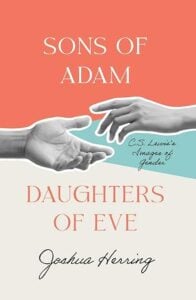
 Sons of Adam, Daughters of Eve: C.S. Lewis’ Images of Gender
By Joshua Phillip Herring.
The Davenant Press, 2026.
Paperback, 234 pages, $31.95.
Reviewed by Nathanael Blake.
C.S. Lewis can’t fix everything.
It is tempting to try, though. Lewis was a wise and learned man with a knack for expressing philosophical and theological truths in ways that were both comprehensible and memorable. He had much to say about many things, and so looking up what Lewis said about something is often an express lane to insight.
This is the impetus for Joshua Herring’s new book, Sons of Adam, Daughters of Eve: C.S. Lewis’ Images of Gender, which looks to Lewis for help with our culture’s gender troubles. As Herring notes, the “consensus on human anthropology has shifted,” leaving our age confused about matters such as what a woman is. And so he looks to Lewis for answers and believes that he finds them, and in them a guide to living well (or at least better) in this world. In Herring’s words, “By articulating a strong understanding of the human person as gendered, and of gender as a complex yet unavoidable part of reality, Lewis equips a confused modernity to recover wisdom in the face of technological possibility.”
And this equipping is as much an imaginative one as it is philosophical or theological. Our views of ourselves and reality are formed as much, or more, by stories and images as they are by reasoning. Of course, Lewis wrote wonderful stories for both children and adults, and so Herring sets about rebutting the false philosophies of the likes of Simone de Beauvoir and Judith Butler not just with facts and logic, but with the better stories Lewis told, which fire our imaginations and instruct our hearts. These tales, Herring argues, can teach us how to understand and embrace the realities of sex and gender, viewing them as good gifts from God: “Lewis invites his readers to discover the goodness of gender, and in so doing his myth making re-enchants the mind to perceive the complexity and wonder of being made imago dei.”
As this suggests, Herring did not write for those who have embraced gender ideology. Rather, he hopes that his exploration of Lewis’ work will inspire and equip Christian readers to understand and respond to our culture’s gender confusion. In doing so we are showing love for our neighbors, for a right understanding of who we are as male and female is not just a matter of Christian doctrine or church practice, but about recognizing and flourishing within reality. As Herring explains, Lewis teaches us that “[l]iving well in this world requires perceiving the world as a gift, and ourselves as contingent beings in the creational order.” To be happy we must accept the gift of reality, including our sexed bodies and the masculinity and femininity they partake of. This complementarity, which is most fully realized in marriage, leaves room for variation, play, and even some temporary or partial inversions amidst the great dance of existence, but not revolt.
This is all well and good, and Sons of Adam, Daughters of Eve convincingly draws these themes out of Lewis’ work, especially from the Space Trilogy and the Chronicles of Narnia. We are contingent and finite, and find ourselves and our joy not in efforts at self-creation, but through accepting reality as a gift. And insofar as this book reminds us of this truth, it is a gift to its readers. But there are also two significant flaws.
The first, and lesser, problem is stylistic. Herring’s writing is good from line to line and even page to page, but the overall organization and effect is too much like a dissertation. He devotes too much space to summaries of both gender theory and Lewis’ influences, and persistently deploys too many (and too extensive) quotations. This book would have been shorter and better if it were written with more authorial authority.
The other, and more significant, problem, is Platonism. Herring describes Lewis as a neo-Platonist, and presents this as the key to Lewis’ views on sex and gender. He claims that for Lewis, “The masculine and feminine…are values, principles, ideas radiating throughout creation; they function as axiomatic principles that are received, recognized, and built upon.” Thus, Herring explains that “Lewis presents gender as the universal category and sex as the particular application of the category.” This means that, for Lewis, gender, “is more real than sex; it appears in language, in creation, and in biology; it takes particular expression through male and female biology. As such, it is part of what is given to human beings in the created order.” We are therefore to welcome our embodied, sexed participation in the universal principles of the masculine and feminine, which “are existent ideas within creation.”
This opens a metaphysical can of worms. It also raises the question of what the universal ideas of the masculine and feminine consist of. Herring explains that “Lewis equips readers to perceive the masculine as an outward orientation toward strength, protection, and leadership. The feminine is an inward orientation toward being fluid, creating the conditions of life, and submitting to masculine leadership.” There is some fluidity to this, as there is some room for play and even inversion in a “dance of complementarity.” But we must not set our sex and our gender permanently against each other, or sever the necessary connection between them.
But, returning to the metaphorical worms now escaping the metaphysical can, why not? Herring’s presentation of Lewis legitimates a core claim of transgender ideology—that we have a gender identity deeper and more real than our sex. And if this gender identity, as we might call it, is a pervasive principle (or pair of principles, really) throughout the universe, then why is it obviously wrong to posit a mismatch between a person’s interior gender and exterior body? Herring’s exposition of Lewis leads us back to the possibility that there may be a mismatch between sex and gender as gendered souls end up in the wrong bodies.
Surrender to gender ideology does not necessarily follow—perhaps God ensures that, even in our fallen state, our gender and sex always correspond. But the door is opened, and needlessly so. There is no need, certainly none derived from Christian Scripture and doctrine, to make masculinity and femininity into metaphysical universals above biological sex. And treating them as such creates other problems, such as this book’s persistent impulse to reduce hierarchy to the interplay of masculine and feminine.
Herring is too acquiescent toward his subject, but Lewis is the real problem. He seemingly wanted our sexed embodiment to be an expression of something higher, or deeper, or more real, but in chasing that within his fiction he stumbled into a metaphysical morass. But we need not try to ground sex in any deeper magic or metaphysics. We don’t need no stinking metaphysical ideals here, for what could be higher, deeper and so on than the ordering of human bodies toward the begetting of new persons? This is illustrated by an anecdote about Elizabeth Anscombe. As retold by Rachel Lu,
Anscombe was an Oxford professor, a high-profile analytic philosopher, and also a mother of seven. People sometimes had opinions about that, and the story goes that she came into her classroom one day (pregnant with her seventh) to find that some mean-spirited troll had written the words “ANSCOMBE BREEDS” on her chalkboard. Calmly, without apparent embarrassment, she picked up the chalk and added two words. “ANSCOMBE BREEDS IMMORTAL BEINGS.”
It doesn’t get more real than that.
Nathanael Blake, Ph.D., is a Fellow in the Life and Family Initiative at the Ethics and Public Policy Center. He is the author of Victims of the Revolution: How Sexual Liberation Hurts Us All.
Support the University Bookman
The Bookman is provided free of charge and without ads to all readers. Would you please consider supporting the work of the Bookman with a gift of $5? Contributions of any amount are needed and appreciated!
