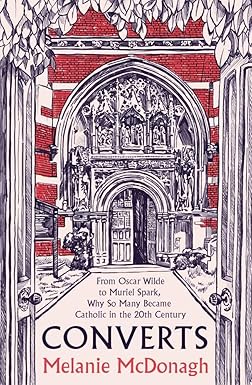
 Converts: From Oscar Wilde to Muriel Spark, Why So Many Became Catholic in the 20th Century
By Melanie McDonagh.
Yale University Press, 2026.
Hardcover, 354 pages, $38.
Reviewed by Adam Schwartz.
In September 2025, King Charles III visited the Birmingham Oratory to honor its founder, John Henry Newman. The king’s sojourn was particularly poignant in light of an enduring paradox of British Catholicism: even as the British state and its established church have often fostered enmity toward Roman Catholics throughout the modern era, leaving them a “rejected minority,” a disproportionate number of Britain’s leading minds, beginning with Newman, converted to Roman Catholicism and made their adopted faith their intellectual and imaginative mainspring. Melanie McDonagh adds to a quarter-century of scholarship exploring this “remarkable sociological development” by telling the story to a new generation. Her rendition surveys frequently-studied luminaries, like G. K. Chesterton, Graham Greene, David Jones, Muriel Spark, and Evelyn Waugh, while containing some distinctive features, such as including Elizabeth Anscombe and Gwen John in a panoramic prosopography. Her accounts inspire reflection on the allure of Roman Catholicism to noteworthy nineteenth and twentieth century thinkers, specifically its stress on authority, tradition, and dogma, its aesthetics (especially liturgical), and its forceful critique of predominant secularist ideologies and systems. However different these converts were, then, they all found countercultural Roman Catholicism a compelling counterstatement to their epoch’s regnant religious and social norms.
As the Church of England’s trumpets sounded more uncertain in late modernity due to the influence of biblical higher criticism, and as even Anglo-Catholicism was swayed increasingly by theological modernism, the singular surety of the Roman magisterium was refreshing to numerous seekers. Greene spoke for many when he craved “something firm & hard & certain, however uncomfortable, to catch hold of in the general flux.” This yearning for what Chesterton called a “truth-telling thing” propounding an “irrefragable metaphysic” was satisfied for these intellectuals by the papacy, as they were persuaded, like R. H. Benson, that “the primacy of Peter is of divine origin.” In fact, “poping” became a common colloquialism for conversion to Rome. Siegfried Sassoon summarized this widespread desire and its fulfillment candidly: “My need for authority was what finally settled it.”
The Catholic Church’s warrant for that authority was demonstrated further to various writers by its perceived historical tradition. At a time of sensed radical discontinuity between modernity and past ages (what Jones named “the Break”), Roman Catholicism seemed the sole unbroken, living link to Christ, the Apostles, and the Church Fathers. Jones maintained that “only by becoming a Catholic can one establish continuity with Antiquity,” an impression Newman articulated picturesquely: “were St Athanasius and St Ambrose in London now they would go to worship, not to St Paul’s Cathedral but to Warwick Street or Moor Fields.” Several of their fellows formulated a logical corollary to this principle, claiming that Catholic Christianity was the basis of Western culture and thus the best bulwark against the civilizational decline they feared, especially in the Spenglerian interwar years. “A society that has lost its religion,” warned Christopher Dawson, “becomes sooner or later a society which has lost its culture.”
Yet, the converts cautioned, embracing the Catholic religion must not be a matter of political or personal preference. Distressed by the discerned growth of subjectivism and the prevalence of what Newman called “the anti-dogmatic principle” of liberalism, the new Catholics were reassured by the Church’s assertion of objective, dogmatic convictions. Contravening what C. C. Martindale labeled the “loathsome I,” Chesterton declared of Catholic orthodoxy: “I did not make it. God and humanity made it; and it made me.” To him, regarding Roman Catholicism as this “solid objective truth” was one of the “really fundamental” reasons for joining it, as it suited what he considered a basic human trait: “Man can be defined as an animal that makes dogmas.” He and other converts consequently found the “dogmatic principle” liberating rather than restrictive. Whereas Benson deemed Anglican latitudinarianism “a liberty which is a more intolerable slavery than the heaviest of chains,” Maurice Baring countered that “in becoming a Catholic, you bow your head under a narrow door to enter…infinite freedom.” Hence even when some authors were unsettled by doubts about discrete beliefs, they affirmed the bedrock truth of their faith persistently, with Greene confessing at the end of his life, “I don’t believe my unbelief,” and Spark insisting, “I could not not believe.” For all of them, then, Roman Catholicism provided (in Greene’s phrase) an unrivaled “sense of reality.”
That reality was artistic as well as discursive. Roman Catholicism’s appeal to creative figures was not merely aesthetic but its perceived beauty was integral to its attractiveness to sensitive Britons. Oscar Wilde, for instance, lauded the “beauty” of the Incarnation while writers as dissimilar as Ernest Dowson and Spark held that an artist “must” become a Catholic “or she will never be an artist.” This attitude was epitomized by the likes of Jones and Gwen John, who postulated an intimate relationship between art and sacrament. For them, both such “makings” were acts of re-presentational anamnesis; Jones therefore went so far as to dub the Mass the “supreme art-form.” This sensed synergy of faith and subcreation spurred many converts to ponder the implications of being a “Catholic writer.” Although some, like Benson, were unapologetically apologetical, most of them defined this role more subtly. In their minds, Catholicism supplied a comprehensive ontology, revealing reality in its complete natural and supernatural dimensions, that was necessary for fully accurate artistic renderings of life; Spark could thus characterize a “Catholic play” as one that portrays situations that are “wholly true.” This “infused faith” in turn equipped them to depict a religious anthropology to a secular age. Waugh contended that being able to “represent man more fully…man in his relation to God” allowed Brideshead Revisited to “trace the workings of the divine purpose in a pagan world.” Roman Catholicism hence set the lines of excellence along which these artists exercised their vital powers.
Jones was not alone in designating the Catholic liturgy the exemplar of beauty. Baring, for one, judged the Mass “beauty far above all human reach.” He also saw the Tridentine rite as embodying the Church’s commitment to continuity, using “the same words, said in the same way with the same gestures” across centuries. To numerous coreligionists who lived through the Second Vatican Council, its liturgical changes undermined these qualities. The vernacularization of the Mass seemed to disrupt historical constancy while other alterations were taken (as a 1971 protest put it) as a vulgarizing accommodation of “the materialistic and technocratic civilization that is increasingly threatening the life of mind and spirit.” If none of the principal converts ceased to practice their religion, their grief at the renovation of the household of faith was still acute. Anscombe’s plangent lament was emblematic: “This is not the Church I converted into.”
Part of the converts’ heartsickness stemmed from their impression that the Church had hitherto been the chief subverter of secularist worldviews. Chesterton felt it was the “one fighting form of Christianity,” a “Church that will move the world” away from what Sassoon termed “the heathendom which afflicts the modern world.” Chesterton was foremost among those Catholics who were consistent critics of industrial technocracy, a rebellion intensified by the mechanized combat of the world wars that culminated in nuclear weapons, which Dawson styled “the arch-achievement of technocratic civilization.” Indeed, Anscombe counterposed Catholic just war theory to consequentialist rationalizations of the “massacre” of Hiroshima and Nagasaki bluntly: “For men to choose to kill the innocent as the means to their end is murder.” The converts’ rejection of capitalism led some to indulge antisemitic stereotypes, and to investigate totalitarian alternatives. Greene, for example, was drawn to communism’s teleological bent and its sympathy for victims of economic exploitation; but his faith’s emphasis on the perdurance of evil made Marxist utopianism look naïve and cruel ultimately. Obversely, other Catholics were enticed by fascism’s opposition to capitalist and communist materialism and its ostensible respect for traditional religion’s role in cultural life; yet most of them cast it finally as neo-pagan statism based on a racialized will to power. Even Waugh, who supported Mussolini’s invasion of Abyssinia, nevertheless concluded that “Christianity and the race myth cannot long work together.” As a new “dark age” of ideology appeared to be dawning, various converts enunciated a “counterpolitics” grounded in theology, notably Chesterton’s distributism, which “had a coherent vision of how life could be lived differently.” This model of society rooted in decentralization and broad, small-scale property ownership was instantiated famously by Eric Gill at Ditchling, an experiment McDonagh rates “a brave attempt to live out a social order where real craft and handwork were valued and in which religion was a way of life.”
Another architect of distributism, cradle Catholic Hilaire Belloc, welcomed the wave of converts as “a gathering army from all manner of directions, all manner of men each bringing some new force.” However, this advance regularly met resistance from relatives, peers, and clerics who derided the converts as déclassé, credulous “perverts” who were guilty of “treachery” (due to Roman Catholics’ alleged dual loyalties). Such losses were offset only partially by the gains of family, friends, priests and nuns, and historical forebears who led and accompanied them on the path to Rome. They nonetheless persisted in their unpopular faith amid social ostracism, ecclesial disappointment, and political marginalization. Believing with Baring that Catholicism was the “only real living religion at this moment that is influencing mature humanity,” these literati remained aboard the barque of Peter through external and internal tempests, convinced that it alone could convey them to the New Jerusalem. In the minds of modern Roman converts, then (as one of Wilde’s confidants proclaimed), the choice was stark, but clear: “you must be a Catholic or nothing.”
Adam Schwartz is the author of The Third Spring: G. K. Chesterton, Graham Greene, Christopher Dawson, and David Jones (2005; 2012). A professor of history at Christendom College, his scholarship is in the Catholic literary revival and the Inklings. His Disturbers of the Twentieth Century: Catholic Social Critics in Modern Britain is forthcoming from The Catholic University of America Press.
Support the University Bookman
The Bookman is provided free of charge and without ads to all readers. Would you please consider supporting the work of the Bookman with a gift of $5? Contributions of any amount are needed and appreciated!
