
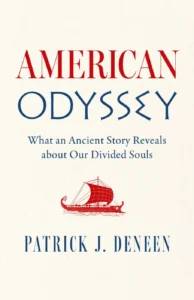
 The American Odyssey: What an Ancient Story Reveals about our Divided Souls
By Patrick J. Deneen.
Creed & Culture, 2026.
Hardcover,198 pages, $26.00.
Reviewed by Alexandra Bevins.
In American Odyssey, Patrick Deneen draws from political theory, classics, American literature, and film to understand the American concept of homecoming and adventure. The book addresses several core themes: the American identity as a mobile people; issues of loneliness; failures of liberalism and the township ideal; and nostos (homecoming) as portrayed in The Odyssey and in American literature and film. The text is structured around a chronological analysis of The Odyssey, broken down across four chapters and compared with relevant works of American literature and film, including The Wizard of Oz, Huckleberry Finn, Field of Dreams, and It’s a Wonderful Life.
By the end of the book, the reader has a solid grasp of the primary characters and events of The Odyssey. The reader also comes to understand classical American literature conceptually as drawing from and transmitting themes within the Western tradition. This book may be helpful for challenging undergraduates to think about literature not as physical books limited in authority by the time in which their authors wrote and lived, but as existing within a tradition that asks questions about what it means to be human. It may encourage students to connect with literature in a way that makes it more relevant to them—amplifying not the mere rise and fall of a text’s action, but directing them toward themes of struggle, failure, and courage.
For example, while discussing The Wizard of Oz, Deneen incorporates the work into a conversation about nostos. He notes that Dorothy “is the pragmatic American ‘everywoman,’ longing at once to get away and to go home.” She is driven by a desire to move beyond the mundane familiarity of a Kansas homestead in search of adventure. Yet only by travelling afar can she discover the centrality of that which she had forsaken—her home—to her humanity. Dorothy comes to understand aspects of her humanity through those with whom she interacts. Deneen draws a parallel between Aristotle’s Politics (in which Aristotle notes that beasts and gods are, by nature, without a city) and the inhabitants of Oz and the witches. As Deneen illustrates, these characters are, by their nature, self-sufficient. The Ozmites built the Emerald City for the amusement of the Wizard rather than to fulfill an otherwise unmet need for political justice. Prior to the Wizard’s arrival, they presumably lived in villages, a proportionate level of development in which their everyday and extended needs were met. They did not desire to develop a city because their nature did not give rise to a deficiency that would necessitate this. In comparison, the witches of the East and West are solitary beings. They act as gods whose categorical superiority to the city’s inhabitants renders the city functionally arbitrary and unnecessary for them. In these nonhumans, Dorothy finds a foil for her humanity. She understands the importance of the city as home for being human. Hers is a story that perfectly replicates the hero’s journey through its examination of the significance of place and hearth to being human. An examination of this sense of place would particularly appeal to young undergraduates, many of whom are engaged in their first true journey away from home and learning firsthand about the nature of adventure and homecoming. A book such as this one may prompt students to think more meaningfully about their experiences and thus connect them with larger questions about what it means to be human.
In Huckleberry Finn, Deneen finds a ready parallel to The Odyssey as both works are animated by the temptation of adventure, homecoming, and clever protagonists who swindle other characters. He explores the appeal of immortality to Odysseus and Huck and their choices to risk damnation and remain human rather than pursue that which is beyond their nature. For Odysseus, this comes in the form of Calypso’s offer to remain on her island for eternity and dwell with a goddess. The alternative, vividly known to him because of his descent to Hades, is a lifeless existence in which souls of the dead are wholly unable to communicate with those in and beyond Hades without assistance. With complete knowledge of the alternative, Odysseus chooses to leave Calypso, thereby forfeiting her offer of immortality. Similarly, Deneen writes that Huck refused to turn Jim into Miss Watson, despite legal and religious imperatives, because of a great bond of friendship that had formed between the two characters. Believing from a Christian point-of-view that it would cost him his soul in the afterlife, he prioritized his fellow man. Deneen interprets the actions of both as the choice to remain human given other appealing alternatives. Odysseus and Huck recognized their humanity and did not give into the temptation to move beyond it. Deneen’s emphasis on remaining human further develops the reader’s understanding of the contours of being human. His interpretation is thoroughly helpful for considering elements of both texts and their larger thematic discussions.
The reader should approach the text with appropriate expectations. Despite Deneen’s stature as an academic, this book is addressed to a popular audience. This alters the general methodological approach in various ways. For example, the book does not explain why several of the literary works primarily addressed are choice-worthy representations of homecoming and adventure in the American literary imagination. Deneen reasons through his selection process by noting that their characters parallel the development of those in The Odyssey. When discussing It’s a Wonderful Life, he likens George Bailey’s restlessness with his hometown to Odyssean themes of adventure. However, a number of Marvel and DC superhero films of the last two decades would ostensibly meet this criteria as well. Setting their popularity aside, what makes these works choice-worthy representations of adventure and homecoming in a way that others in our literary corpus are not?
Given the text’s remarkable brevity, an effect of its enormous thematic scope is to truncate the reader’s understanding of these complex and distinct themes. At times, the disparate content it attempts to address—social commentary, underlying premises about the failures of liberalism, and references to events in American history—lack adequate context or integration. For example, Deneen includes brief remarks on baseball in a section dedicated to framing his argument around Tocqueville and refers to Martin Luther King Jr. without further explanation in a section concerning The Odyssey. These and other essentially stand-alone references distract from broader themes.
Altogether, Deneen’s work addresses Odyssean themes of adventure and homecoming in American literature and film. His analysis of the characters and themes of The Odyssey is undoubtedly the strongest element of the book, and students and general readers will likely find it helpful. It should not escape the reader that Deneen explicitly notes the harried timeframe in which American Odyssey was composed. While this version of the book has wide appeal to general audiences, it is not the longer and more developed project that a scholarly audience might expect—one that I, and doubtless many others, would greatly enjoy.
Alexandra Bevins is a doctoral student at The University of Iowa. She is interested in American political development, political philosophy, Leo Strauss, historicism, storytelling, and the Platonic dialogues.
Support the University Bookman
The Bookman is provided free of charge and without ads to all readers. Would you please consider supporting the work of the Bookman with a gift of $5? Contributions of any amount are needed and appreciated!

