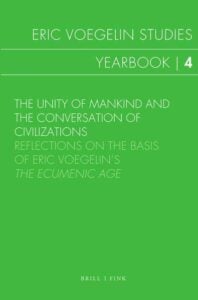
The Unity of Mankind and the Conversation of Civilizations. Reflections on the Basis of Eric Voegelin’s The Ecumenic Age. Eric Voegelin Studies Yearbook 4.
Edited by Axel Bark and Harald Bergbauer.
Brill Fink, 2025.
Hardcover, 473 pages, $155.
Reviewed by Lee Trepanier.
When Eric Voegelin published Order and History Vol. IV: The Ecumenic Age in 1974, it created controversy among Voegelinian and Christian scholars. The former were surprised by Voegelin’s departure from his first three volumes of Order and History that history does not proceed in a single, predictable line of meaning―that history lacks any discernible overarching narrative; the latter were upset that Christianity was not perceived by Voegelin as the spiritual apotheosis of humankind and asked where the figure of Christ was in Voegelin’s book. The controversy about this work continues today with scholars defending, criticizing, and questioning Voegelin’s work.
This collection of essays revisits The Ecumenic Age. It is the product of an annual international conference about Voegelin’s works and part of an ongoing series, Eric Voegelin Studies. A reexamination of The Ecumenic Age is worthwhile not only for addressing a number of open questions about this work, but also for reflecting on our contemporary global moment, with the rise of empires and geopolitics in the United States, the European Union, China, and Russia.
Voegelin’s adoption of the title, The Ecumenic Age, was to describe a period in which “the cosmological understanding of reality was definitively replaced by a new understanding of reality, centered on the differentiation of the truth of existence through Hellenic philosophy and the Christian revelational experiences.” This period began around the time of Zarathustra and lasted until the end of the Roman Empire, including the imperial expansion of multi-civilizational states such as the Persians, Alexander, the Romans, the Maurya Dynasty, and the Ch’in and Han Dynasties. Voegelin traced this historical process in which civilizations transitioned from the “truth of the cosmos” to the “truth of existence,” as manifested in symbolic form.
The Unity of Mankind and the Conversation of Civilizations opens with a tribute to Peter J. Opitz, who, among other scholarly activities and publications, founded the Eric Voegelin Archives at the University of Munich in 1990. It is then organized into three sections, with the first examining Voegelin’s philosophical basis for The Ecumenic Age, the second looking at his intellectual environment, and the third publishing selected book reviews about Voegelin. The contributors to the collection are prominent ones in Voegelinian studies, creating a work that is thoughtful, reflective, and enduring.
The first chapter by Wolfgang Leidhold sets the stage for the rest of the volume by comparing The Ecumenic Age with Voegelin’s earlier works, noting Voegelin’s departure from a historical unilinear process to a multidimensional field. Matthias Schmid next explores how Arnold J. Toynbee and Karl Jaspers influenced Voegelin’s The Ecumenic Age with their attention to spiritual outbursts, ecumenic empires, and historiography. Axel Bark then examines Voegelin’s own theory of history and his discovery of “historiogenesis,” the creation of a sequence of meaningful events in a historical uniliteral process. Instead of historiogenesis, Voegelin adopted a theory of “equivalence of symbolic forms” where history was multidimensional and multifaceted.
The next set of chapters look at specific aspects of The Ecumenic Age: Bernat Torres analyzes how Voegelin’s identification of symbolic equivalences among different Christian and Stoic philosophers helped clarify Voegelin’s own philosophy of history; Barry Cooper compares the Chinese and Western formulations of their “spiritual worlds” and how each evokes a symbolism of universal humanity; and Jürgen Gebhardt situates Voegelin’s work among other scholars’ attempts to understand inter-civilizational relations.
The next chapters address Voegelin’s controversial claims about Christianity in The Ecumenic Age. Carol Cooper argues that Voegelin’s focus on St. Paul in The Ecumenic Age enables him to reassert a vision of universal human reason that is more open to spiritual reality than religious or political movements. David Walsh’s analysis of Voegelin’s use of “universal humanity” looks at the concrete community of humankind that unfolds across time and that reaffirms Augustinian theology and Aquinas’ recognition that Christ is the head of all humankind. History is “Christ written large.”
The second section of the collection examines Voegelin’s intellectual environment. Patrick Giddy situates Voegelin in conversation with Marcel Gauchet and Charles Taylor on the relationship between liberal democracy and Christianity, examining whether these two traditions distort one another. The late Peter J. Opitz explores how Voegelin’s essay, “Gospel and Culture,” played a critical role in Voegelin’s writing The Ecumenic Age, breaking away from the paradigm he had established in Order and History Volumes I-III. Stephan Sattler also examines why Voegelin broke from his methodology in The Ecumenic Age, believing that his meditative interpretation of classical texts led to a reconsideration of his philosophy of history.
Tilo Schabert explores the role that prophecy plays in Voegelin’s The Ecumenic Age, having been drawn from Plato’s dialogue Politikos. Muen Liu compares the Chinese concept of Tianxia with Voegelin’s methodology in understanding traditional Chinese order and its interaction with Western civilization. And finally, James Greenaway interprets Voegelin’s understanding of participation as “belonging,” in which humans partake in both the cosmic and microcosmic orders of their existence. According to Greenaway, the language of belonging is a better and more productive way to preserve Voegelin’s insights about humans partaking in spiritual reality.
The Unity of Mankind and the Conversation of Civilizations is a rich resource for Voegelin scholars to consult for their own academic and intellectual pursuits. It revisits one of Voegelin’s most controversial works and treats it with the careful academic probing and intellectual curiosity that The Ecumenic Age provokes. Revisiting this work and learning from it is all the more important today amid the rise of civilizational empires and the global spread of religions. Reading Voegelin and works like The Unity of Mankind can provide us with a grounded perspective to evaluate the claims made by others in the name of history, empire, and civilization.
Lee Trepanier is Dean of the D’Amour College of Liberal Arts & Sciences at Assumption University and Editor of the Bloomsbury’s Politics, Literature, and Film series.
Support the University Bookman
The Bookman is provided free of charge and without ads to all readers. Would you please consider supporting the work of the Bookman with a gift of $5? Contributions of any amount are needed and appreciated!


