
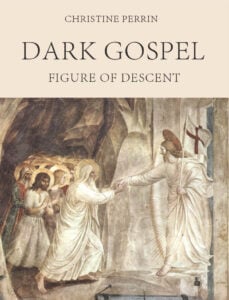
 Dark Gospel: Figure of Descent
By Christine Perrin.
Eighth Day Books, 2026.
Paperback, 91 pages, $22.00.
Reviewed by Sarah Reardon.
When in my early teenage years I first heard of the Christian doctrine of the “Harrowing of Hell,” I was shocked. The essence of that doctrine—that Christ, after his death, descended into the realm of the dead to free all the righteous who had died before his death and resurrection—was not spoken of much in my Protestant community. At the time, the doctrine was a bit unsettling to me, as it raised questions I had never before considered. Over years, however, I came to see the Harrowing of Hell as an essential piece of the beautiful redemption taught by the Christian faith: Christ descended even unto Hell for his salvific purposes.
Such descent into the most shadowy places is the subject of Christine Perrin’s recent poetry collection, Dark Gospel: Figure of Descent.
I read many of the poems from Dark Gospel: Figure of Descent while nursing a newborn in the middle of the night. Given the darkness of the title and the themes dwelt upon in the collection, that was a fitting way to read Perrin’s work.
As I read the collection, David’s words from Psalm 139 resounded in my mind:
If I say, “Surely the darkness shall cover me,
and the light about me be night,”
even the darkness is not dark to you;
the night is bright as the day,
for darkness is as light with you.
Perrin’s poetry pictures the same truth that David pronounced: that there is divine light in the darkness. Perrin’s collection begins with the darkness of the womb (which is also famously dealt with in Psalm 139) and ends with meditations on illness and death. Throughout the collection, Perrin often writes in blank verse or in free verse, and some of the poems are found poems. Perrin draws much on mythology and artwork; an entire section of the collection is devoted to poems about Virgil’s Aeneid, and prints of paintings dot the pages of the book, complementing Perrin’s words.
In the titular poem, “Figure of Descent,” Perrin asks whether “all the great stories or old dreams begin / in descent,” and the rest of her collection answers like a chorus with a resounding “yes.” Some of the stories of descent that Perrin tells are those same great stories re-told, as with her poems on the Aeneid, and others are personal stories, whether those of chemotherapy or those of walking in the woods.
In Dark Gospel, the anguish and confusion of descent is real. In “Another Forest Story” Perrin begins by proclaiming that “The beloved is lost, the forest dark and wild” and soon asks, “When do we find the path?” In “Mothers and Fathers,” Perrin pictures the mothers of the epic heroes standing on walls, watching with grief as their sons leave, and “counting slowly / down, down, down, down.” In “Nostos,” Perrin takes up the voice of the Trojan wives who, spurred on by Juno’s schemes, set fire to their boats in Book 5 of the Aeneid. Perrin regards their desperation as a common human experience:
…Ingloriously we
Set fire to our own boats, vessels that might
Have born us onward home, that great love,
Profaned in anguish and desperation…
…We found ourselves
Weary, boatless, on a desolate beach.
I begin to expect you’ve been there too:
Chest-punched without breath and no poet
Sunk in awe could tell how many waves
Remain, how broad a sea for us to cross.
Perrin’s poems rarely end with an easy resolution of such anguish. Lament is real here. But the song of suffering and descent that Perrin repeats in manifold tunes is not without its beauty or its hope for ascent, for resurrection.
In “Birds Descending” the poet watches with wonder as birds “all in a rush” descend upon a birdfeeder and treasures their echoing song. Likewise, in “Under” the speaker marvels, despite sorrow, at a bluebird and enjoins the reader to, like her, “feel the Lords’ finger finding you under the wonder.” Poems with titles such as “Grammar of Flowers in Stage Four Cancer” and “During Chemo I Plant my Mother’s Daisies” reveal Perrin’s preoccupation with the paradoxical interweaving of pain and beauty, life and death. In one poem Perrin contends that “Beauty bids and gathers and bestirs / to itself by the longing to have it.” Such bidding is Perrin’s concern just as much as the motif of descent; what’s more, the bidding of beauty and the descent of the soul are in fact intimately connected. In “Winter Flowers” Perrin beholds
A marvel of design, of made things—seed
heads of burdock, mullein, coneflower,
papery miracle of the wasp nest unanchored.
Even at its strictest and darkest the land
shows forth signs and we go out
in search of them, expecting them.
This collection holds out encouragement to those who are in their “strictest and darkest” winters, but it also bestows upon any reader, whatever his state, “signs” of beauty, of that divine light in the darkness, of the one who harrowed hell and rose victorious.
Sarah Reardon’s first collection of poetry, Home Songs, was published by Wipf and Stock in 2025, and her essays have appeared in First Things, National Review, Plough, and elsewhere.
Support the University Bookman
The Bookman is provided free of charge and without ads to all readers. Would you please consider supporting the work of the Bookman with a gift of $5? Contributions of any amount are needed and appreciated!

