
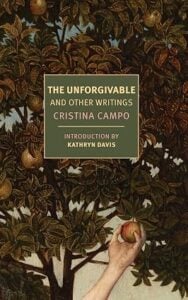
 The Unforgivable and Other Writings
By Cristina Campo. Translated from the Italian by Alex Andriesse. Introduction by Kathryn Davis.
New York Review Books Classics, 2024.
Paperback, 288 pages, $18.95.
Reviewed by Fr. Joseph Hudson.
There is an image near the opening of the title essay in The Unforgivable and Other Writings that is hard to shake. Cristina Campo is describing a scene from the chronicles of the Boxer Rebellion, which she found in Hofmannsthal: a line of Chinese men waiting their turn at the guillotine. Some of them are beating each other bloody. Two or three keep charging the executioner. And one man, near the middle of the line, is reading a book.
“In an era of purely horizontal progress,” Campo writes, “the only nonfrivolous attitude seems to be that of the man in line who is reading a book.” The man was released — though she tells us it is wise to forget that. Apparently, the German officer could not cope with his composure. Asked why he had been reading, the man said: “I know that every line read is a gain.”
That is the whole of Campo’s argument, and the whole of her temperament, in a single anecdote: the conviction that attention to something perfect is not an evasion of catastrophe but the only serious response to it. It is also why she is worth the time of anyone who reads Wendell Berry, Emily Dickinson, Russell Kirk, or, and especially, Simone Weil. In other words, anyone who has ever looked closely at a poem when the world around them is in chaos.
Until now Campo has been almost entirely unavailable in English. This New York Review of Books volume—Alex Andriesse’s translation of both her books of essays, Fiaba e mistero (1962) and Il flauto e il tappeto (1971), together with a dozen uncollected pieces and one autobiographical fragment—is the first real chance American readers have had to meet her.
She was born Vittoria Guerrini in Bologna in 1923, the daughter of a composer. A congenital heart defect kept her out of school and away from other children. So she read instead, in five languages, in a Tuscan villa that reappears in her prose like a recurring dream: the green iron table under the cedar of Lebanon, tea at half past four, the last meadowsweet shedding its petals on the gravel. She published under pseudonyms, of which “Cristina Campo” was one. She translated far more than she wrote—Mansfield, Woolf, Dickinson, Donne, Hofmannsthal, William Carlos Williams, Simone Weil. She died in Rome in 1977, at fifty-three.
As Kathryn Davis notes in her introduction, Campo “had written little and would like to have written less.” The corpus is a few dozen essays and one thin book of poems. It is enough.
Campo’s diagnosis of her own literary moment reminds one of C.S. Lewis’s essay The Abolition of Man. Like Lewis, she abhors the loss of objectively meaningful words, words that can form the basis of shared experience. “It’s telling,” she writes in the title essay, “that the very word ‘mastery’—as well as the humbler ‘technique’—has by now dropped out of critical language, as have the simple, unappealable definitions ‘beautiful’ and ‘ugly,’ which today are the patrimony of the world of footballers and boxers.” Discussions of art, placed on their natural axis—“the greater or lesser mastery of the artist”—are immediately “shunted onto other, not very clearly laid tracks, such as the artist’s ‘commitment’ or ‘presence.’” Sixty years on, those expressions have hardened from novelty into cliché.
Her instinct is to combat this tendency by becoming a better sounding board. “The critic is an echo, yes.” She writes in Deer Park. “But isn’t he also the voice of the mountain, of nature, to which the poet’s voice is directed? . . . He must give it back not like a simple mirror but like an echo: laden and suffused with the long road traveled, in nature, by both voices.” Whenever something is truly received and given back, it returns changed. The better the sounding board, the better the echo. For Campo, again back in the title essay, that ravine is Leopardi—poet, philologist, and “the last critic” Italy had, the last “to examine a page as it ought to be examined, in the manner of a paleographer, on five or six levels at once: from its feeling for human destinies to its ability to avoid discordant vowels.” Destiny and vowels in one breath, with no sense that one is grand and the other pedantic—that is the range and texture of the literary critic that Campo is searching to become.
She succeeds. Though like a master painter she executes a flawless fresco with such ease that the viewer doesn’t notice the hours of preparation and technical precision. That is the epitome of sprezzatura: making the difficult look effortless.
She lingers, for example, on a letter long attributed to Mozart as his last, with its lament about the stranger in the black cloak, and then the burst: “Life was, indeed, so beautiful . . .” Campo takes the sentence apart one word at a time. “Life was beautiful” is the workaday formula. “Life was so beautiful” is nostalgia. “Life was, indeed, beautiful” is candor. Only the five words together make “the dagger that pierces, drawn from its sheath by two monosyllables, arranged in a simple and inscrutable order.” “Life was, indeed, so beautiful . . .”
Her judgments, it should be said, can be brutal. She writes in her introduction to William Carlos Williams of the Beat generation—“this pathetic, inarticulate group who scream at the top of their lungs in a state of ecstasy far too reminiscent of weeping”—is not an argument. But even there she lands a real distinction. What the Beats were looking for in Williams and in Zen artists, she says, were “strange beings who do not need drugs, stuporous music, or mad trips on transcontinental trucks to discover, in the real world—in a sea rock, a face, a garbage can—the Himalayas and prairies.” The Beats were “apostles of forced imagination” hailing Williams and the “untroubled masters of attention.”
“Attention and Poetry” perhaps best summarizes her understanding of art.
Here Campo challenges the idea that imagination makes the poet. Her complaint is that for several centuries this idea has relegated poetry to the unreal. She makes her point by drawing a comparison between the judge and the poet. At first glance, the virtue of justice and imagination seem to be “antithetical terms.” Yet, the just man is one who reads a situation well. He reads it well, Campo argues, because he gives it his attention. His eye is whole, to borrow an evangelical phrase. He is not looking after his own interest divided against that of others. His heart is pure, free, and thus, so is his judgment. This is why we call for the judge’s attention, rather than his imagination.
From here the comparison is made to the poet. Poetry, too, “involves reading, on multiple levels, the reality around us . . .” And then the line that turns the whole literary tradition of the last two centuries on its head: “Dante is not, however scandalous it may sound, a poet of imagination but a poet of attention.”
For anyone raised on Burke’s moral imagination, this sounds implausible. But read a little further and you find Campo admitting that attention is imagination, “the most legitimate, absolute form of imagination.” Like the alchemists of old, attention dissolves an image into a fluid and then watches how it solidifies into different figures. Unlike the common idea of imagination, which seems to recoil from reality, attention confronts, takes it in hand, and translates it into symbols. Thus, “attention frees the idea from the image, like the genie from the bottle, then gathers the idea back inside the image.”
Attention is thus disciplined imagination. “If attention is a patient, fervent, fearless acceptance of reality, imagination is impatience—a flight into the arbitrary: an endless labyrinth navigated without Ariadne’s red thread.” She then gives attention another name: responsibility, that is, “the capacity to respond on behalf of something or someone.” One is responsible for another when one agrees to watch over them, to give them attention. Taking inspiration from a phrase from the French poet Valéry she likely found in Weil, she concludes that “Souffrir pour quelque chose, c’est lui avoir accordé une attention extreme” (to suffer for something is to give it extreme attention).
Hence the sentence that is the moral center of the book: “truly every human, poetic, or spiritual error is nothing, in essence, if not inattention.” This is not aestheticism. It is closer to a theory of fidelity. You cannot be loyal to what you have not troubled to see.
Campo’s part in Weil’s Italian reception is the fact most often mentioned about her and least often examined. The essay on Venice Saved is the one that should be pressed into the hands of every localist who has never read a word of either woman. Weil’s unfinished tragedy turns on Jaffier, the conspirator who betrays a plot to sack Venice. Campo shows why Weil made a hero of the man history calls a traitor: Jaffier alone among the conspirators is “a creature capable of pure attention.” He alone can actually see the city—can think of it “beyond his desire to possess it, sack it, destroy it.” And once he sees it, saving it becomes an inescapable duty, which costs him everything, including in the end his own mind.
At the center of the tragedy is Venice itself, which Weil describes as “a human milieu of which we are no more conscious than the air we breathe. A contact with nature, the past, tradition.”
Set against it is the conspirator Renaud, coolly explaining what conquest requires:
Tomorrow they must no longer know where they are. They must no longer recognize anything that surrounds them. They must no longer recognize themselves. The local people must feel like strangers in their own home. This has always been and always will be the policy of conquerors: to uproot the conquered.
Campo’s gloss is worth memorizing: “There is thus no difference between the agony of a populace and the agony of one man. It is always a matter of the most total and irreparable misfortune: the misfortune of being uprooted.” Or, in Weil’s flattest phrase, which Campo quotes: “He who has been uprooted can only uproot.” Her preface to Il flauto e il tappeto calls that book “a humble attempt to dissent from the game of forces, ‘a profession of disbelief in the omnipotence of the visible.’”
More practically, Campo is useful to anyone trying to live in a particular place, on purpose, because she takes the two things we usually keep in separate drawers—the way a sentence is made, and the way a life is owed to something—and shows that they are the same discipline. Style, for her, is not decoration but “a heightened feeling for life.” Attention is not a mood but a debt. In her essay On Fairy Tales, which she reads better than almost anyone, fairy tales are not mawkish: “Nothing, with the exception of the Scriptures, is more radically unsentimental than a fairy tale.” Such things teach us how to live because they expose the idea lying dormant in the image.
She ends the title essay where she began it, in the guillotine square, with instructions. “Sit with your back to the wall, read Job and Jeremiah. Wait your turn. Every line read is a gain. Every line in the unforgivable book.” Whether we evade catastrophe isn’t the point. It is how we respond to it that matters for Campo.
Fr. Joseph Hudson, OSB, is a Benedictine monk who teaches spiritual and moral theology at the Pontifical University of Sant’Anselmo (Anselmianum) in Rome. A former Wilbur Fellow at the Russell Kirk Center, he writes on Thomas Aquinas, deification, moral theology, and the intersection of tradition, culture, and law.
Support the University Bookman
The Bookman is provided free of charge and without ads to all readers. Would you please consider supporting the work of the Bookman with a gift of $5? Contributions of any amount are needed and appreciated!

