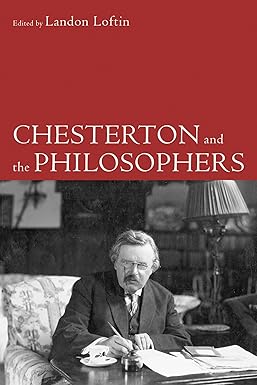
 Chesterton and the Philosophers
Edited by Landon Loftin.
Wipf and Stock Publishers, 2026.
Paperback, 222 pages, $28.00
Reviewed by Chuck Chalberg.
Editor Landon Loftin has the temerity to agree and then disagree with Garry Wills, who had the temerity to declare that G. K. Chesterton was “not a philosopher, nor did he want to be.” Rather, as far as Wills was concerned, Chesterton was simply a “defender of philosophy, which is quite another thing.” To be sure, Loftin agrees with Wills that Chesterton was not a trained philosopher; nor was he a philosopher in the general sense that any and everyone is a philosopher in one way or another, or at least to one degree or another.
Loftin also agrees that Chesterton was a defender of philosophy, while adding that the “really interesting question” concerning Chesterton and philosophy is whether or not he was a philosopher in the “oldest, most common sense.” That is to say, was Chesterton or was he not a “friend or lover of truth?”
In truth, he was both a friend of truth and a lover of it. Loftin has gone about demonstrating the full truth of his statement by gathering together a number of trained philosophers, as well as a number of would-be friends and lovers of the writings of G. K. Chesterton, to confirm that very truth, thereby eliminating the either-or-ness of his initial contention.
There are sixteen essays in this collection. Commenting on all of them in this single review essay would be unwieldy, not to mention impossible. So let’s clear that deck with this simple and single declarative sentence: There isn’t a clunker among them.
In a very real and concrete sense, Loftin has accomplished in this brief volume what my undergraduate Jesuit teachers sought to accomplish years ago. Five courses in philosophy were then required of all students. (In case you haven’t guessed, I am not a recent college graduate!) Four of the five were various dimensions of Thomism. And the fifth? Titled “Thomism and Modern Thought,” the course essentially used the philosophy of Thomas Aquinas to criticize and even debunk almost every modern philosopher and/or philosophy.
And Landon Loftin and his cohorts? Their goal—and no doubt his intent—is to use G. K. Chesterton to criticize and debunk a fair number of modern philosophers and their philosophies, the vast majority of whom or which had little or nothing to do with philosophy in the “oldest, most common sense.”
And who might those philosophers be? Not surprisingly, they include the likes of Marx, Hume, Freud, Schopenhauer, and Nietzsche. In a very real sense, Loftin is also deploying St. Thomas to criticize these modern philosophers. After all, St. Thomas borrowed from Aristotle, who expanded on Plato, and G. K. Chesterton borrowed from both Aristotle and St. Thomas, while also expanding on Plato.
Loftin acknowledges and demonstrates just that in an opening page that precedes the first chapter. First is a line from Plato: “Wonder is the feeling of a philosopher, and philosophy begins in wonder.” Then comes Aristotle: “It is through wonder that men now begin, and originally began to philosophize.” St. Thomas chimes in with: “Wonder is defined as a kind of desire for knowledge.” And that leaves Chesterton to conclude that “the world will never starve for a want of wonders, but only for want of wonder.”
That line belongs near the top, if not at the top, of any listing of the great and telling lines of G. K. Chesterton. Many more great and telling Chesterton lines can be found in this slim volume as well.
Therefore, a question arises: Ought one to settle in and read a good deal of Chesterton before tackling a book such as this? Not at all. But far be it from me to discourage anyone from reading Chesterton unfiltered and unexpurgated. For that matter, the possibility that a potential reader might be unaware of what he or she is in store for should not be a discouragement of any sort either. Chesterton wrote for the common man of his day, and he can still be read by that large category of potential readers today.
In other words, one doesn’t have to be a trained philosopher, especially a trained modern philosopher, to read G. K. Chesterton. In fact, such a status might well be a hindrance, rather than a help. I am a trained historian, which may or may not be either a hindrance or a help. In any case, I didn’t start reading Chesterton until I was well into my thirties. (His absence in my college education was a glaring omission, but his absence was pretty much everywhere in the dark days of the 1960s–and for a good while beyond that.)
In some significant measure, Chesterton wrote for the common man to warn him against the philosophies that had captured a good deal of the literary elite of his day. And need I add that these are the same philosophies that have continued to have a hold on that same elite of our own day? For that matter, he stood against much of the political elite then, and he continues to be of great use for those who oppose and challenge all too much of the political elite of our day.
Neither a man of the left nor right, Chesterton called himself a distributist. As such, he had serious issues with both capitalism and socialism, specifically large-scale capitalism and what would inevitably have to be large-scale socialism. Small-scale capitalism existed then and still exists today. Small-scale socialism is a contradiction in terms. It is either large-scale or it isn’t socialism.
The essay on Chesterton and Marx was authored by one Duncan Reyburn. (There are no notes, brief or otherwise, on any of the contributors, which is an unfortunate omission.) Let’s begin with a line that Reyburn borrows from Chesterton: “Communism is merely the child and heir of capitalism, and nobody knew it better than Karl Marx.”
Then it is Reyburn’s turn: “In saying this, Chesterton delicately skewered Marx’s supposedly revolutionary vision by stressing its dependence upon the very order he claimed to oppose.” In the view of Chesterton and Reyburn, too much of capitalism, as it was then coming to be, was not all that different from socialism. In sum, Marxism was a “mirror image” of industrial-scale capitalism. Communism, in a few more of Reyburn’s words, simply substitutes “private tycoons with state bureaucrats.”
In a column written near the end of his life, Chesterton concluded that Marx was “consistent” and “lucid” in essentially the same way that John Calvin was “consistent” and “lucid.” One could quickly surmise that this amounted to a backhanded compliment at best—and one that captured the worst of their highly deterministic worlds. On that score, Chesterton added that determinism was actually the “worst part of Calvinism” that had been advanced by Marx.
While on the subject of determinism, there might have been a chapter on Darwin; in truth there probably should have been, but there isn’t. Of course, strictly speaking Darwin was not a philosopher, but then neither was Freud, who did make the Loftin cut. Here the author is Chesterton troubadour Dale Ahlquist, who begins by failing to resist the inevitable temptation to open with this wonderful Chesterton couplet: “The ignorant pronounce it Frood, to cavil or applaud, the well-informed pronounce it Freud, but I pronounce it fraud.”
Once again, it’s the single-minded tunnel vision of this “philosopher” and his one “size explains all” approach to life that Chesterton rejected. In all likelihood, Chesterton would not have had a problem with what comes under the broad umbrella of philosophy, whether in Loftin’s mind’s eye and for Loftin’s purposes. But he did have a large problem with, as well as an opportunity for delightful alliteration, by referencing the “fashionable fatalism founded on Freud.”
Chesterton, the prognosticator, may have been at work as well when it came to Freud. Actually, both Marx and Freud were on his mind in the introduction to his book Fancies vs. Fads, published in 1923. To borrow from Ahlquist, who borrows from Chesterton: “As we have seen a new republic (?) of Russia founded entirely on Marx, perhaps we may eventually see a new republic of America founded entirely on Freud.” And perhaps that republic (?) has now arrived. (Question marks added.)
On that score Chesterton was convinced of two things when it came to Russia and America. In the first place the Soviet revolution would ultimately fail because it ran against human nature, meaning our natural desire to own things. And in the second place the sexual revolution would likely and unfortunately succeed because it ran directly parallel with our fallen human nature.
Then there is Nietzsche, who comes closer to falling somewhere under the general heading of “philosopher.” Nietzsche also qualifies as Chesterton’s chief bête noire, since he both detested the German’s thinking and feared his impact. Put simply by essayist Ted Janiszewski, Chesterton found this philosopher “both personally odious and intellectually intolerable.” Therefore, Chesterton threw himself into combat with Nietzscheanism—and “with vigor and unusual seriousness” to boot.
Janiszewski opens with a Nietzsche line from The Will to Power that would have been certain to set Chesterton’s blood boiling: “What I don’t at all care for is that Jesus of Nazareth or his apostle Paul . . . put so much into the heads of little people, as if their modest virtues were worth anything.” (Italics were likely added, but there is no indication one way or the other.)
In Orthodoxy Chesterton is willing to concede that Nietzsche was a “poetical and suggestive thinker.” But once again this is a case of damning with faint praise. Later Chesterton went so far as to offer that Nietzsche, while he may have been “one of the most brilliant men of the nineteenth century,” was also a thinker whose philosophy amounted to little more than “force and supremacy.”
As far as Chesterton was concerned, Nietzschean nihilism had to be aggressively countered both because it was wrong and because of the actual and potential power of its “force and supremacy.” In fact, Janiszewski declares, not at all inaccurately or uncertainly, that Chesterton’s “entire oeuvre can be read as a polemic against nihilism.”
If God is dead anything is possible. Chesterton is often quoted as responding to that Nietzschean declaration by saying or writing that those who don’t believe in God will believe in anything. There is no evidence that he ever said or wrote those very Chestertonian words. But there is plenty of evidence that Chesterton knew that he had to attack Nietzsche—and that he would do so with a kind of force, minus any presumed sense of supremacy, that was uniquely his own.
Was God dead? Not for G. K. Chesterton, who could and did write that “Christianity has died many times . . .” But he then quickly added that it has always “risen again; for it had a God that knew the way out of the grave.”
Janiszewski also uses his chapter on Nietzsche to expose the latter’s theory of the evolution of morality by praising Chesterton’s commitment to objective good. In other words, if evolution dictates that there is no such thing as objective good, then there are no grounds for passing judgment on whatever one declares to be good at the moment. As far as Chesterton was concerned, such an approach amounted to what Chesterton too kindly called a “false theory of progress.” Such a misguided theory essentially meant that “we alter the test instead of trying to pass the test.”
In other words, Chesterton thought that one could only be called a progressive if one had a firm idea of what the individual—or society—wanted to be progressing toward. After all, “if the standard changes, how can there possibly be improvement, which implies a standard?” Fair enough. Actually and assertively, more than fair enough.
Lastly, Chesterton challenged Nietzsche’s emphasis on the power of the will. Of course, we all have something called willpower. More than that, we all have free will. But Nietzsche glorified Will as an end in itself. Chesterton could not resist having fun with this, while making an important point at the same time: “Every act of will is an act of self-limitation. When you choose anything you reject everything else. . . Just as when you marry one woman you give up all the others.”
And just where does all of this leave you, dear reader? To be sure, if you should choose to pick up this book and read it, you will be spurning many other books. But you won’t be disappointed. Nor will you be wasting your time or making a mistake with this one. And that will be the case in two different ways. Each essay is well worth reading on its own, which should be the case whether you are a trained philosopher or something less—or more—than that. In other words, one’s background should make no difference at all when it comes to choosing to read this book. You only need to be a friend or lover of truth—or, better yet, both at once.
John C. “Chuck” Chalberg writes from Minnesota and once performed a one-man show as G. K. Chesterton.
Support the University Bookman
The Bookman is provided free of charge and without ads to all readers. Would you please consider supporting the work of the Bookman with a gift of $5? Contributions of any amount are needed and appreciated!

