
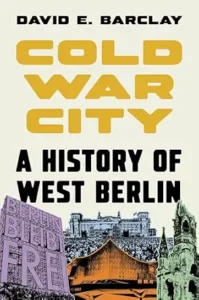
 Cold War City: A History of West Berlin
By David E. Barclay.
Princeton University Press, 2026.
Hardcover, 680 pages, $39.95.
Reviewed by Nadya Williams.
It is perhaps fitting that after spending the first decade of my life in the Soviet Union, I first learned about the Cold War as a high-schooler in America. Fish, the cliché goes, don’t think about the water in which they swim, although I think this was even more complicated for the fish swimming in the Soviet fishtank. Soviet news dissemination was carefully curated by official channels. Although also at fault is likely the reality that I was in second grade—hence I was not paying close attention to events abroad. The same fall that the Berlin Wall fell and Velvet Revolutions swept across Eastern Europe, all I remember is my induction into Oktyabryata, the “Children of October,” an organization commemorating a much earlier revolution. Induction for all elementary schoolers was mandatory, as was the wearing of the little pin with Lenin’s face in the middle on my school uniform. Up until the last moment of collapse in 1991, Soviet schoolchildren continued faithfully sporting these pins. I wonder what everyone did with them thereafter. I imagine a room somewhere in the creases of folding time and space, where millions of pins with the smiling genial image of Lenin all went.
And yet, even as Soviet schoolchildren and probably many adults were unaware at first, the end of the Cold War was unfolding from 1989, when the Berlin Wall fell, to 1994, when the final contingent of Allied troops was withdrawn from West Berlin. Maybe in Russia the fish didn’t yet see the changes in the water in 1989. In Germany, though, they did.
Berlin as a city exemplified the Cold War in the strangest way of all, arguably. Located over a hundred miles beyond the Iron Curtain, the unified city was split in 1961 into two separate cities. A thick wall separated West Berlin from East Berlin in an arrangement reminiscent of duplexes, where one house is really two—except the wall in this case didn’t just simply go down the middle. It went all the way around West Berlin, creating an island city unlike any other, and separating it not only from Eastern Berlin but also from West Germany, to which West Berlin belonged. With the removal of the Wall in 1994, the city once again was reunited.
And yet, fifty years (if we include the immediate post-war turmoil that roiled the city and led to the construction of the Wall to begin with) is a long time. How did this fifty-year period and 33-year separation shape West Berlin into a city? How did the identity of this city evolve over time from simply being the Allied stronghold in Communist territories into a flourishing city in its own right? And what were the limitations that this identity imposed on the city’s day-to-day existence and its local culture? These are the questions that drive historian David E. Barclay in his new book, Cold War City: A History of West Berlin.
While German histories of West Berlin exist, Barclay’s is the first such book in English. Proceeding chronologically, the book begins with the end of WWII in 1945 and ends in 1994. Barclay emphasizes the distinctives of his approach: his book “makes use of a wide range of archival materials in Germany, the United States, and the United Kingdom. It starts with one fundamental but historically rather obvious premise: that the Cold War city called West Berlin was a distinct entity, certainly not part of East Germany (of course), but also not really part of West Germany either.”
Barclay writes as both an insider and outsider. While he is not German, since 1972 he has spent many years studying and living in West Berlin. He met his wife in West Berlin—another outsider who was living there for a time—and they got married in the city. Thus he spent the final two decades of the Cold War observing this city first-hand as a resident and researcher alike, so he feels well equipped to make the claim that “West Berlin was a place like no other during the Cold War.”
The story begins in the bombed out, cold, and starving Berlin of 1945—a city devastated by WWII and struggling to rebuild itself, much like the rest of Germany. Electricity and other utilities are a concern, and minor diplomatic tensions are ever present, threatening to explode. And then the Americans arrived. “The Berlin Hilton was completed in 1958, a year that also marked the beginning of a second Berlin crisis that would lead to the construction of the Berlin Wall in 1961.” So much for fancy hotel diplomacy.
And yet, the Hilton’s construction fits right into the avant garde culture of West Berlin, already before the wall. A free-spirited city, it was a place to seek freedom for the staggering 3.5 million people from East Germany who crossed the border between 1945 and August, 13, 1961—“Barbed Wire Sunday,” on which the border prefiguring a solid wall at last went up. And even then, some desperately tried to escape to the West from buildings right by the boundary, whether by dramatically rappelling out of windows or jumping down onto mattresses placed below. As we imagine the solid wall that subsequently existed until 1989, we don’t think of the ordinary houses in front of which this wall was constructed. One could overnight find oneself living in East Berlin while seeing the free West Berlin directly outside one’s window—until some windows and doorways were bricked up. The Reconciliation Church on the border with the Wall was likewise walled shut, a fitting symbol of the denial of freedom—including freedom of religion. The division of the city also left many families permanently separated from relatives.
But the free West Berlin had its own problems in the years following the wall’s construction. Fear of nuclear confrontation ever loomed—and just because it never materialized does not mean that it did not shape daily lives of ordinary people living on either side of the Wall. And then there were the more ordinary problems of life in a modern city. Rampant drug use and prostitution—especially among the drug addicted, some of them underaged—scandalously plagued some neighborhoods in the city, especially the area around the Berlin Zoo. And the Berlin Philharmonic Orchestra, a world-renowned institution under the direction of Herbert von Karajan in the 1980s, had its own share of scandals, the latter involving political tensions over musical appointments. Even the arts, the stories Barclay narrates remind us, are political in pressure cookers like West Berlin in its final decade.
And then, on the evening of November, 9, 1989, it was all over in very anti-climactic fashion. An announcement came in a confusing (to many at the time) press conference from East Berlin that the border was now open. “That was how the Cold War ended, for West Berlin and East Berlin alike. The Wall had opened accidentally.” This strange conclusion to the long separation left many questions that were not answered satisfactorily for those who had lived through these events. “Perhaps the old West Berlin might most appropriately be described as a place of catastrophes that did not occur,” Barclay muses in his Epilogue, “of terrifying events that did not take place, of a nuclear calamity that did not happen.” Yes, the wall left many tragedies and traumas in its wake, but things could have been much, much worse—for Berliners and, of course, the rest of the world. Now all that’s left is souvenirs, pieces of the wall available to purchase on eBay by all and sundry.
I only know about this last phenomenon because a couple of years ago my American-born son, then just 9 years old, used his hard-earned chores money to purchase a piece of the Berlin Wall on eBay (with his dad’s help, of course). A week later it arrived, wrapped in multiple layers of bubble wrap, precious artifact that it is. A certificate of authenticity was enclosed to assure us that this really was chipped from the Wall; no simple graffitied rock this. This trading in wall fragments seems almost too simple, too banal 37 years later.
And yet, if this is how memory is preserved, maybe that is for the best. Barclay agrees. West Berlin is less remembered than he would like it to be precisely because of what never happened—the fears of nuclear confrontation that created the city to begin with never materialized. Still, this in itself is worth remembering, he contends: “In the end, perhaps, West Berlin’s most lasting legacy is as a monument to a very important road not taken, a road that would have been calamitous for all humanity.”
Nadya Williams is interim director of the MFA in Creative Writing at Ashland University. She is books editor at Mere Orthodoxy and the author of Cultural Christians in the Early Church (Zondervan Academic, 2023), Mothers, Children, and the Body Politic (IVP Academic, 2024), and Christians Reading Classics (Zondervan Academic, November 2025).
Support the University Bookman
The Bookman is provided free of charge and without ads to all readers. Would you please consider supporting the work of the Bookman with a gift of $5? Contributions of any amount are needed and appreciated!

