
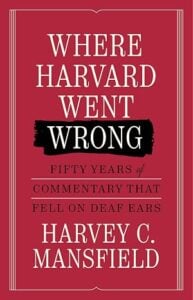
 Where Harvard Went Wrong: Fifty Years of Commentary That Fell on Deaf Ears
By Harvey C. Mansfield.
Encounter Books, 2026.
Hardcover, 152 pages, $24.99.
Reviewed by Adam Kissel.
Like Harvey “C-minus” Mansfield, I attended a college in the Boston area. Mansfield evidently received a great education in the 1950s. Mine in the 1990s was decent despite oppressive political correctness, rampant grade inflation, and affirmative action. In 2025, Harvard gave out A’s like candy and hired drag queen LaWhore Vagistan to teach “Queer Ethnography.” Mansfield saw it coming and shows us Where Harvard Went Wrong.
This volume collects sixteen of Mansfield’s award acceptance speeches and short pieces, several of them solicited by The Harvard Crimson in 2025, together with 35 pages of accounts of his “speeches” in faculty meetings over 1975–2006. Mansfield’s central and most important complaint about Harvard (literally at the center of the volume) is that its faculty has failed to design or even to articulate the general education that might characterize the educated man. A college should at least be able to explain itself. A great college would use high standards to define merit. It would admit students accordingly and grade them accordingly.
Instead, Harvard has an elective system and a distribution requirement that substitutes for a true core curriculum. To excuse this lack of coherence, Harvard merely posits that an educated person is one who has had glimpses of how scholars operate in multiple disciplines.
Since Harvard has traditionally led the nation, Harvard’s abdication has given most other colleges an excuse to use distribution requirements, too. This is why a book about Harvard has national resonance. Racial preferences, faculty activism, and grade inflation have been nationwide ills.
For the elective system, historians credit (I blame) the influence of Ralph Waldo Emerson. “As the human body can be nourished on any food, though it were boiled grass and the broth of shoes,” Emerson observed in his “American Scholar” speech in 1837, “so the human mind can be fed by any knowledge.” Mr. Vagistan’s students, therefore, can glean wisdom from RuPaul’s Drag Race!
Mansfield’s related, second major complaint about Harvard is that it long ago sacrificed merit for multiculturalism. Mansfield’s faculty speeches since the mid-1970s explain how. Sacrificing merit is easy when a college’s faculty is embarrassed by its own elitism and prefers social change. As a result, Mansfield wrote in 2017, “Affirmative action and grade inflation in the universities came on the scene together.” Grade inflation could hide Harvard’s weakening of academic merit in admissions. It also suits students’ Harvard-sized ambitions and coddles their self-esteem.
We know that Mansfield’s faculty colleagues were listening to his speeches. The record shows that they laughed at his jokes. But when he turned to substance, they grew deaf. Year after year, meeting after meeting, he would ask: Is there one other with the courage to join me in decrying what Harvard is becoming? Each speech ends in silence—a pusillanimous or embarrassed silence for some, perhaps, and probably a supercilious silence for most.
Mansfield’s preface argues that Harvard has now forgotten how to distinguish the academic from the political. Harvard’s conflation of the two “was beautifully stated by the unfortunate Claudine Gay,” its most recently canceled president, in 2023. “The Ivory Tower view of the university, she said, was for the past; now Harvard was to consider itself a ‘part of society.’” Mansfield responds correctly that “to renounce the Ivory Tower is to surrender the independence of the university.”
When you push against society, don’t be surprised when it pushes back. The result for public universities has been legislation that holds them accountable and limits their curricula to what hoi polloi’s representatives think best. The results for Harvard and its sister Ivies go beyond public shame to all the ways that the biggest representative of them all, Donald Trump, is punishing them. In a Crimson op-ed, Mansfield observes that Harvard’s “gratuitous partisan posture, practiced for decades,” is now limiting the independence that Harvard once deserved.
Mansfield frequently warned Harvard’s faculty of such dangers. In 1992, he quoted president Derek Bok on point:
Universities can hardly claim the right to be free from external pressure if they insist on launching campaigns to force outside organizations to behave as their students and faculties think best. … Student activists often argue that this danger is only hypothetical and that the university should ignore the risk until retaliation actually occurs. By that time, however, it may be too late.
In another Crimson op-ed, Mansfield argues for the Ivory Tower metaphor. “It represents a university that is in society but towers above because it seeks truth beyond what society takes for granted.” Higher education is up high. To play out the Platonic valences: The philosophers look to the heavens as they walk up, see what can only be seen from the heights, then look down. Those at ground level or below don’t want the learned to mix too much with them.
The philosophers who return, like Socrates, appear to corrupt the youth by challenging common sense, asking questions that may undermine the traditional beliefs of the people, and teaching the youth to do the same. Meanwhile, the sophists corrupt the youth by actually corrupting them. Or, as recorded in Mansfield’s 1994 speech before the Harvard faculty, “It was Professor Mansfield’s belief that the faculty had lost its way and descended to a much lower level than where it had been.”
Higher education is inherently apart from society and therefore at risk, activist or not. In a book review, Mansfield writes, “Devotion to truth is what makes universities at heart independent of society’s desires” (1990). “Deans and presidents cannot afford to show how well they argue, not because they are incapable, but because they cannot afford to annoy those whom they might excel” (id.). “One must be careful about announcing the need for an elite” (2017).
The risk increases drastically when faculty members become activists and insist, for instance, that men can become women through self-expression. Eventually, the everyman figures out who is a real philosopher trying to help and who is a Vagistani sophist, but not necessarily before the people have toppled the tower in disgust.
Mansfield’s policy recommendation for Harvard is affirmative action for conservative faculty members. While overt viewpoint discrimination won’t work at a public university, a private university that needs to reform itself should take the idea seriously. Racial discrimination provides a good analogy: limited, targeted redress is allowed and sometimes even demanded by the federal government due to recent invidious discrimination. That’s exactly parallel to how Harvard has treated conservatism and how Harvard should atone.
Substantively, Mansfield argues that for Harvard to realize its newfound principle of institutional neutrality, it must first understand where neutrality lies. In its current progressive monoculture inside the New England bubble, the faculty generally presumes that the neutral middle lies somewhere near Bernie Sanders. In contrast, only by hiring and listening to a substantial number of conservative faculty members in many disciplines will Harvard’s faculty have a chance of reaching neutrality. “To achieve nonpartisanship,” Mansfield writes, Harvard “must first become bipartisan.”
The stock of Puritan intolerance has not died but has merely changed its dogma. Somehow, though, Harvey Mansfield was never canceled at Harvard, not even when he exposed the university’s biases or tore apart its feminism. It appears that he was neither loved nor feared among the faculty—conservatives on campus were never a threat worth worrying about. Mansfield’s scholarship and teaching are subjects for other books.
Why did he stay? In Mansfield’s telling, he has always loved his alma mater a bit more than she deserved. Anyway, where would he go? Socrates reminds his friend Crito that throughout their decades together in Athens, he stayed. He agreed to be bound by the city’s rules. Going rogue at this late date, even to save his life, would be a betrayal on many levels—of the city, of his friend, of his children, of himself, of justice. And since the next place would just play out the same way, Socrates may as well have stayed in the city most reputed for its wisdom and strength (per the Apology) and tried to improve it.
Thus also Mansfield at Harvard.
Adam Kissel is a faculty member at Trinity College (Hartford), a visiting fellow for higher education reform at The Heritage Foundation, and a board member of the National Association of Scholars.
Support the University Bookman
The Bookman is provided free of charge and without ads to all readers. Would you please consider supporting the work of the Bookman with a gift of $5? Contributions of any amount are needed and appreciated!

