
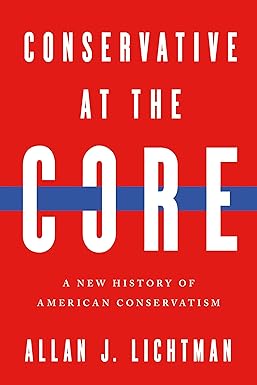
 Conservative at the Core: A New History of American Conservatism
By Allan J. Lichtman.
University of Notre Dame Press, 2025.
Hardcover, 376 pages, $32.
Reviewed by Michael Lucchese.
For a decade now, the American Left has utterly failed to understand the forces behind the rise of right-wing populism. Its political leaders have doubled down on the extremist tendencies that made them unpopular in the first place. And among left-wing writers and activists, attempts to give conservatives a fair shake could lead to the terrible auto-da-fé of cancellation. For the most part, then, accounts of conservatism from the Left are profoundly unimaginative—and frankly boring.
The most recent entry in the genre is Allan Lichtman’s new book, Conservative at the Core, published by the University of Notre Dame Press. The American University history professor is perhaps most infamous for his “Keys to the White House”—a set of thirteen criteria he claims can accurately predict the outcome of every presidential election. In 2024, though, Lichtman’s formula failed him in spectacular fashion; he prophesied a victory for Kamala Harris. The “keys” he offered as serious analysis turned out to be no better than the perpetually unfulfilled millenarian forecasts of the Rapture. Facing public ridicule, Lichtman chose to accuse voters of behaving “irrationally” and giving into the “darkest impulses in American life.”
Conservative at the Core is his attempt to explain those “dark impulses” he believes fueled Trump’s rise by assessing American conservatism. It is not a convincing effort.
Throughout the book, Lichtman poses as an objective historian—even avowing that his “sole objective is to understand conservatism on its own terms by deconstructing conventional myths and revealing the true essence of what the U.S. conservative movement truly represents.” Rather than presenting a narrative rooted in honest historianship, though, Lichtman writes as an inveterate partisan. He understands conservatives as the Left understands them, never as they understand themselves.
At the outset of the book, Lichtman writes that the “true essence” of American conservatism is “two hard core principles”: private enterprise and traditional Christian values. Fair enough—those principles have always been near and dear to the postwar conservative movement. But Lichtman never explores these ideas as ideas. Rather, he treats them as mere pretexts for the accumulation of power. Conservatives, in his account, are simply the agents of oppression, reaction, and raw self-interest who are plotting to undermine the republic itself. “Since the 1930s, conservatives have not sought to maintain stability, which would have meant acquiescing in the liberal state,” he writes towards the end of the book. “Instead, they have pursued the revolutionary objective of overturning the liberal order and challenging our pluralist civilization.”
Never once does Lichtman pause to seriously consider why conservatives have historically opposed the triumph of the liberal state. Over recent decades, a number of far more serious scholars have developed a serious body of literature about the movement’s intellectual and political culture—from George Nash in The Conservative Intellectual Movement in America Since 1945 or Matthew Continetti in The Right: The Hundred-Year War for American Conservatism, to the late Lee Edwards in his incredible body of work. And that’s not even to mention countless biographies and studies of specific conservative figures. And yet these works appear nowhere in Lichtman’s footnotes. No, as his subtitle arrogantly proclaims, his goal is to provide “a new history of American conservatism.” Armed with an ideological formula, Lichtman has no need to consult scholars who may disagree with him—or even provide more complicated accounts of the past.
Given this utter lack of engagement with actual scholarship on conservatism, it is impossible to take Conservative at the Core seriously as a work of history. Although Lichtman asserts that he strove for a historian’s objectivity when writing, there is no evidence of this in the book itself. How can he claim it is objective about his subject, for example, when he provides a seven-page attempt at a theological refutation of conservatism? Lichtman did not honestly set out to test a thesis through an investigation of primary sources. He writes not as a historian seeking to make sense of the past, but as a partisan wanting to embarrass and ultimately vanquish conservatism from American life.
Even more offensively for the reader, Lichtman does not even attempt to write in the literary tradition of history as a genre. There is no narrative in the book; it is little more than cherry-picked quotations from a cast of villainous demagogues he drafts to paint conservatism as a wicked ideology. Take, for instance, his constant references to the segregationist George Wallace. If he were a serious historian, perhaps Lichtman would have examined William F. Buckley, Jr.’s staunch opposition to Wallace’s politics of racial grievance in some detail—and yet he does nothing of the sort. Much the same could be said of Lichtman’s uncritical references to right-wing demagogue Joe McCarthy. Some conservatives certainly supported his conspiratorial crusade, but others—including eminent figures such as Russell Kirk and Whittaker Chambers—warned that there was nothing conservative about his populism.
Another egregious example of this lack of historical curiosity comes when Lichtman tries to write about conservatives’ position on foreign policy. He asserts that conservatives’ chief goal is the preservation of “national sovereignty” for the sake of the aforementioned “core values,” and lumps in conservative internationalists such as George W. Bush and Ronald Reagan with right-wing isolationists like Charles Lindbergh. The debates between these camps have, as some of the aforementioned historians demonstrate, constituted a profound tension within the conservative movement. Serious studies of them have much to teach us not only about pressing policy questions in Washington today, but also the greater meaning of America and its place in the world. And yet Lichtman’s terribly simplifying schema does not allow him to take those debates seriously at all.
The worst instance of Lichtman’s unprofessional disregard for conservative history comes in one of the closing chapters, “Donald Trump and Conservatism.” He sets out from the beginning of the book to prove that Trump’s populist revolution is a culmination of the conservative tendency in American politics, “not an anomaly but the logical heir to the modern conservative movement.” The chapter merely repeats his claims to that effect throughout the book. To be sure, many conservatives have supported Trump since he won the Republican Party’s presidential nomination in 2016, but others have opposed him for his departures from historical and otherwise traditional conservative principles. Lichtman himself cites a number of prominent conservative writers, including George Will, who argue Trump has abandoned conservatism—only to immediately dismiss them and descend into name-calling and calumny.
The condescending attitude—even animus—behind this book is, in fact, among the reasons Trump came to power in the first place. Voters, clearly sick of being sneered at by elites like Lichtman and his colleagues in the established commentariat, have turned to populism as an outlet for their frustrations. Yet these liberal aristocrats, safely ensconced in the commanding heights of culture, politics, and academia, have largely just doubled-down on bad-faith accusations of bigotry and backwardness. For them, politics is not about deliberation among people with different opinions about the future, but rather a merciless competition between the apostles of progress and a mob of reactionaries.
History, properly understood, is a discipline of moral imagination. By attempting to understand the people of the past as they understood themselves, the earnest historian’s craft ought to be marked by a profound sense of empathy. Works in this spirit could go a long way to helping the public understand the discontents fueling the populism of this present age—and they could help genuine opponents of demagoguery imagine ways to respond more productively. Unfortunately, Allan Lichtman’s Conservative to the Core does no such thing.
Michael Lucchese is the founder of Pipe Creek Consulting, an associate editor of Law & Liberty, and a contributing editor to Providence.
Support the University Bookman
The Bookman is provided free of charge and without ads to all readers. Would you please consider supporting the work of the Bookman with a gift of $5? Contributions of any amount are needed and appreciated!
