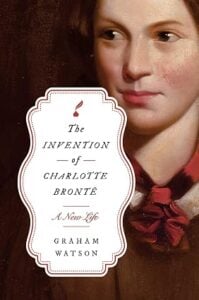
 The Invention of Charlotte Brontë: A New Life
By Graham Watson.
Pegasus, 2025.
Hardcover, 288 pages, $29.95.
Reviewed by Paul Krause.
Today, everyone knows Charlotte Brontë as the author of Jane Eyre. That wasn’t always the case. During her own lifetime, she had written under the pseudonym Currer Bell. It wasn’t until the end of her life that she was revealed to be the writer of one of the most famous Victorian Gothic novels of all time. But how did Charlotte Brontë become Charlotte Brontë, the now famous author we all know? That’s the story that Graham Watson tells in a riveting new biography, The Invention of Charlotte Brontë.
When Jane Eyre was first published to notoriety and intense criticism, England’s literary establishment debated who Currer Bell truly was. Elizabeth Gaskell, who wrote the definitive nineteenth century biography of Charlotte, was ecstatic to learn that the author of Jane Eyre was a female. But in the late 1840s and into the 1850s, the sex and known authorship of the work was in doubt. We who read and love the writings of Charlotte Brontë can be very far removed from the world she inhabited, both as a human and as an author.
It was not uncommon for female authors to hide behind male pseudonyms. Charlotte’s own sister, Emily, did the same when she published Wuthering Heights. So too did Mary Ann Evans as George Eliot. In fact, whereas Charlotte Brontë is now the name that adorns her works, rather than Currer Bell, Evans’s great novel—Middlemarch—is often still printed with George Eliot named as the author. The ostentatiously male literary establishment that dominated England’s literary world often had a hard time accepting the riveting stories that scandalized Victorian society could possibly have been written by women.
Graham Watson’s biography of Charlotte is a judiciously researched and well-written overview of the final years of Charlotte’s life. It reconstructs the final decade, really the last five years, of her life. Not only will readers find great, new insights into what influenced her writing, readers will learn just how central Charlotte was to the literary establishment that both praised and scorned her.
To start, other famous writers like William Thackery knew Charlotte and were relatively close to her. Likewise, a young Matthew Arnold was more than a passing contemporary and acquaintance with Charlotte; they both personally knew each other and, much to Charlotte’s dismay, he had an unfavorable view of her and her works. Nevertheless, Charlotte was not a recluse entirely aloof from Britain’s literary establishment. The fact that her work was written about in all the prominent magazines and journals, despite the frequent criticism of her novels, should have foreshadowed their future prominence.
Hardship, grief, and the desire to love and be loved characterize Charlotte’s great works, especially Jane Eyre and Villette. While Charlotte’s “grief was obliterative,” it is the grief and hardship of her life—manifested in her great heroines—that captivates contemporary readers and captivated critical reviewers during her time. Not only was Charlotte writing to express the grief and struggle of an entire sex that was often overlooked even just two centuries ago, she was writing to “confront the world that overlooked her sisters.” In detailing the final five years of hardship, struggle, and grief that Charlotte lived through, Watson helps us to better understand Jane and Lucy Snowe. While Charlotte may have been defensive over the overtly critical receptions of her female heroines, the ability to empathize with them is her greatest accomplishment.
Elizabeth Gaskell, one of the first to learn that Currer Bell was Charlotte Brontë, became a close confidant and friend to Charlotte as the world was still convinced that she was a he, and that no woman could have ever written the powerful works that she is now fondly remembered for. Elizabeth, who grew to become close friends with Charlotte—chatting on topics from politics to literature—would resolve, after Charlotte’s death, to attack all those she deemed responsible for the death of the final Brontë sister.
Watson’s book, therefore, is really a biography in two parts. First is the story of the final five years of Charlotte’s life which is meticulously recounted and made alive by his pacing and prose. It is gripping and hard to put down. Then, following Charlotte’s death, the book pivots to how Elizabeth “invented” Charlotte in the famous scandal that rocked the Victorian world. From the dead to the living, reputations and memories were now at stake when Elizabeth, “exhausted” from her work of writing Charlotte’s biography, finally felt some ease that “everyone who had wilfully wronged Charlotte” would be brought to “public shame.”
There is a third aspect of Watson’s work, in detailing the old but now new familiar story of who’s to blame for Charlotte’s mistreatment, that deserves our attention.
Elizabeth, though she too suffered from the attacks of Britain’s literary and social establishment, meant to write a biography that was empathetic to her friend she felt was so cruelly and wrongfully abused and condemned during her lifetime. Elizabeth Gaskell was truly channeling the best of Charlotte’s storytelling mission: empathy, especially empathy for a marginalized individual.
The two novels and two characters that factor prominently in Watson’s biography are Jane Eyre and Lucy Snowe. In many ways, readers can see Charlotte’s own life in these characters. The spirit of empathy, however, has now triumphed over our reading imagination when we encounter both in their stories. They are raw, human, passionate, and very real—just as their author was. Watson’s reconstruction of the final years of Charlotte’s life and the scandal of Elizabeth Gaskell’s biography that made Charlotte famous (and infamous) after her death is moved by the most important spirit in all literature: empathy.
Readers and lovers of Charlotte Brontë and her works will find in Graham Watson’s new biography a fresh, riveting, and page-turning read that makes us all the richer and all the more empathetic for having read it. Not only are we treated to an in-depth analysis and reconstruction of Charlotte’s final years, we gain insights into how to approach her famous characters and their stories. Furthermore, we get to relive the scandal of Elizabeth Gaskell’s biography which catapulted Charlotte into even greater fame and notoriety after her death. In reliving that scandal, we are also made all the richer and kinder in learning the love that Elizabeth really did have for Charlotte, which led her to castigate a world that was cruel to her friend during her brief life.
Empathy and compassion amidst a cruel and admonishing world. That’s the world of Jane Eyre. That’s the world of Villette. That’s the world Charlotte knew and lived in. That’s the world we often experience in the twenty-first century. Let us follow Charlotte’s advice found at the end of Jane Eyre. Forgiveness. Forgiveness is the greatest expression of empathy and compassion in our world. These are the permanent virtues that have made Charlotte’s stories, and her story, enduring.
Paul Krause is the editor-in-chief of VoegelinView and the author of, most recently, Sir Biscuit Butterworth and Other Short Stories, Poems, and Fables (2026), The Incredible Adventure of Passer the Sparrow (2025), and Dante’s Footsteps: Poems and Reflections on Poetry (2025).
Support the University Bookman
The Bookman is provided free of charge and without ads to all readers. Would you please consider supporting the work of the Bookman with a gift of $5? Contributions of any amount are needed and appreciated!
