
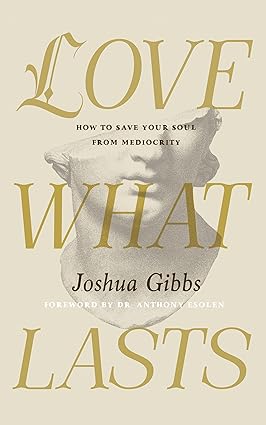
 Love What Lasts: How to Save Your Soul From Mediocrity
By Joshua Gibbs.
Circe Institute, 2024.
Hardcover, 272 pages, $28.99
Reviewed by Sarah Reardon.
A significant part of Russell Kirk’s legacy is that he reminded moderns to seek and cherish the “permanent things” over and above the passing things. For Kirk, the “permanent things” referred to “those elements in the human condition that give us our nature, without which we are as the beasts that perish. They work upon us all in the sense that both they and we are bound up in that continuity of belief and institution called the great mysterious incorporation of the human race.” To love the permanent things, then, is an important part of what it means to be human.
Yet the age of the internet makes a mockery of the permanent things. While virtually everything on the internet is permanent in that it can be dug up and accessed at any time, virtually everything on the internet is also fleeting in its content. The seeming infinitude of internet content renders it transient: just one more funny video, just one more brightly-colored photo from family vacation, just one more horror story on the news, just one more passionately-written think piece.
The wide dissemination of screen-based media in our day makes such ephemerality ubiquitous, and it makes that which is permanent seem even more rare and difficult to reach. This rarity of permanence is precisely what Joshua Gibbs addresses in his recent book Love What Lasts: How To Save Your Soul From Mediocrity.
The book is composed of thirteen chapters on subjects such as freedom, heirlooms, and beauty, their meanings and their relation to the mission of loving what lasts. Gibbs traverses the terrain of modern thought about art, tradition, and other “old things” as he considers what is required to be the sort of person who cherishes the permanent things.
Gibbs considers three categories of cultural artifacts in the book: common, uncommon, and mediocre things. Common and uncommon are rather easy to define: common things are the bread and butter of culture, while uncommon things are more like a meal of steak and red wine. Gibbs refers to Bruce Springsteen’s Nebraska as an example of a common album, as it does not deal with grandeur but with the human experience of everyday life. It is the sort of thing that one could listen to on a commute to work, the sort of thing that, while worth returning to, will not be widely loved longer than the span of a lifetime. Many movies, books, artwork, and experiences fall into this category: a cup of coffee, a J. Crew sweater, the sort of flower painting that one might hang in one’s bathroom. To my own mind come novels like those of Agatha Christie—good, simple stories worth spending time on, but that will not change the shape of a soul or last (on a large scale) for much longer than a hundred years.
Uncommon things are the jewels of our existence. Gibbs gives them the adjective “divine,” for they have persisted beyond that which is standard for humanity. Gibbs gives examples such as Dante’s Inferno, Paradise Lost, and the work of Rembrandt and Bach. Uncommon things are like heirlooms, which grow in value as they are passed to new generations. They are those things that last beyond the span of a lifetime, yet they do not merely last, for they are also honored. Truly uncommon things are loved and studied and revered a hundred years after their creator’s death. h
Common and uncommon things both have their proper place in life, with common things having much more frequency, but uncommon things much more honor. That which is mediocre has no proper place, for it is a perversion of the beautiful. The mediocre thing is “spectacular, highly sensual, fashionable, and easily disposable.” It is a “blockbuster” thing—whether a “blockbuster” movie or an enthralling romance book that tops the bestseller list for a few weeks and is forgotten in a few years. If common things are bread and butter and uncommon things steak and wine, then mediocre things, in Gibbs’s taxonomy, are like Taco Bell chalupas.
Gibbs acknowledges that “mediocre” seems a strange choice of word, as mediocre often suggests what is plain and boring. Still, he defends his usage by saying that mediocre things “are actually dull when they are released, but that this dullness is masked by their novelty and our own desire to be fashionable, current, and up-to-date.” Elsewhere, he uses the words “shallow” and “ephemeral” to describe such mediocrity. That which is mediocre offers a sort of sensual, short-lived pleasure that “tends to corrupt our ability to enjoy the uncommon.” He lists Drake’s music, Michael Bay’s movies, and E.L. James’s books as examples.
Much of Gibbs’s book is spent diagnosing the spiritual disease that comes from a culture dominated by mediocrity, awash in ephemerality, and subdued by the tyranny of the fashionable. He traces, too, the historical changes that banished uncommon things (and even some common things) to the province of the “backwards” and brought mediocrity to the fore: namely, the upheaval that followed the French Revolution. Gibbs’s historical considerations reveal both his Burkean conservatism and his long experience teaching the humanities. He praises the virtues of monarchy and aristocracy and argues that the Enlightenment and the French Revolution marked a decisive break in how societies view art, the self, and tradition.
Gibbs writes, “[S]ince the French Revolution, the relationship between art and the human soul has been trivialized by the idea that art is primarily about self-expression rather than communion with God, the cultivation of virtue, or the redemption of ugliness.” He later writes that even those self-professed conservatives who “scoff at relativistic philosophy” have adopted the “progressive belief which ultimately gives birth to all the rest, which is that art is fundamentally an act of self-expression” instead of the belief of those before the French Revolution, which was that art had to do with beauty, and beauty had to do with the divine.
How can we get back to such a view? Well, put short, love what lasts. Embrace the goodness of common things, marvel at what is truly marvelous, and reject the ideas that we need to consume that which is cheap and trashy in our culture for the sake of “cultural engagement” or “worldview analysis.” Listening to the latest Taylor Swift album probably won’t make us “a better witness to the culture,” and analyzing it won’t tell us much we don’t already know about our culture’s dominating worldviews. Instead, Gibbs would say that Taylor Swift will weaken our ability to appreciate truly good music. Gibbs writes that every moment spent on the mediocre shapes us away from the uncommon:
Of course, very beautiful things become even harder to like the more we give ourselves over to the spectacular, sexy, shocking, ultra-sensual, fashionable art and ethics of modernity. So far as acquiring good taste is concerned, balance is a myth. Every blockbuster film a man watches makes the task of reading Paradise Lost and Jane Eyre seem more dull and more pointless. Every Top Forty song he listens to makes Mozart and Bach more incomprehensible. In refusing to bear witness to the real length and breadth and depth of the human experience and insisting that life is nothing other than sex, violence, blasphemy, capital, revolution, and thrill, mediocre art not only hinders our ability to understand other people, it demands that we interpret our own lives through a laughably narrow range of emotions which are largely defined and curated by the unmarried, agnostic, pro-choice twenty somethings who now run our culture.
(Gibbs’s book is rife with zingers like the above-mentioned of “pro-choice twenty somethings”).
Sometimes an encounter with the thrilling, sensual, and trashy actually whets one’s appetite for the uncommon instead of weakening it, but I think that speaks to the possibility of a person’s taste already being shaped toward the good and away from the trashy by his or her habits. I believe that what Gibbs says accords with my own experience, and probably yours too: the more social media I consume, the more I find it difficult to devote my undivided attention to something like reading or writing. The more feminist or individualist philosophy I become unwittingly accustomed to, the more I find certain passages of the Bible “difficult.” The more Doritos I snack on or artificially-dyed frappuccinos I drink, the more I find reaching for an apple in the mid-afternoon impossible.
However, some mediocre things are not mere junk food like Doritos, as Gibbs clarifies near the end of his book. Some mediocre cultural artifacts are, instead, poison, particularly for children. Gibbs places social media in this category. Instead of imagining social media consumption as something heavy to be balanced on the scales of life by consuming good things, we should imagine social media as “the heavy rock by which the scales are smashed.” Acclimation to social media, he argues, will render good things incoherent, just as “if a man pours bleach into his eyes, he cannot balance the effects of the bleach later by contemplating icons of Christ because he will not be able to see those icons.”
Gibbs suggests not only that we refrain from the mediocre and seek after the uncommon, but also that we seek churches and authority structures that help us to do so. His distaste for flashy, nondenominational churches is evident throughout the book, as he sees them as outworkings of the same desires and ideas that lead to mediocre things. Gibbs advises that we should submit to our churches’ interpretations of the past and the aesthetics that flow from the church traditions we are a part of.
Throughout the book, Gibbs pleads with his readers that we not only think of the soul in terms of salvation but also in terms of health. Good taste won’t save one’s soul. But it will nourish the soul and incline the soul towards virtue much more than the bad taste we will acquire from mediocre things. As Gibbs writes on the final page of his book, “Common art prepares us for uncommon art, and uncommon art prepares us for the halcyon joys of Glory. God has gifted a few great artists with the power to acclimatize us to heaven. We must use their help to begin acquiring the taste for Glory now.”
Sarah Reardon lives in Maryland with her family. Her writing has been published in outlets such as First Things, National Review, and Plough. Her first collection of poetry, Home Songs, was published by Wipf and Stock in 2025.
Support the University Bookman
The Bookman is provided free of charge and without ads to all readers. Would you please consider supporting the work of the Bookman with a gift of $5? Contributions of any amount are needed and appreciated!
