
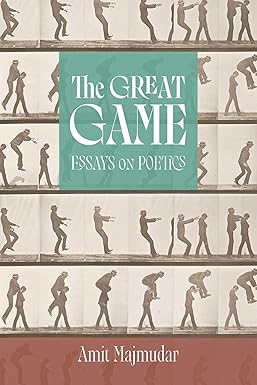
 The Great Game: Essays on Poetics
By Amit Majmudar.
Acre Books, 2024.
Paperback, 288 pages, $18.
Reviewed by Steven Knepper.
Literature, Amit Majmudar warns, must never plod: “Plodding prose, plodding thought, rhythmless lifeless stuff you can’t step to: that’s plod, and it’s what poets strive, instinctively, to avoid.” Still in his forties, Majmudar has already served as Ohio’s first-ever poet laureate and been anthologized in The Norton Introduction to Literature. These are impressive accomplishments for any poet, but especially for one who broke onto the scene as an autodidact, as a true outsider. Majmudar never earned an MFA and only took one introductory poetry course in college. He usually writes, unfashionably, in rhyme and meter. He works in radiology, where “reading” and “scan” mean something quite different than they do in a poetry workshop. (See the essay “The Ten Commandments of Reading” in the collection under review.) Majmudar has succeeded in large part because he never plods.
No one, for instance, takes poetic hairpin turns at speed like Majmudar does. His poems are full of sonic swerves and surprises, thematic twists and dialectical daring. He’s like a Tour de France cyclist who, descending some peak in the Pyrenees, slices through a vertiginous switchback, mere centimeters from a wipeout. Of course, sometimes those expert cyclists crash. Sometimes Majmudar does as well. Occasionally, Majmudar cannot sustain the leveraged lean and hits the road or shoots out over a cliff. But even this is glorious. Watching a risky sport is exciting. So is reading poetry that takes risks.
Critics often trudge worse than the worst open-mic poet. Over the past half-century or so, criticism has crushed literature beneath the plodding tread of obvious “methodologies.” In the 24 essays gathered in The Great Game, however, Majumdar proves to be as lively a reader of literature as he is a writer of it. He remains the risky speedster. Does he ever crash? In the final essay, he claims, “I believe literature is how the brain has brainsex with the brains of strangers.” I think that line leaves some skin on the pavement. But mostly he speeds along, offering lively paragraphs of insight before curving into the next topic. Here’s an example with a much more effective brain metaphor:
Just as the interface where two neurons connect is a synapse, the interface between two books or poems is an allusion. A more complex brain has more synapses; a more complex book, say, Ulysses, has more allusions. But complexity is not necessarily the writer’s only goal. You can make your work too allusive, too hyperlinked to carry out the very simple function of communication, ending up with a complicated tangle of wires and transistors that doesn’t actually perform any function. Joyce’s next novel, Finnegans Wake, is arguably such a book.
This is the confident wisdom of a writer who has thought about what you can reasonably ask of an audience. It is also the confident wisdom of a reader with definite aesthetic judgments.
At times, Majmudar’s prose even ignites into poetry proper, as in a verse essay that compares weight training to writing poetry. Majmudar provides a prose preface:
The heroic couplet has the bipartite structure of a weight-room repetition. The second rhyme sets down what the first rhyme lifts; the tension in the line is the tension in the tendon. This essay on (pumping) iron…has a personal trainer in Alexander Pope, who stood only four feet six inches, wore a canvas back brace for scoliosis, but maxed out at a positively beastly six hundred thirty-four couplets in his “Essay on Man.”
Then in the verse essay proper, we get couplets like these:
My agony is Agni. I’m a rishi
As ancient as my ancestors could wish me,
My sacred mandala the power cage,
And ink—svāhā—an offering to the page.
There is no virtuosity without reps, including poetic reps. (It turns out instinct isn’t enough.) And the reps can become rituals. These sorts of connections between poetry, sport, and religion run throughout The Great Game.
The collection’s first essay riffs on poetry as play, which includes the pure pleasure of rhythmic language. But play also means competition. Majmudar echoes Harold Bloom on poetic competition, though being much lighter on his feet, he is less anxious about influence. Paradoxically, play can be serious. Majmudar gives an early nod to Johan Huizinga’s classic Homo Ludens: A Study of the Play-Element in Culture. Play is closely related to the sacred. The excessive festivity of the game with its “charmed circle” is close kin to worship in ceremony, rite, liturgy. Poets write within charmed circles “of their own chalking.” They, too, deal in the sacred. Majmudar is not only a poet and critic. He is also a religious thinker and a practicing Hindu. He has translated the Mahabharata in three volumes (four if you count Godsong, his standalone translation with commentary of the Bhagavad Gita).
Good form is important in pumping iron, in performing religious rituals, and in writing verse. Majmudar has no quarrel with well-crafted free verse; he writes some of it himself. Yet he relishes a wide variety of traditional forms. While he does not shoot (many) darts at free versers, they have rarely been so gracious toward formalists in recent decades. In many workshops and classrooms, form is seen as a straitjacket, or at least as stuffy, boring, backward-looking. But Majmudar continually reminds us that the links between poetry, rhythm, and sonic richness are as ancient as humankind. Free verse, he tells us, while now practiced around the world, is yet another American cultural export: “It originated with Laforgue and a few others in French, but it quickly emerged in other languages thanks to American global dominance; the whole world ended up following Eliot and Pound.” Majmudar often takes the long view, and from the long view, free verse is a new arrival in a variegated poetic history that stretches back into prehistory. To embrace it alone is to cut oneself off from that sweeping history and from the resources to be found there. There is still vitality in these neglected traditions. They are not a dead past.
Returning to the connections between sport and poetry, both involve rules. Indeed, virtuosity is only possible within a set of rules: the slider that seems gut-aimed until it crooks into the strike zone, the step back behind the line to hit the three, the elaborate trap laid by the chess master. In poetry, a “rulebook” is likewise generative for the skilled poet. Majmudar gives the obligatory nod to Robert Frost’s quip that writing free verse is like playing net-less tennis, but he also notes that “every poet, even the supposedly unruly Beat (often, following Whitman, quite enamored of anaphora), chooses rules of play.” If the broader poetry world were to recognize this, if it were to see that virtuosity comes from deftly navigating a set of rules, “all the conventional twentieth-century critical metaphors of containment, imprisonment, binding, and restriction would have to be scrapped. A new understanding must rely on new metaphors. Form is the engine, the lottery, the kaleidoscope; the void that gives you what you fill it with, the call you teach yourself to echo; the luck maker, the goad, the god.” As his list goes on, Majmudar underscores that formal constraints give rise to inspiration.
In an essay on “Formal Restlessness,” Majmudar notes that there are many productive formal trajectories for a poet. Any number of mid-twentieth-century poets started as formalists and ended writing in free verse. Earlier poets often mastered one form, such as Pope and his couplets. More recent poets such as Agha Shahid Ali, working in the ghazal, and Kay Ryan, working in the ultra-compact lyric, continue to write excellent verse by focusing (mostly) on one preferred form. (Majmudar devotes essays in The Great Game to both the ghazal and to Ryan’s lyrics.) But the main focus of “Formal Restlessness,” as the title suggests, is poets who explore a wide range of forms. Keats is this kind of poet, as is Goethe, as is Majmudar himself. The essay is framed by the scene with Proteus in the Odyssey. Proteus is not formless; he is the god of fluid, ever-shifting forms. Majmudar provocatively suggests that the Greeks didn’t realize it, but Proteus is actually a god of poetry, of “formal fluidity.” While Nietzsche goes unmentioned, Majmudar undoubtedly has in mind The Birth of Tragedy’s famous contrast between the Dionysian (formless fluidity) and the Apollonian (fixed form). These gods do not offer enough poetic finesse, he implies, even if we honor both of them. We instead need a god of protean forms.
Majmudar is at his most ambitious when he explores the connections between religions and poetic forms. (He shares this concern with another great literary polymath, George Steiner, who receives a brief tribute essay in The Great Game.) Majmudar links the Hindu epics’ many meters to their polytheism, Japanese poetry’s “specificity of local description and observation” to its animistic background. Nowhere is Majmudar’s wide-ranging erudition and rich spiritual imagination more apparent than when he pursues such connections. He makes some bold claims, though, and his fast pace risks overgeneralization. I’d contest, for instance, his suggestions that Christian monotheism—St. Francis of Assisi aside—un-souls the world and its creatures until the Renaissance. Sacred wells and green men and stained glass and vaulted naves, beast fables and bestiaries suggest a much stranger and richer medieval Latin Christianity. This is in part due to baptized pagan traditions, yes, but also to a widespread theological vision of the world as theophany.
But I do not want to press this point. Majmudar is far more gracious and informed about Christianity than most Christians are about Hinduism. Consider his beautiful reflection on why Genesis, unlike so many ancient epics of origin, is not written in verse. He connects it to the Fall, concluding “it is as though these passages [of the creation narrative] were rebuilt into sense from the ruins of some crumbled musical edifice.” Whether he is discussing religion, poetry, sport (or science, another major topic of this collection that I have not even discussed), Majmudar plays the “great game” at a very high level. This is a play of the most vital and enlivening kind.
Steven Knepper teaches in the Department of English, Rhetoric, and Humanistic Studies at Virginia Military Institute. He is the author of Wonder Strikes: Approaching Aesthetics and Literature with William Desmond. His essays, poems, and reviews have appeared in a number of journals.
Support the University Bookman
The Bookman is provided free of charge and without ads to all readers. Would you please consider supporting the work of the Bookman with a gift of $5? Contributions of any amount are needed and appreciated!

