
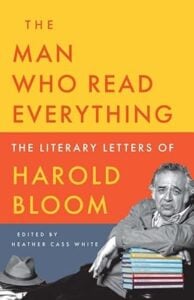
 The Man Who Read Everything: The Literary Letters of Harold Bloom
Edited by Heather Cass White.
Yale University Press, 2026.
Hardcover, 248 pages, $30.
Reviewed by Oliver Spivey.
Harold Bloom (1930-2019), with his preternaturally expansive intellect, stocked with countless poems and passages of prose, and his dramatic (maybe melodramatic) presence, was one of the great literary critics of his time. His public appearances, including his popular interviews with Charlie Rose that started in the 1990s, helped establish him as the leading defender of the Western literary canon against the assaults of what he called the “School of Resentment,” those tenured radicals who had seized control of the nation’s English departments. Bloom usually looked like an embattled critic. He wore a droopy, world-weary expression—suggesting the polymath’s fatigue with having to suffer fools daily—and his clothes and hair seemed forever in a state of partial dishevelment.
But it was perhaps his voice, with its deliberate pronunciation and pacing, that was most memorable. Heather Cass White, editor of The Man Who Read Everything: The Literary Letters of Harold Bloom, tells us that those who “knew Bloom heard a great deal of his voice. He was intensely social, and spending time with him meant listening to floods of talk in his long, intricate, fully realized sentences, whose every subclause eventually, implausibly, landed where it meant to.” His speech, says White, “bristled with quotations, inside jokes, barbs, fretting, boasting, and teasing.” That same civilized voice comes across in the letters. As in Bloom’s criticism, we find those familiar ex cathedra assertions on a work’s aesthetic power and chances for literary survival. Yet there are also intimate notes of self-doubt, modesty, melancholy, and love. These exchanges, between Bloom and his writer friends, reveal the complicated human being behind the titan of criticism.
The “core” of Bloom’s “charisma,” according to White, “was that he took literature seriously.” Literature for Bloom was not just part of a life well lived: it was life itself, snatched from the flux of things and shaped by the artist, a kind of secular transcendence. To his author friends, he often effused about the meaning of their work and the nourishment he received from their vision. In a 1969 letter to A. R. Ammons, Bloom writes of his experience of happening upon a poem to which he had paid scant attention: “I read ‘Bridge’—because the book fell open to it—a poem I hadn’t been open to before—and Arch, it opened to me and found me—immensely beautiful, healing, Archie, as only Wordsworth and Stevens and Ammons can heal. I am very moved, very, very moved.” Bloom’s overwhelming love and longing for Ammons’s work continued to grow throughout the 1970s: “[W]hat your poems do for me is make understandable a body of broodings that can’t make sense to me otherwise—the peculiarity of your genius is to re-imagine, always freshly, what by rights can’t be imagined any more, and what I would find stale without you. You have to keep writing, because readers like myself need you and have no one else since Stevens died. You are what there is.” The Romantic style and tone of these missives are at times redolent of Keats’s letters or Hazlitt’s journal entries.
Such epistolary confessions of love reflect Bloom’s view of reading as an attempt to repel existential loneliness. Bloom explains in his preface to How to Read and Why (2000):
Reading well is one of the great pleasures that solitude can afford you, because it is, at least in my experience, the most healing of pleasures. It returns you to otherness, whether in yourself or in friends, or in those who may become friends. Imaginative literature is otherness, and as such alleviates loneliness. We read not only because we cannot know enough people, but because friendship is so vulnerable, so likely to diminish and disappear, overcome by space, time, imperfect sympathies, and all the sorrows of familial and passional life.
His rationale for deep reading was doubtless born of personal experience. Ammons kept close ties with Bloom for decades, and the latter’s constant remarks on Ammons’s work seem to have been instructive. As the poet admitted to Bloom in 1970, “You have clarified me to myself so that I’m sure I can read now with more intelligence and seeking. And look within myself with more discrimination. And be sustained in times of woe.” But the vulnerabilities and “imperfect sympathies” of friendship still found a way.
Bloom often spoke as if he were rendering the final verdict on matters of interpretation, evaluation, and classification. His insistence on an author’s ranking in his personal pantheon of masters and masterworks—not infrequently based on his theory of the anxiety of influence—surely annoyed and alienated some of his writer friends. Bloom posited a very particular American poetic tradition, into which he inserted Ammons: “The best of it—Emerson, Dickinson, Stevens, [Hart] Crane, and now you . . . is always Transcendental[.]” And Bloom always knew a poet better than a poet knew himself. Hence, he tells Ammons, “you are a poet of the sublime when you are most useful to yourself.” But Ammons had different ambitions for his poetry than Bloom. He wrote in his journal that “Harold wants me to be intense, mad, consistently high. I want to be ordinary, casual, a man of this world.” Nevertheless, Bloom’s placing of Ammons in the Emersonian-Whitmanian lineage is well-founded, even if his infatuation blinds him to Ammons’s flaws, like his tendency toward formlessness, abstraction, and prolixity.
A more obvious rupture occurred between Bloom and his erstwhile idol, the literary critic and theorist Northrop Frye, author of Anatomy of Criticism: Four Essays (1957). Bloom was initially something of a Frye epigone, but he gradually distanced himself from Frye’s tastes and theories. By the late ’60s, the two were beginning to disagree on Bloom’s incipient theory of influence. Frye did not see literary influence as a necessarily agonistic, anxiety-ridden relationship between a writer and his precursor: “If you mean influence in the more literal sense of the transmission of thought and imagery and the like from earlier poet to later one, I should think that this was simply something that happens, and might be a source either of anxiety or of release from it, depending on circumstance and temperament.” Nearly a decade later, Frye would write that Bloom was “increasingly isolating himself from the general critical tradition, and I find his books progressively less rewarding.”
Bloom the theorist was less persuasive than Bloom the practical critic and literary sage. His theory of influence fails to convince for several reasons. For one, it is a totalizing conception of the creative act. As White notes, Bloom purports “to have discovered the fundamental mechanism of literary creation at work in every writer since Shakespeare.” Moreover, the influence one writer wields over another “is always agonistic, never cooperative.” And Bloom gets too engrossed in what White calls his “arcane, idiosyncratically repurposed vocabulary.” Yet by the time of How to Read and Why, Bloom would affirm the supremacy of practical criticism: “Literary criticism, as I have learned to understand it, ought to be experiential and pragmatic, rather than theoretical. The critics who are my masters—Dr. Samuel Johnson and William Hazlitt in particular—practice their art in order to make what is implicit in a book finely explicit.” He had found his way back, albeit without ever discarding his theory, to the heart of the humanistic critical tradition.
Despite Bloom’s occasional misjudgments, these literary letters abound with wisdom and humorous surprises. Consider this, to the poet-critic John Hollander about intellectual labor going unnoticed: “It doesn’t matter. We must look elsewhere. Where? Only to thought, I suppose. Like our ancestors, we must study, we must ponder, and then do the best we can when we write and teach. The rest is all fashion, anyway.” Or this Emersonian aphorism sent to the struggling poet Alvin Feinman: “Defy this age, and you will finally convert it to your greatness; Deprecate yourself and you will achieve nothing.” Or this, the indefatigable champion of Romanticism and Transcendentalism declaring his displeasure with trees: “[I] begin to hate trees, which if you stop to consider them are drab objects.” What isn’t drab is the legend himself, “the first and last and never-again Harold Bloom” (as Cynthia Ozick says in her blurb). These letters further confirm that Bloom, a guardian of our Western literary heritage, was one of the most important minds of the past half century. We shall not look upon his like again.
Oliver Spivey is a professor of English at Sandhills Classical Christian School near Pinehurst, North Carolina, where he teaches literature, rhetoric, and the history of ideas. His critical writings have appeared (or are forthcoming) in such outlets as Literary Matters, Academic Questions, Modern Age, VoegelinView, and Pietas.
Support the University Bookman
The Bookman is provided free of charge and without ads to all readers. Would you please consider supporting the work of the Bookman with a gift of $5? Contributions of any amount are needed and appreciated!


