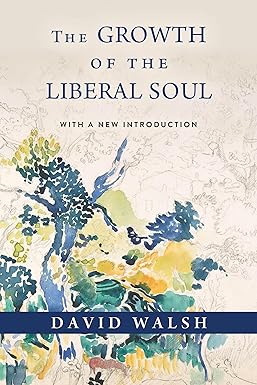
 The Growth of the Liberal Soul (2nd Edition)
By David Walsh.
University of Notre Dame Press, 1997/2025.
Paperback, 416 pages, $39.
Reviewed by Joseph R. Fornieri.
In today’s hyper polarized climate, the partisan label of “liberal” denotes either praise or blame depending upon one’s red or blue hue on the political spectrum. Though liberal democracy prevailed over the twin totalitarian perils of communism and fascism in the mid-twentieth century, critics yesterday and today continue to assail its theoretical incoherence and its hollow moral core. Notwithstanding the optimism of some at the dawn of the millennium that liberal democracy’s triumph over competing ideologies heralded “the end of history,” more than three decades later, there are tell-tales signs of its exhaustion and decline. On the right, Patrick J. Deneen is the latest critic who has proclaimed its failure and bankruptcy: “In this world gratitude to the past and obligations to the future are replaced by a nearly universal pursuit of immediate gratification: culture, rather than imparting the wisdom and experience of the past so as to cultivate virtues of self-restraint and civility, becomes synonymous with hedonic titillation, visceral crudeness, and distraction, all oriented toward promoting consumption, appetite and detachment.” On the left, postmodern critics in the universities have dedicated themselves to unmasking the liberal enlightenment’s claim to “self-evident truth” and “objectivity” as a clever pretext for control and domination. Finally, the recent examples of political assassination, antisemitism, demagogic populism and civil unrest all bear witness to a rising wave of “illiberalism” in the west. Will liberal democracy survive as the authoritative understanding of political order in the twenty-first century? If not, then what “illiberal” alternatives can we expect to replace the power vacuum left in its wake? A resurgence of the discredited ideologies of fascism and communism? autocracy? tribalism? feudalism? theocracy? techno-plutocracy? world bureaucracy? Or have the rumors of liberalism’s death been greatly exaggerated, as Mark Twain once joked about himself.
Bearing these questions in mind, we would do well to revisit the new edition of David Walsh’s The Growth of the Liberal Soul reissued by Notre Dame University Press. In this profound work, Walsh engages the friends and foes of liberalism alike to reveal its enduring appeal and resilience. Throughout he urges us to consider liberalism not so much as a stale academic doctrine, but as a lived experience rooted in the core belief of the inviolable dignity of each person as a free and rational being. He proclaims his bold thesis in the book’s new introduction: “The reader who is prepared to accompany me thus far will discover that Nietzsche’s depiction of liberal democracy as the offspring of philosophy and Christianity was indeed correct.” This tantalizing verdict begs for further explanation. How could Nietzsche, who proclaimed the death of God and held liberalism with utter contempt, serve as a guide to understanding its spiritual underpinnings? Perhaps it should be remembered that for Nietzsche the death of God was more than a banal observation of waning religious belief at the dawn of the twentieth century. Rather, it was a philosophical broadside against all attempts to ground morality and politics upon an ultimate foundation that would provide purpose, meaning, and direction to human life. As Nietzsche’s postmodern successors would consistently underscore, all such claims to “objective” and “universal” truth are nothing more than arbitrary impositions of the will to power. Nietzsche embraced the seemingly bleak realization of God’s death with gusto since it heralded the possibility of unbridled human freedom and autonomy. Like Dostoevsky, the only psychologist he once admitted he could learn from, he recognized that the budding secular ideologies of the nineteenth century such as socialism, communism, liberalism, and nationalism all presumed an implicit religious belief in “truth” and “justice.” Nietzsche’s statement from The Gay Science is apropos: “it is still a metaphysical faith upon which our faith in science rests—that even we seeking after knowledge today, we godless anti-metaphysicians still take our fire, too from the flame lit that is thousands of years old, that Christian faith which was also the faith of Plato, that God is the truth, that truth is divine.” Walsh takes up this challenge in a philosophical jiu jitsu that turns Nietzsche’s argument on its head. While Nietzsche was correct about the foundations of liberalism, he erroneously ruled out its enduring truth and underestimated its resilience as a lived experience. Thus, Walsh seeks to enkindle the glowing embers of liberalism as the offspring of Christianity and philosophy by noting that “the neglect of this spiritual or moral dimension…is the source of the liberal instability.” Walsh’s task is to show how the growth of the liberal soul must overcome this neglect.
The book begins with a magisterial appraisal of recent liberal thinkers. Most notably, Walsh provides a trenchant critique of how John Rawls’s admirable commitment to the principle of liberal neutrality undermines his own philosophical edifice. In addition, he considers the important contributions of MacIntyre, Dworkin, Nozick, Rorty, Stout, and Flatham. In each case, the evasion of moral truth collapses into a relativism, skepticism, and uncertainty about the very liberal principles the theorist attempted to defend. Walsh reminds us that the liberal penchant for self-criticism and doubt may constitute a source of strength if tempered by a more realistic appreciation of its enduring strength and appeal. His intellectual odyssey of how twentieth century liberal theorists have failed to provide a coherent moral foundation is an education itself and worth the price of the book. In sum, he observes: “Liberal intellectuals are more in the manner of lost souls who carry within them the flickering sense of that for which they search.” By contrast, the contribution of Michael Oakeshott, whose work is too often overlooked in many political science departments, stands out as an exception to the theoretical collapse because he recognized that “liberal society and politics rest on a level of experience prior to liberal conceptual elaboration.” According to Walsh, Oakeshott “presents us with the theoretically most profound account of liberal political order currently available.” Indeed, the effort to find an apodictic rational demonstration for liberalism was doomed from the start since “the moral life is based not on ideals or arguments, but a living practice.”
The next section of the book moves backwards in time to remedy the liberal tradition’s historical amnesia about its own foundations. Here Walsh provides a comprehensive overview of seminal liberal thinkers from the sixteenth to nineteenth century beginning with Hooker, Hobbes, Locke, Kant, Rousseau, and Mill, the last liberal theorist. In particular, he praises Hegel’s view of the “ethical life” for harmonizing individual autonomy with wider duties to the community. At the conclusion of this section, he poignantly expounds Tocqueville’s prophetic warning of liberalism’s loss of higher purpose and its willingness to trade freedom for equality guaranteed by the soft despotism of the nanny state. Walsh encourages today’s liberals to pursue Tocqueville’s task in fusing aristocratic virtue with democratic individualism. The nuances of this comprehensive study of the foregoing liberal thinkers are beyond the scope of this review. Even where one may disagree with Walsh’s benign analysis of some of these thinkers, particularly Hobbes and Hegel, his original and provocative interpretations challenge the usual assumptions in the field of political philosophy. For example, though he acknowledges the important and enduring contributions of Eric Voegelin and Leo Strauss, he maintains that their recovery of the ancients paid insufficient attention to the redeeming elements of liberalism. Eschewing the ancient vs. modern dichotomy, he reminds us that “[l]iberal order has its roots in spiritual and moral traditions that are premodern.” In support of this claim, one need only consider the mutual influence of Christianity and Roman Republicanism on the liberalism of the American Founders.
Walsh’s labor culminates in the noble effort to evoke a minimal liberal consensus: “The deepest level of [liberalism’s] appeal is that this is the form of order that speaks to our human dignity as rational, self-governing beings.” The danger is that liberalism will forget its spiritual underpinnings that make freedom both possible and meaningful. Thus, he forthrightly reminds his readers that “It was the Christian idea of the soul whose origin and destiny is transcendent that first made it possible for the individual to stand over against society and the world, as a reality that can never simply be contained by them. This was the source of individual rights. To this, Christianity added the related idea of the equality of all souls before God.” Notwithstanding the separation of church and state and our secular society and culture, “The transcendent dignity of the person may be characterized as religious or quasi religious.” Reprising his profound exposition of Dostoevsky’s “Myth of the Grand Inquisitor” in his first book After Ideology, the precursor to this volume, Walsh reminds us that “The gift of freedom is indistinguishable from the mystery of redemptive divine suffering of freedom.” The Grand Inquisitor’s promise to relieve humanity of the “burden of freedom” conceals his thinly disguised contempt for humanity and his lust for power. The dramatic portrayal contrasts the secular messianism of the Grand Inquisitor with the humble and silent character of Christ who suffers redemptively on the cross alongside humanity. Walsh’s philosophical journey scales the heights of Nietzsche, Dostoevsky and Christ’s redemptive suffering to understand and appreciate liberalism.
In conclusion, Walsh is under no illusion about liberalism containing “the seeds of its own destruction.” His task throughout the book is to remind us of what is at stake by ignoring or devaluing the core experiences and yearnings that are part of its enduring attraction. As Churchill allegedly quipped, liberal democracy may be the worst form of government until one considers the alternatives. Walsh’s observation thirty years ago at the time of the book’s publication holds true today: “no more powerful witness to the authority of the liberal democratic ideal can be imagined than the voluntary movement of millions of human beings around the world toward its realization.” As a former doctoral student of Dr. Walsh around the time that this book was first published, he often reminded us that even illiberal regimes like the People’s Republic of China, the Islamic Republic of Iran, and the Democratic People’s Republic of Korea cloak themselves in the guise of liberal democratic values for their legitimacy. When once asked about the challenge that radical Islam posed to the West, he replied with his characteristic mirthful and mischievous Irish smile by explaining that just as some of the authoritarian and intolerant elements of Christianity in the west were tempered by the liberal enlightenment, so one day there might be an Islamic John Locke who will reconcile Islam with liberalism. In these divided times there is need for further reflection on what we have in common as both human beings and citizens. In reminding us of the moral and spiritual core at the heart of liberalism, Walsh goes far in breaching our ideological divide. Following Thomas Jefferson’s evocation of a deeper unity between Federalists and Republican parties in the highly contested election of 1800, perhaps we should give more thought to saying in our own partisan times that “we are all liberals, we are all conservatives.” To the extent we may do so we owe a debt of gratitude to David Walsh.
Joseph R. Fornieri is Professor of Political Science at the Rochester Institute of Technology and Director of the Center for Statesmanship, Law, and Liberty.
Support the University Bookman
The Bookman is provided free of charge and without ads to all readers. Would you please consider supporting the work of the Bookman with a gift of $5? Contributions of any amount are needed and appreciated!
