
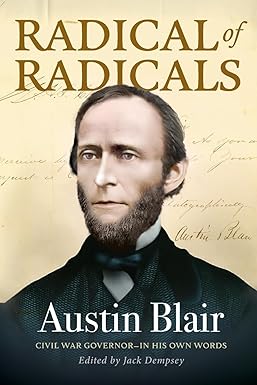
 Radical of Radicals: Austin Blair—Civil War Governor—In His Own Words
By Jack Dempsey.
Mission Point Press, 2025.
Paperback, 360 pages, $18.95.
Reviewed by Miles Smith IV.
In every intelligent history of the Civil War Era, the major players show up on stage, right on cue. There are the patrician slaveocrats of the South, haughty and proud. Then comes the statesmanlike Midwestern everyman, Abraham Lincoln, moderate in his opinions and committed to the Union. Finally, there are the radical idealistic New Englanders, the moral purists, who turn Lincoln’s war for Union into a crusade of liberation.
This isn’t wrong per se, but it misses just how many Midwesterners were radically committed to ending human bondage in the United States at all costs. Ohio, Illinois, Wisconsin, and Michigan all had their abolitionists, but few if any Midwestern abolitionist politicians were able to put their beliefs into action as effectively as Michigan’s wartime governor Austin Blair. The New York-born and educated governor became a leading advocate for racial equality in the era, but he has long remained hidden in the shadows of the Civil War Era, treated as little more than a historical footnote. In fact, he was influential in reshaping Michigan, the Midwest, and the broader Union. And thanks to Jack Dempsey and the Michigan Civil War Association, Blair now has a short biography and a collection of his papers accessible to both scholars and the general public. Radical of Radicals: Austin Blair–Civil War Governor–In His Own Words is an exciting contribution to both Civil War libraries and to the political history of the Civil War Era United States.
Jack Dempsey’s 25-page biography of Blair at the beginning of this collection is perhaps the most important piece of the work. Blair’s radicalism was not, we might note, the sort of radicalism that advocated for social revolution in the United States. His radicalism was born of his frontier New York upbringing. Reared in the still wild section of the state centered on the Finger Lakes and Lake Ontario, Blair grew up in a log house and attended the local common school. Devotees of Laura Ingalls Wilder can imagine Blair being the type of man that Almanzo Wilder looked up to in the 1860s Upstate New York of Farmer Boy. The Evangelical Protestant religion that fired the region in the 1820s was not lost on Blair, and he combined his love of the Bible with a classical education that focused on Latin and Greek. He also studied and revered the natural sciences. As the early American Republic went, Blair was an exemplar of the ideas, religiosity, and politics that coalesced into the Whig Party in the 1830s and 1840s.
Like so many young men in New York state, Blair turned towards the Old Northwest—the modern Midwest—to make his mark. Everyone, he said, was making for Illinois or Michigan. He arrived in Jackson, Michigan, in 1841. The Wolverine State was barely four years old. Blair pursued the law, and his career, Dempsey noted, mirrored to a significant extent another young frontier lawyer in the region: Abraham Lincoln. And like young Lincoln, Blair’s life was to have its fair share of sorrows. In quick succession death claimed a daughter, Gertrude. Two years later, his wife Persis died. Blair remarried and eventually had a large family. His early tragedies did not, however, make him brood. He remained ever an optimist and believed that society could be freer and more loving for all mankind. It was that spirit that made him an early advocate of women’s suffrage. Those same beliefs convinced him that slavery could not exist in a free society and that eventually, something would have to be done about the slaveholders who ruled the South. Blair’s socio-religious commitments led him to envision a world not only where races and genders were equal, but where what he thought were archaic and barbaric practices like the death penalty were finally abolished. Blair represented Jackson County in the U.S. House of Representatives, where he gained the goodwill of the anti-slavery Conscience Whigs of New England. Whereas Abraham Lincoln looked like an Illinois anti-slavery version of his Kentucky Whig hero Henry Clay, Blair looked and acted more like Charles Sumner, the abolitionist firebrand who eventually was assaulted by a southern representative.
Blair’s political career in the 1850s was that of a man committed to human freedom and to the hallmarks of what became in 1854 the new Republican Party. Blair, as Dempsey notes, certainly fit the bill of a radical. The notion that slavery’s expansion needed to cease—the Lincolnian proposition—was far too mild for him; he wanted to kill slavery where it was, and he nurtured a burgeoning community of like-minded institutions—civic, educational, political, and religious—in Michigan. Hillsdale College, a voraciously abolitionist institution that admitted women and blacks on equal footing with white men, granted Blair a degree, good evidence if any that Blair stood on the radical end of the Republican spectrum.
The Civil War was the apotheosis of Blair’s brand of Midwestern radicalism. He was at the forefront of the Republican Party’s war recruiting efforts. Abraham Lincoln’s war for the Union was an opportunity for much more, and radical governors like Blair were determined to make the most of the conflict. Blair took his role as the state’s commander in chief seriously. Famous Michigan regiments in the Iron Brigade and other units earned immortality at Gettysburg. Austin Blair made sure that Michigan earned its place at the forefront of a war not simply for union, but also for freedom.
Jack Dempsey’s book is mostly a collection of primary sources, but it is also a window into Michigan and the Midwest’s contribution to what Robert Penn Warren called the central event in the American imagination. Michigan’s contributions have not been celebrated in or outside of the state in a way that reflects the state’s massive contribution to the cause of human liberty. Austin Blair is not as famous as Charles Sumner or Thaddeus Stevens, but he arguably did more politically to ensure the Union war effort was carried out. After the Civil War, Blair assisted those other Radical Republicans in carrying out Reconstruction. Eventually, he served as the chairman of the House Republican Conference. Blair was an undeniably pivotal figure in American politics in the middle of the 19th century, and thanks to Jack Dempsey, he’s finally getting his due.
Miles Smith is Assistant Professor of History at Hillsdale College. His research focuses on the American South and the Atlantic World in the 19th Century. He is the author of three books and contributes regularly to scholarly and popular outlets.
Support the University Bookman
The Bookman is provided free of charge and without ads to all readers. Would you please consider supporting the work of the Bookman with a gift of $5? Contributions of any amount are needed and appreciated!

