
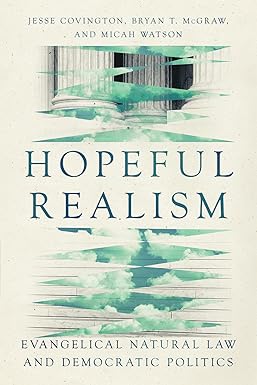
 Hopeful Realism: Evangelical Natural Law and Democratic Politics
By Jesse Covington, Bryan T. McGraw, and Micah Watson.
IVP Academic, 2025.
Paperback, 264 pages, $26.00.
Reviewed by William H. Rooney.
Hopeful Realism is a laudable collaboration among three political theorists that addresses natural law and democratic politics from an evangelical Protestant perspective. The authors present “Hopeful Realism” as an “approach to the natural law tradition [that] can provide much-needed guidance for evangelical political engagement and can contribute to the flourishing of a liberal democratic order.”
The challenge for Hopeful Realism and for all natural law theorists is the proper ordering and integration of the contingencies of a given culture and the universality of the primary precepts of natural law. Despite much to appreciate in Hopeful Realism, especially its recognition of creational norms, it treats the contingent error of contemporary ethical pluralism as an ontological necessity and thus recommends compromising universal moral precepts to protect political “pluriformity.”
Hopeful Realism lays its theoretical foundation by rightly acknowledging that natural law arises from the order of created reality, which itself flows from the mind of God, “participates in the goodness of the Creator,” and thus has an authority that is nothing less than divine. The authors quote St. Augustine, whom they invoke as their steadfast guide, as teaching that “nothing is just and legitimate in the temporal law except that which human beings have derived from the eternal law. … [T]he notion of the eternal law that is stamped upon our minds: it is the law according to which it is just that all things be perfectly ordered.”
Although St. Thomas Aquinas receives only passing references, Hopeful Realism does endorse Thomas’s teaching that “the natural law [is] our ‘participation in the eternal law.’” Man participates “in the eternal law by acting according to our nature as rational beings…. As bearers of the divine image, we imitate God’s ordered reason (to the extent possible) as part of our nature.” To follow natural law is to participate in God’s goodness; to compromise the natural law is to deviate from God’s goodness.
To its credit, Hopeful Reason, in its own voice, embraces the importance and authority of the created order: “[M]oral norms are part of the created order and are intelligible to humans, a position philosophically described as moral realism. … [M]oral realism contends that moral standards are universal, intelligible, and part of the good, created order.… For all the challenges of perceiving, sharing, obeying, and applying creational norms, we cannot escape the reality that we are bound by moral truths.”
At the same time, however, the evangelical perspective of Hopeful Realism leads to a distinctive emphasis on “themes of antithesis,” or “the difference…between Christians and non-Christians,” and “the profound effects of the Fall: falling into sin carries with it a sweeping impact on human experience and capacities, including our rational and moral abilities” and “our assumptions, epistemology, and ability to live rightly—both individually and corporately.”
The authors’ understanding of the profoundly debilitating effects of the Fall pervade Hopeful Realism and are offered to justify the “humility” and restraint that it recommends in applying its natural law framework to political issues. The result, as discussed below, is a consistent deference to contemporary pluralism even when universal moral standards are at stake. To wit, the authors conclude: “The pluriformity of society—manifest in everything from families, business, clubs, schools, and far more—warrants protection from the intrusions of government.” The guiding themes are “the limits of politics, human finitude, and the effects of the Fall.”
A less severe view of the impact of the Fall on man’s capacity for truth and right action would likely yield different conclusions on both natural law and political engagement. Pope John Paul II, for example, argued in his encyclical Fides et Ratio that philosophical inquiry can yield “true and authentic knowledge” of reality and its meaning. By regaining a “genuinely metaphysical range,” the pope continued, adequating the mind to reality, and addressing “the very being of the object which is known,” philosophy can “attain something absolute, ultimate and foundational in its search for truth.”
Reflecting that sapiential confidence and the fundamental goodness of God’s created order, John Paul, in his encyclical Veritatis Splendor, described natural law as “participated theonomy,” emphasizing the inextricable connection among eternal law, natural law, and human reason. Man thus “participates in [the ‘knowledge of good and evil’] by the light of natural reason and of Divine Revelation, which manifest to him the requirements and the promptings of eternal wisdom.” John Paul, quoting Pope Leo XIII, summarized: “It follows that the natural law is itself the eternal law, implanted in beings endowed with reason, and inclining them towards their right action and end; it is none other than the eternal reason of the Creator and Ruler of the universe.”
In this view, man has the capacity, by his nature and as assisted by God’s revelation and grace, to receive the light of the divine countenance and to attain an authentic knowledge of reality, truth, and goodness. That capacity allows a line of causation to run from eternal to natural to human law and to annul human commands that contradict their ontological sources. The authors’ skepticism regarding man’s capacity for truth and right action lead them to reject that line of causation and to constrain the application of natural law when addressing contested political issues.
When considering natural law’s application to politics, Hopeful Realism summarizes our predicament with two propositions: we have both (1) “a shared interest in creational goods that are ordered to human flourishing”; and (2) a “deep disagreement about the nature of that flourishing and thus the goods attached to it.” Instead of recognizing the universality of the first proposition and the contingency and error in the second proposition, Hopeful Realism adopts the second proposition as part of the fabric of reality and as a justification for compromising creational goods in the political sphere.
Hopeful Realism charts that course by constructing a matrix of human goods and political principles. The goods are “physical” (bodily), “volitional” (agency), “rational” (knowledge, wisdom), and “relational” (social). The political principles are “the common good and civic friendship,” “confessional pluralism and religious liberty,” “restraint and liberty,” and “democracy and decentralization.”
Neither the goods nor the political principles are ordered hierarchically, either internally or with respect to each other. Evangelicals are invited to draw among the goods and principles according to a three-step “methodology” to develop positions on political issues. The result typically splits the difference between socially progressive and conservative views in deference to civic friendship, shared governance, political restraint, liberty, and humility.
At the conclusion of a chapter devoted to marriage, sex, and the family, for example, Hopeful Realism recommends against a national resolution that would define marriage as a heterosexual union, which follows from the authors’ “commitments to pluralism and volitional goods” and the political principles of restraint, liberty, and decentralized democracy. Hopeful Realism instead advocates “policy nudges” and “carv[ing] out spaces in which traditionally minded citizens of whatever background can continue to put their own convictions into practice,” while generally accepting the status quo on marriage as “[having] been decisively settled.”
At the core of Hopeful Realism is an equivocation on the “realism” that it claims for its title. In its discussion of the theoretical foundations of natural law, Hopeful Realism embraces moral realism and the intrinsic moral goodness of created reality. In its discussion of political engagement, Hopeful Realism accommodates moral realism to the social and political “realities” of twenty-first-century America.
In the Conclusion, the authors respond to the objection that “natural law might be true in principle but not much (practical) use in the realities of our political life.” They claim that Hopeful Realism offers “a way to address those difficulties, acknowledging that they are…facts of our social and political life that we cannot just wish away and that do not admit of easy answers.” The authors further assert that to build “a political theory on the assumption of [a] broad social consensus…about…highly contested issues is to traffic in” the unobtainable.
But Hopeful Realism has that calculus backwards. The authors themselves acknowledged in their discussion of moral realism that the fundamental truths of eternal and natural law constitute “moral standards [that] are universal, intelligible, and part of the good, created order.” Those standards are facts of our moral life that, far more than contingent and erroneous cultural disagreement, cannot be “wish[ed] away, ignore[d], or…reconstruct[ed],” again quoting the authors on moral realism. To compromise universal moral truths for political interests is to traffic in evil and to elevate the changeable over the constant. When divine goods are at stake, we must obey God, not man, and we must conduct our political engagement accordingly.
William H. Rooney is a lecturer and the Lumen Legis Fellow of the Center for Law and the Human Person at the Columbus School of Law at The Catholic University of America.
Support the University Bookman
The Bookman is provided free of charge and without ads to all readers. Would you please consider supporting the work of the Bookman with a gift of $5? Contributions of any amount are needed and appreciated!

