
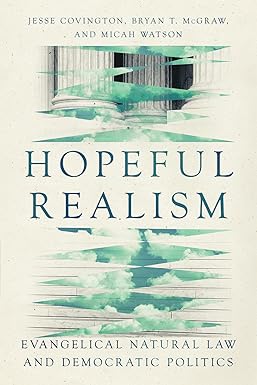
 Hopeful Realism: Evangelical Natural Law and Democratic Politics
By Jesse Covington, Bryan T. McGraw, and Micah Watson.
IVP Academic, 2025.
Paperback, 264 pages, $26.00.
Reviewed by Josh Herring.
At the 2025 Academy of Philosophy and Letters meeting, Jason Jewell argued that academic writing produces one good: clarity. Those practiced in academic writing learn to articulate ideas, their research, and the significance of their ideas. Hopeful Realism: Evangelical Natural Law and Democratic Politics, co-written by three political science professors—Jesse Covington, Bryan T. McGraw, and Micah Watson—has a burden of clarity to meet. They set themselves the task of articulating the natural law tradition, showing how Protestant, Evangelical Christians can access that tradition, and demonstrating how applying natural law thinking can enable political decision-making. They achieve the first two goals, and are to be commended for highlighting the need for further Protestant thought along natural law thought lines. Their book, however, falls short in clarity.
This book does an excellent job highlighting the way the authors think about political choices. They illustrate political weighing of goods; they must make excellent Socratic instructors in the classroom, able to highlight the various goods in play within a given political scenario. Such, however, is not the need they identify within this book. Published in 2025, yet most likely written across 2022 and 2023, this book reflects the political polarization in American evangelicalism during the Biden administration. The authors’ primary concern is to highlight the ways that their approach can create unity. In doing so, however, they offer ambiguity where the need is clarity in Christian conviction.
Hopeful Realism begins with the natural law tradition, grounding natural law thought in the biblical case for nature revealing the Creator. In their description of natural law reasoning, they describe the importance of human nature: “In the Christian intellectual tradition, the natural law has for centuries described a set of stable, morally obliging norms for human action, grounded in a common human nature. The basic idea is that we have a nature oriented to the particular ends that are proper to us as human beings such that we are obliged to pursue those and avoid what works against them.” The authors lean on Romans 1 and Psalm 19—“The heavens declare the glory of God” —to argue that some elements of reality reveal moral truths. They then develop a natural law framework to apply to contemporary political questions of economics, marriage, war, and religious liberty. In application, the authors’ inability to uphold the moral convictions of natural law theory and apply those convictions to the political sphere becomes inescapable.
They present their method in three steps. When faced with a political decision, one should:
- Identify the good or principle and how it relates to human flourishing;
- Discern and choose among options;
- Apply prudential considerations.
Political questions begin with comparison of political goods, and thus the first step in reaching a decision is determining which goods are in play. Such may be a fine method of political reasoning, but it is not a distinctly natural law beginning. They do not, in their practical examples, begin with a discussion of the actual nature of the issues under discussion. Abortion is a side issue in Hopeful Realism, but it illustrates where the disjoint emerges. “To some questions—should there be a broad right to abortion?—we think Hopeful Realism, as with any natural law argument, will give a clear answer. (It is no, in case you were wondering).” While “no” is the correct answer regarding a right to abortion, the authors’ view remains ambiguous. How narrow is the right to an abortion? In what circumstances ought the nature of the mother be counted as of greater value than the nature of the child? The authors do not discuss the ambiguity of their answer. In several places, the authors articulate positions best described by the slang term “squishy.” They write that “the details of the moral vision of the good life—including sexuality—to be incorporated into primary school curricula might better account for local norms.” Such a view would affirm radical states like California or Illinois’s explicit instruction of LGBTQ ideology in elementary school, for example.
When they do write with moral clarity, they do so apologetically. The following examples illustrate their tone:
This is as good a place as any to state that we affirm the traditional Christian sexual ethic, even as we also acknowledge and lament that the church has not done very well in loving our fellow image bearers who are same-sex attracted. We also acknowledge and lament that too often we Christians have emphasized some ways of falling short of the standard and neglected other ways (cohabitation/divorce/pornography) that may be even more prevalent in churches. We recognize these matters beg for a fuller treatment than we can give them here.
The authors write a chapter on marriage from a natural law framework and do not condemn homosexuality. They affirm the “traditional Christian sexual ethic” without directly stating what the ethic is. The same tone of apology emerges in their discussion of single parents:
To be absolutely clear, this is in no way to impugn the mothering and fathering done by single parents, nor to say in any way that two men or two women cannot love and care for a child. It is to say, however, that while two men may both be good fathers, they will not be a good mother, and while two women may both be good mothers, what they provide will not be fathering. Moreover, to also be quite clear, acknowledging such differences does not provide any carte blanche basis for reinforcing all cultural gender standards—something that has been badly abused over the years.
Homosexual parenting is a violation of human nature, and in a confused age such a Christian position requires clear articulation. The traditional family of father, mother, and child also requires clear articulation in an age where open marriage, polycules, and polyamory appear as options the secular world endorses. The apologetic tone with which these authors write fails to equip the reader with a clear understanding of the insight natural law can provide to important political questions.
The same flaw emerges in their discussion of possible alliance with LGBTQ+ groups: in their discussion of “civic friendship,” the authors note that such friendship “may also manifest in thicker forms ranging from neighborhood associations to bringing neighbors together on a regular basis to long term, relationally engaging initiative from disparate groups—such as the LGBTQ groups working with religious organizations to find a mutually honoring path towards policy solutions.” If discussions of “civic friendship” begin with a discussion of nature, the possibility of partnering with organizations that deny a fixed human nature vanishes.
Covington, McGraw, and Watson approach the question of politics as liberals in the political sense; they are not post-liberals à la Patrick Deneen. They assert that the American liberal regime is compatible with Christianity and argue that a pluralistic democracy is ideal. Here too the question of a common agreement on nature functions as a necessary foundation. Without an agreement on what it means to be human, political questions of organizing human beings diverge. They write, “The divergent ultimate loves within a commonwealth will only be finally addressed at the Last Day, not in the next election or court decision. Protecting this sort of plurality is a key political good.” This assertion, that pluralism is an inherent good, goes undefended, and leaves the reader contemplating potential limits to pluralism. Does liberal pluralism extend to sharia?
The method of political thought advocated in Hopeful Realism invites readers to ask questions, compare goods, and reach ambiguous conclusions. These are excellent activities for the college classroom; they are less helpful for the pastor or layman identified as the audience the authors hope to reach. “[W]hile we are academics writing with some degree of scholarly details, our primary audience in this effort is the church—our fellow believers and colaborers in Christ….we aim primarily to equip our fellow believers more than to persuade those who disagree with us.” What pastor or lay Christian would find ambiguous political reasoning helpful for a) opposing or celebrating a new development in his town? b) deciding how to vote on a ballot measure regarding his state’s stance on surrogacy? or c) how to respond to a gathering of men with whom he shares general political convictions yet discovers that those views come wrapped in whiteness and Christian nationalism? Christians need clarity on the way their faith shapes their political activity. This ambiguous book fails to provide that clarity.
Dr. Josh Herring is Professor of Classical Education and Humanities at Thales College, host of The Optimistic Curmudgeon podcast, and author of the forthcoming Sons of Adam, Daughters of Eve: C.S. Lewis’s Images of Gender (Davenant Press, 2026).
Support the University Bookman
The Bookman is provided free of charge and without ads to all readers. Would you please consider supporting the work of the Bookman with a gift of $5? Contributions of any amount are needed and appreciated!

