
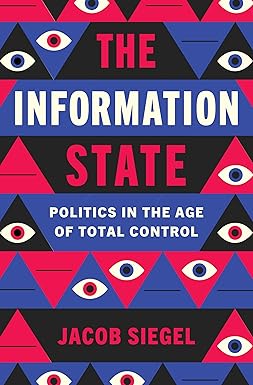
 The Information State: Politics in the Age of Total Control
Jacob Siegel.
Henry Holt and Co., 2026.
Hardcover, 336 pages, $29.99.
Reviewed by Albert Norton, Jr.
Just within the last year, Paul Kingsnorth published Against The Machine about the source of our increasing uneasiness at being herded into algorithmic channels imposed upon us externally, essentially by anything that has power over us institutionally, like school or employment, or by commercial need, like the businesses we have to patronize to live, or by coercion, like the government and its private delegatees.
Siegel’s thesis in The Information State dovetails, providing a convincing “how” for the advance of the Machine, particularly with respect to the government’s role. We should be wary of the government’s participation in the march to technocracy because, as with any government, it has the exclusive power to coerce. Exclusivity in the power to inflict violence inheres in every government—that’s essentially what government means. Because we can’t escape it, it can easily become the worst and most oppressive element of the Machine. And its effects are multiplied because, without permission from the demos, the government shares out its coercive power in government/private partnerships, government-funded NGOs (which sounds like, and ought to be considered, an oxymoron), and a vast philanthropic industrial complex.
A 2002 documentary now on YouTube called The Century of the Self by filmmaker Adam Curtis chronicles the rise of psychology as a worldview—as well as its mass manipulation, first to reinforce public morality in line with Freud, and then in the latter half of the twentieth century, essentially the opposite, in Marcusean liberation. The documentary begins with Wilsonian progressivism engaged in shaping public opinion, especially concerning participation in The Great War, employing for this purpose Freud’s nephew Edward Bernays. After the Wilson era, Bernays moved into the private sector (back when the barrier between the two was clearer than it is now) but did the same kind of work, this time reshaping public opinion in service of commercial interests.
Siegel also mentions Bernays in The Information State, and for the same reason, but combines that historical experience with the rise of cybernetics, essentially the science of systems. Informational feedback systems are an integral part of cybernetics and are studied and applied to steer a particular purpose through gathering and selectively deploying information. The “system” in play in this case is the collective workings of society, and the undertaking by government to steer it in some particular way, starting with whether and how to wage war.
In any exercise of agency beyond the individual, the question that really matters is “who decides.” But, we reflexively blow past that important question, taking it as normal that someone or something vaster and more powerful than ourselves steers public opinion through the science of cybernetics and its attendant information-gathering. Instead of finding this offensive, we have come to think it is normal. Steering public opinion now seems to be a natural function of commercial, tech, media, pharma, Wall Street, and other influential power centers. And so likewise, the government. We should pause to consider the significance of this point. Where does the government get off steering your opinion about war or anything else? Who works for whom? Consider how inured “we the people” have become to propagandistic control.
Nor let it go unnoticed how democracy is thus bastardized. If democracy means government accountability to the vote, then it is compromised to the exact extent that coercive government power is delegated to unelected organizations. We know that open-society types would define “democracy” differently. So let’s have that discussion, too, and know what we’re talking about and what’s at stake when we countenance deft shape-shifting of words from one meaning to another.
Information control became a primary focus of American war-making after World War II. In Vietnam it involved making the war palatable to Americans, for as long as it could, and in South Vietnam to stiffen support, and among the opposing forces of North Vietnam and its sponsors, by softening targets. This genie out of the bottle, all is now fair game for the government’s ongoing collection and manipulation of information. It has become normalized to witness the government engaged in opinion-shaping in all its efforts, including those leveraged through nominally private entities. Whole-of-society surveillance and information management is the norm in large part because we have lost the significance of the public/private divide, which is necessary to any hope of curtailing runaway government power. We have become lax in preventing the incremental ceding of individual agency to the collective. It hardly made a blip when we learned the government has been spying on its own citizens for years, directly and through its ostensibly private media sock-puppets.
Thus we succumb to the cybernetic steering of Big Brother because we imagine him wise, kind, and benevolent, while we are asleep to the per se violation of surveillance, including surveillance through a cravenly obedient private proxy. Sophisticated and pervasive information manipulation softens the target, and the target is we the people. The goal? Progressivism, of course, but not just the old-school leftism that wanted socialism slightly faster than those on the other end of a very short spectrum. Republicans, after all, were chiefly responsible for the infamous Patriot Act.
The progressivist environment was a return to Wilson-era government activism. It could come about now because, as Siegel puts it:
The revolution in information technologies cleared away older causes. In their place, globalism, which presupposed the essential interchangeability of human cultures, became the great unifying cause of the American ruling class.
The progressive elite initiated and continues to sponsor this Wilsonian effort to reshape the world in the image of those who know best, rather than according to the vote of us unwashed proles who must be herded along to leave behind our quaint provincialism. The elites driving this train mouth democratic ideals while knowingly subverting them through lies, manipulation, theft, and corruption, with a great big side order of barely-concealed self-dealing.
The information manipulation is also clear in several political episodes of recent history, also discussed in The Information State. The Obama-initiated Russian interference hoax persisted through most of Trump’s first presidency. The overt lies, counter-lies, and counter-counter-lies of the Covid years. The suppression of evidence of a Biden/Biden conspiracy involving Russian oligarchs. The cover-up of Biden’s incompetence. The progressive elites’ diversion of money to fund partisan patronage networks. There’s no defending this corruption.
The manipulation could not be clearer than in the “disinformation” efforts of the government and its servile patsies in recent years. Siegel rightly highlights the short-lived Ministry of Truth—that is, the “Disinformation Governance Board”—which was thankfully disbanded in 2022 because it moved a little too fast and was seen as the flagrant censorship it was. It was another blatant attempt to undermine the First Amendment, a bedrock of our Republic, so it was wrong and will always be wrong. This one time it was called out and withdrawn. But when the tide of censorship rises to its next swell, perhaps we’ll just swim with it. We have been giving up our freedoms a little at a time for years.
Enough. Go read The Information State, and consider how to resist.
Albert Norton, Jr. is a practicing attorney and the author of several books, including most recently The Discovered Self: Identity in the Therapeutic Age (New English Review Press 2025) and The Mountain and the River/Genesis, Postmodernism, and the Machine (New English Review Press 2023). You can find him at albertnorton.substack.com.
Support the University Bookman
The Bookman is provided free of charge and without ads to all readers. Would you please consider supporting the work of the Bookman with a gift of $5? Contributions of any amount are needed and appreciated!


