
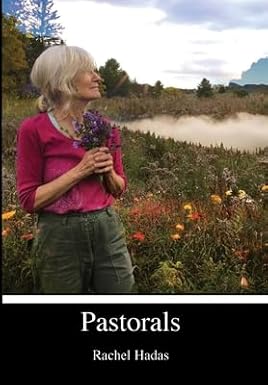
 Pastorals
By Rachel Hadas.
Measure Press, 2025.
Hardcover, 88 pages, $25.
Reviewed by Midge Goldberg.
What are Rachel Hadas’s pastorals? Not poems, not essays, not quite prose poems. What they really feel like are “visits.” You go to a friend’s house, sit down in the kitchen, in the living room, or on the porch. Your friend pours you a cup of coffee (or tea or wine), and tells you a story, which reminds you of a story, and the visit begins.
Pastorals are defined as idealized, nostalgic depictions of rural life, and they have been written for millennia, starting with Theocritus and Virgil. What Hadas brings to the genre in Pastorals is intimacy with the reader, a drawing in, a sense of a conversation. It’s as if, in “Summer Variation 1,” Hadas is sitting in the chair opposite you, asking, “Can someone feel nostalgic for the present?” She says, “I still use some of the pots and pans my mother used,” and you think of the candles you light in your grandmother’s candlesticks, or your fishing rod that had belonged to your father. She mentions the “phantom listeners” in a Walter de la Mare poem she read as a child, and you make a note to look it up later. She tells you what brings on the feeling:
I might be going up the stairs or walking to the
compost heap or down the driveway to the
mailbox, and be struck by—memory isn’t as
precise a word as presence. The presence of an
absence…. Something, someone is close by,
attentive, listening.
And you know exactly what she means. Nostalgia, the presence of an absence, is all around, waiting to be noticed. You answer the question along with her: “Of course.”
The pieces are set primarily at Hadas’s house in rural northern Vermont, and the house itself becomes the intersection where the tangible and intangible, the present and past, even prose and poetry, inextricably blend. In “Windows, Doors,” Hadas starts with how the physical structure frames ever-changing perspectives: “Each window in this house faces in a different direction and therefore frames a different view. Not only that; seasons and weather have to be factored in: sun, snow, cloud, smoke from wildfires.” Then add “the time of day, the way the light falls.” And “don’t forget the phases of the moon.”
But then the views turn intangible: a threshold “that throbs with meaning but also is inconspicuous enough to be almost invisible until you look back and understand that you have crossed from one realm to another, with maybe one last glance over your shoulder at the baffled revenant, travel-stained, weary, waiting on the other side to be let in.” Windows and doors open, not just to the outside or other rooms, but onto memory.
Anything can serve as a trigger to memory, as Hadas discovers on her porch. In “Hum of the Season,” the phoebes are pretty darn present:
The table where I write and where I sometimes
make collages: phoebe poop…Down the backs
of the lawn chairs: phoebe poop. On the
floorboards of the porch; on the ratty quilt that
covers the cot at the far end of the porch:
phoebe poop.
But the phoebe “is probably a descendent of the phoebe that built a nest on this same porch one summer late in my father’s life, perhaps even his last summer. She is also, presumably, a closer descendant of the phoebe that built her nest on this porch one of those years during the pandemic when we arrived before spring had begun.” One poopy bird can be a window onto multiple pasts in a place returned to year after year.
As part of your “visit,” Hadas invites you to take a walk, where she points out not only the physical landscape, but also what resonates just underneath. In the “Walking Around the Triangle” poems, she sees two spiderwebs: “Sitting on a stone, bare feet in icy water, I wasn’t anticipating anything,” until, at the last moment, “just perceptibly, they trembled.” The walk continues past a summer neighbor’s house, where “as if someone had just now gotten up, the swing suspended from a tall pine on the patch of lawn sloping down to the Water Andric sways slightly.” On Widow Road, through a window, “it’s possible to make out part of a piano, the corner of a table.” Every scene contains itself, as well as what was, or what might have been, that “presence of an absence.” Hadas knows the town is right in warning us about what we might find, posting a sign reading “CLASS 4 ROAD. PROCEED AT YOUR OWN RISK.”
As in all conversations, some stories are more relatable than others. The pieces about dreams represent different periods and fears in Hadas’s life, but without the grounding reality of the house and nature, it’s harder to find the common ground so prevalent in the other pieces. Yet they have a beautiful language all their own, “that porch of the imagination.”
Past and present finally meet face to face in “Summer Variations II.” All the family members, alive and dead, dwell in the house simultaneously, though in real life they are separated by years, if not decades: Hadas’s mother weeding; her father “typing with two fingers”; her first husband, deceased for many years, “at the piano upstairs”; while her present husband Shalom is in his studio. Bedrooms shift their furniture from twins to doubles and their occupants from brothers to children to adults. Hadas quotes Keats, who describes monks patching and patching a shirt until nothing of the original remains, but still calling it “St. Stephen’s shirt.” Like the shirt, the house and its occupants change and change and also remain the same. Unlike that shirt, however, there is a constant—Hadas herself, the “careful monk” of this house.
In the way Hadas weaves together opposites, these pastorals are more like conversation and not poetry, until they are. In “The Old House,” Hadas is almost chatty, talking to herself. She recalls John Ashbery’s line, “silence already filled with noise.” She comments on it, saying, “I can’t think of a better description of these summers,” but then interrupts herself: “or wait, ‘noise already filled with silence’ works just as well.” She corrects herself and doesn’t take it out. In “Black and White: Suspension Bridge” she explains her unedited style of writing:
Ellipses, corrections, hiatuses that fill the book
of days. Some words bully others. But all of
them as I scribble, clauses subordinate yet not
yet left out, pulled from oblivion, rescued on the
page—they all make marks for someone to
decipher. The act of writing fights the drift of
white.
But, as in that last line and a half, the poet emerges. In “Storing the Season,” her sentences are unabashedly iambic, ringing off the page:
The summer offers other harvests, too,
less tangible, harder to preserve. What to do with
misty mornings burning off to blue? With
spangled spider webs that delicately stitch two
blades of grass together? You can’t consume a
sight. Or what about that lichened rock on
which I used to perch and gaze out at the line
of drying hay striping the field?
Hadas recognizes it, and why she needs to do it: “The rending gold of summer ending—I can only try to fold it into poetry.”
The essence of Hadas’s pastorals—rural, elegiac, nostalgic, and intimate—is fully realized in the final piece, “Applesauce.” “I feel impelled to take home what cannot be taken: the flavor of memory, the memory of fragrance. To take home time.” As she harvests the apples, she knows she can’t take home everything, but she will do what she can. “Almost everything goes unharvested. I pick up an apple and take a bite.”
Rachel Hadas’s Pastorals mirrors the house within its pages—static, but, like the windows, each one provides a different view each time it is read, depending on the changes in the seasons and the weather of the reader’s life. Pastorals invites you in, shows you around, tells a few stories. Plan a visit soon.
Midge Goldberg is the editor of Outer Space: 100 Poems (2022), published by Cambridge University Press. Her third book of her own poems, To Be Opened After My Death (2021), was published by Kelsay Books. She received the Richard Wilbur Poetry Award for her book Snowman’s Code, was the winner of the Howard Nemerov Sonnet Award, and was a finalist for Plough‘s 2023 and 2025 Rhina Espaillat Poetry Awards. Her poems, book reviews, and essays have appeared or will appear in many journals and anthologies, including The New Criterion, First Things, Light, Hopkins Review, and on Garrison Keillor’s A Writer’s Almanac. She lives in Chester, New Hampshire.
Support the University Bookman
The Bookman is provided free of charge and without ads to all readers. Would you please consider supporting the work of the Bookman with a gift of $5? Contributions of any amount are needed and appreciated!

