
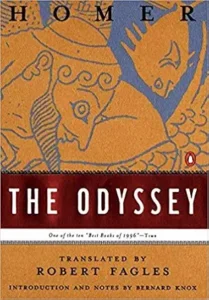
 The Odyssey
By Homer. Translated by Robert Fagles.
Penguin Classics, 1999.
Paperback, 541 pages, $19.
The Aeneid
By Virgil. Translated by Robert Fagles.
Penguin Classics, 2008.
Paperback, 496 pages, $19.
The Oresteia.
By Aeschylus. Translated by Robert Fagles.
Penguin Classics, 1984.
Paperback, 336 pages, $18.
By John Byron Kuhner.
There are precious few scholars who reach the bestseller lists, much less remain on them eighteen years after their death. Yet some thirty years after publication, only a dozen English titles are selling more copies than Robert Fagles’s Odyssey. If you search, Fagles is the subject of no current news stories. The press barely mentions his name. It is in some ways an appropriate tribute: Even at the height of his success as a translator, he was a gentleman of the old school: quiet, gentle, understated, never thrusting himself into the spotlight. He simply did his work well—bringing the literature of another language into a form that could be loved in his own—and would speak intelligently about it when asked. Still I think it is a fine time, now that the Odyssey is back in the news, to celebrate the man who introduced Homer and Vergil and Sophocles and Aeschylus to millions of English readers.
Bob Fagles was my professor in the late 1990s, before he retired in 2002. He had been for decades chairman of Princeton’s Comparative Literature Department. He could teach whatever he wanted. By choice he taught the inexhaustible. It seemed that only a few books mattered to him by this stage, and he wanted to share them with his students: the Iliad, the Odyssey, the Oresteia, the Theban plays of Sophocles, the Aeneid, Hamlet, King Lear, Paradise Lost, Ulysses.
The essence of his teaching was found in his “Tragedy” course, which was attended by about a hundred students every year. He had founded first the Program in Comparative Literature, and then the Department, to teach precisely courses of this type, where he could read Aeschylus and Sophocles beside Shakespeare. The matter of the course’s lectures is captured in his highly indicative (and excellent) essay, “The Serpent and the Eagle,” printed as a preface to his translation of the Oresteia. It is a hundred pages long, and is almost a book in itself. His great theme was suffering—it was the idée fixe in his intellectual life. Was it all “a tale told by an idiot, full of sound and fury, signifying nothing,” as Macbeth says? In general, he did not believe it was, but he knew Macbeth had good arguments. He took as the essence of tragedy Aeschylus’s phrase “pathei mathos,” “learning via suffering,” which contained in it the belief that we could reap a harvest of knowledge from the pain. He translated it as “we must suffer, suffer into truth.” In almost every lecture he quoted a line of Thomas Hardy on the necessity of tragedy in life—“if way to the better there be, it exacts a full look at the worst,” while acknowledging that Hardy felt this was cheap claptrap that hardly offered compensation for the horror of suffering.
In class he was unusual among Princeton professors in that he would drop down into the text and ask students what lines meant. One was (from Lear) “Nothing almost sees miracles but misery.” “I know you know what those words mean,” he said. “But do you know what Shakespeare is saying here?” This was salutary for all involved. He knew where to drop in, of course, so the time was well spent on such a line, and it encouraged us not to skim or doze while reading, because we would be called upon not only to read but to understand.
He was one of the least authoritarian people I have ever known, yet also one of the most authoritative. He was soft-spoken and often hard to hear, but he had a pleasing, beautiful baritone voice which was worth hearing. The room would be silent when he spoke. Though a world-famous translator himself, when he had students who knew the original languages he would openly ask them how they would translate things. He was in his sixties at the time, and he never spoke of any health problems, but he was not vigorous. He would stand up straight and sit up straight, but he made almost no unnecessary movements. Even over a three hour seminar he would hardly ever get up. It appeared that there was something wrong with his eyes, as he often wore dark sunglasses. When I would knock on his door and enter his office, he would often be putting them on. Yet when he did not wear them I saw nothing wrong, though his eyes were narrow and never easy to see. The overall impression, between his motionless body and obscured eyes, was that of a man with some kind of inner sight which had made the frame of his body, and even the working of his worldly eyes, trivial.
His friend Bob Hollander, the late Dante scholar, spoke of his sadness in watching Fagles’s “brave, slow battle with pain.” I do not know if Hollander meant this to refer to the end of his life or more broadly, but it always seemed that pain, emotional at least but probably also physical as well, had long been Fagles’s companion, and that he walked with this companion bravely. It was part of what made him so authoritative: we students felt that he knew suffering. To him, reading tragedy was not merely academic.
As he was translating Vergil’s Aeneid, which would be the last of his great finished labors, he taught a class on epic. His primary angle for understanding epics—from the death of Patroclus to Adam’s loss of Eden—remained suffering, pathos, and the question of whether or not it produced any wisdom, mathos, and if the trade was worth it. He simply saw it in the purest tragic way—it was “a world we never made,” full of problems we had inherited, and so the only good use of our lives was to take on the suffering involved in solving them. “Perhaps no paradox inspired Aeschylus more,” he wrote, “than the bond that might exist between pathos and mathos, suffering and its significance. That bond is life itself.” Hence this was the question in all Fagles’s classes, whether tragedy was their subject or not.
Looking back on the epic class it is remarkable to me how much Greek and Latin we used in class, though not all the students could read the languages. He was willing to teach to the top: he did not consider it rude to read a passage of Greek or Latin aloud to people who did not understand it. Maybe, if he showed how exciting it was to know the languages, they would start learning them. He would try out his in-progress translation of the Aeneid, just in pieces, and accept criticism of it with the greatest humility. He was the finest reader of Greek I ever heard. And he enjoyed reading aloud in class: in fact he insisted on having the original sources read aloud; my guess would be that ten percent of every class was direct recitation from the text. He would ask for volunteers, which he often got, but if he didn’t get them, he would say, “Then I’ll read it myself. It’s so beautiful.”
This was another part of his mystery: his interest in suffering was accompanied by deep appreciation. Appreciation for all kinds of things. Beauty. Poetry. A fine turn of phrase. His students. The authors. Human talent in general. He seemed to know the names of all the Homeric heroes, and he treated them as real and important people. Once when I mentioned that Achilles killed “some random Trojan” who had begged for mercy, he corrected me: “That was no random Trojan. He was a prince of Troy, Lycaon, son of Priam.” This kind of approach affected us: we weren’t allowed to think of a name in a poem as just a name, or a detail as insignificant. What others saw as walk-on corpses in a poem Fagles saw as real people, with stories and histories and details he could love. This invited us all to love as well—to notice details, to discover richness others might neglect, to enjoy something which the jaded might find no pleasure in. Fagles had a good sense of humor, and enjoyed laughing. He loved theater and music and movies and would speak with appreciation and awe of great artists. He created around him a culture of appreciation, and an appreciation of culture. His conviction, which you can find in “The Serpent and the Eagle,” was that beauty wins over ugliness, civilization over barbarism, truth over ignorance. Somehow, the victories are even dearer for all the struggle. Nobility and worth was in those who accepted the struggle, who transformed the suffering into meaning and goodness. “Cry, cry for death,” goes the Agamemnonian chorus, “but good win out in glory in the end.” Or from Lear: “Nothing almost sees miracles but misery.” It was worth it, to see the miracles.
He felt that the greatest authors shared the transcending love of life which he had himself found, after all his suffering. He was the least subversive of translators. He was on his authors’ side: he wanted them to find a new audience. This is the quality which makes his translations stand out today. It is no surprise who was the first person he thanked in his Oresteia acknowledgements: “My thanks to Aeschylus for his companionship, for his rigours and his kindness.” He felt gratitude for the authors, for their lives and their work; it was the root feeling of his entire academic life.
Fagles called translation “in the end a thing of love and homage.” His means to achieve this homage was unashamedly maximalist, and it worked. Aeschylus’s “pathei mathos” line literally goes like this: “Zeus has guided mortals to knowledge, having laid it down he lordly holds that ‘learning is by suffering.’” He writes: “Zeus had led us on to know, the Helmsman lays it down as law, that we must suffer, suffer into truth.” “We must suffer, suffer into truth” can be performed by a chorus on stage effectively enough to make the audience understand that it is a crucial part of understanding the play. Aeschylus achieves this with an impossibly pithy phrase. Fagles achieves it by expansion and repetition. The means are different, but Fagles aimed to drive home the same point he believed Aeschylus was making. He used the same repetitive technique to place “rage” as the first word in his Iliad, as Homer had done, though English grammar does not allow this—so he repeats the word, giving it the same emphasis by repetition which Homer had achieved by position.
It has been said that Fagles may be the single most successful translator the “great books” have ever seen. His Oresteia is fifty years old and still the top selling translation of the work; his Aeneid is also the most popular version; as is his Theban Plays. For Homer, only Emily Wilson surpasses him, and she has the advantage of being a newer flavor; time will tell. For those of us who knew the man, it is a joy to see the continual harvest the world has reaped from his life. His gentlemanly, courtly manner, allowing others to speak while listening intently to their words, applied to the ancients, has brought their voice into our modern age. His responsiveness to beauty enabled him to adorn his verse with enchantments for his readers. His studied consideration of suffering allowed him to evoke the rage of Achilles, the sorrow of Priam, the despair of Odysseus, the horror of Orestes, the visionary humiliation of Oedipus, the mute suffering of Aeneas, and so much more, as if they were his friends, friends he had seen suffer and whose lives he would not have minimized in his presence. And in it all he saw a door to wisdom and transcendence. In “The Serpent and the Eagle” he quotes, like the good old Presbyterians whose stock he was, the line from the Psalms: “Not unto us, O Lord, not unto us, but unto Thy name give glory.” I did not know any of his religious opinions, but I can say that is exactly how he translated—for the authors, giving them the glory. Yet seeing how in his case “good has won out in glory in the end,” I’m willing to let Bob himself take a little of the glory too. Remembering, too, can be a thing of love and homage. It was worth it, to see the miracles with him.
John Byron Kuhner owns Bookmarx Books in Steubenville, Ohio. He writes at Substack.
Support the University Bookman
The Bookman is provided free of charge and without ads to all readers. Would you please consider supporting the work of the Bookman with a gift of $5? Contributions of any amount are needed and appreciated!

