
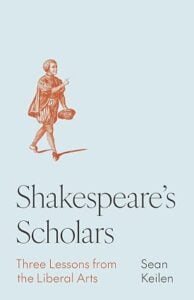
 Shakespeare’s Scholars: Three Lessons From the Liberal Arts
By Sean Keilen.
Princeton University Press, 2026.
Hardcover, 184 pages, $24.95.
Reviewed by Jesse Russell.
“What we need are places, i.e., a table with some chairs around it, in which we can learn again to read together.”
What makes a real university? This is one of the most important questions in twenty-first-century educational discourse. In an age in which enormous glittering college sports stadiums tower over decaying libraries and classrooms, many—students and parents alike—would argue that having competitive Division 1 sports programs makes a university. Other individuals unacquainted with university life would argue that a beautiful and well-manicured campus with Ivy League Gothic or, if the college is located in the Sunbelt or south of Mason-Dixon line, classical and Romanesque buildings, is the defining mark of true university. Perhaps one of the most popular selling points of the twenty-first-century university is “return on investment.” A student should be able to graduate with little to no debt and quickly have a high paying job. One of the last points that contemporary people would point to as a mark of a good university, however, is a strong liberal arts program.
This seems strange because, in addition to law and theology, a liberal arts program has long been considered an essential element of a university. For millennia, the liberal arts have been an essential element of intellectual formation, not only in the West, but throughout the world. Understood as the “humanities,” the liberal arts are what shape and mold someone into a human, helping students to develop both moral and intellectual virtues. As “liberal,” they are what allow us to be free and the things we do when we are free. They are, in the words of Iain McGilchrist, what make us able to think like an adult. However, disappointing the contemporary public’s desire to have “credentials” and the “university experience,” liberal arts are increasingly perceived as a waste of time. In his recent work, Shakespeare’s Scholars: Three Lessons from the Liberal Arts, UC Santa Cruz’s Sean Keilen argues that some of the solutions to contemporary malaise in the liberal arts can be found in the works of William Shakespeare.
Keilen argues that Shakespeare should be read and viewed as a teacher as opposed to merely an object of study. He believes that Shakespeare specifically has much to teach about scholars and scholarship and liberal arts. More importantly, Keilen believes that one can learn about him or herself through the study of Shakespeare. In his approach, Keilen is part of a long tradition of Shakespeare scholars, dating back to at least Samuel Johnson and extending through Thomas Carlyle and Iris Murdoch, that sees Shakespeare as a teacher of a way of life, of philosophy. Keilen further criticizes contemporary academics, who, although viewing their work as contributing to social justice, are sequestered from much of common everyday life.
While Keilen seems primarily to be critiquing left wing professors, the same argument could be made against conservative professors who study and teach the Great Books in isolation from everyday life. Keilen further sees progressive academics as being too focused on critiquing society as opposed to offering humanistic virtues. Taking the lead from Judith Butler, Keilen additionally notes that the route to saving the humanities will be found in teaching love for the humanities. Keilen’s use of the left wing Butler to defend the liberal arts may seem odd for conservative readers, but it is reflective of Keilen’s “big tent” approach of trying to unite conservative and liberals in defense of the humanities. Keilen observes that the discipline of English specifically and the wider liberal arts more generally is beginning to reengage the population in a similar manner to how Joseph Addison did with The Spectator. Addison viewed himself as a new Socrates who brought philosophy among the masses.
Drawing from the writings of Maya Angelou and James Baldwin, who both utilized Shakespeare to articulate their experience as historic black Americans, Keilen notes that Shakespeare has the tremendous capability of speaking across time and place and culture—one of the reasons why, one might add, Shakespeare has not been “canceled.” Again, conservative readers may be puzzled at Keilen’s use of Angelou and Baldwin, who are associated with the political left. However, Keilen, again, rightly or wrongly, is attempting to gather together a collection of individuals from a host of ethnic and political backgrounds in support of liberal arts. The core of Keilen’s argument is built around Shakespeare as a teacher of universal wisdom, who has the tremendous ability of getting his audience to sympathize with both his heroes and villains. Shakespeare himself was a voracious reader who searched for wisdom in books, and Keilen hopes to inspire his readers to likewise search for wisdom in the plays of Shakespeare.
Keilen humorously notes that Shakespeare’s play Love’s Labor’s Lost takes aim at precisely these haughty academics who isolated themselves from the population for insular study. Hamlet likewise tells of a scholar who retreats into his mind away from others, and the bard’s enchanted The Tempest speaks of a scholar-magus who isolates himself on an island. Keilen notes that all these scholars end up in at least semi-tragic situations that include the “loss of authority.” There is a clear reference here to contemporary American distrust of higher education and the belief that the liberal arts have become impractical. Keilen’s goal in Shakespeare’s Scholars is to argue for the values that Shakespeare teaches in the Elizabethan poet’s discussion of scholars and scholarship. One of those values is humility, which Shakespeare teaches in Love’s Labor’s Lost, where Shakespeare lampoons buffoonish scholars who think of themselves as above the hoi polloi. The second value is found in Hamlet: to seek wisdom. The third value is to know oneself, which is one of the messages of The Tempest. Like figures in Greek tragedy before them, the characters in these plays must suffer in order to discover the truth.
Keilen notes that Love’s Labor Lost, Hamlet, and The Tempest all end with a call to action. In The Tempest, Prospero returns to a life of service in Milan. In Hamlet, Hamlet tells Horatio to tell his story, and Love’s Labor’s Lost’s Berowne will set out on a humanitarian mission. While American higher education is often associated with technical and scientific study, Keilen notes that even American scholars such as Harvard’s W.J. Bate as early (or late!) as 1960 argued that the goal of literary criticism is to re-humanize technical science. Indeed, there is a pressing need to accomplish this goal in the twenty-first century, and various tech figures, such as Peter Thiel, have, for better or worse, attempted this process of humanization outside of the academy. Cambridge University’s George Steiner likewise argued for more discussion and reading and less specialization in the 1980s. Keilen makes the interesting observation that there is a strong book culture that is alive and well on the internet. This is a point that professional academics have been side stepping for quite some time. There are innumerable social media accounts and podcasts that discuss literature at level equal to or even superior to much of college instruction. Keilen, for his part, argues that there remains a need for professional academics.
Keilen points to another character in the Tempest, Prospero’s daughter Miranda, who speaks in Act 4 of building a school of virtue and art. Drawing from Wendell Berry (who also does not fall into an easily defined political category), Keilen notes that the humanizing effects of the liberal arts helps make us more than merely naked apes and wards us off from becoming monsters. Some conservative and perhaps even liberal critics of Keilen might question his big tent approach of bringing in so many disparate thinkers. Humanities also help break through human solitude and isolation. The humanities are necessary, Keilen argues, for us to function as a society. Education should come through reading the great works of literature, and, in the English language, Shakespeare is among the greatest teachers. He is one of the greatest teachers because he is a seeker of wisdom, always asking “how to live rightly.” His works explore this search for wisdom and provide a host of often conflicting variants on the good life—and he invites his audience to join him in his search.
There is the underlying question of why there is so much hostility to the liberal arts. Conservatives would argue that the liberal arts became too progressive and deconstructionist, overly criticizing and deconstructing the Western tradition. Those on the left might argue that the liberal arts have always been too elitist and impractical. Postliberals might argue that contemporary twenty-first-century culture has become too plebian, too democratic, and too resentful of intellectual life. Christians may argue that the loss of interest in the liberal arts is part and parcel with the loss of Christian faith in the West. Regardless of which diagnosis prevails, as Sean Keilen argues, one of the sources of revival of the liberal arts is the works of William Shakespeare.
Jesse Russell has written for publications such as Catholic World Report, The Claremont Review of Books Digital, and Front Porch Republic.
Support the University Bookman
The Bookman is provided free of charge and without ads to all readers. Would you please consider supporting the work of the Bookman with a gift of $5? Contributions of any amount are needed and appreciated!


