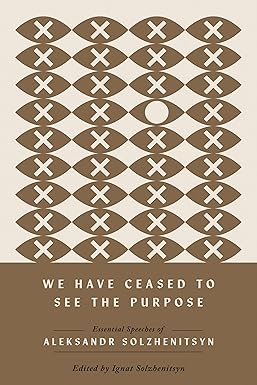
 We Have Ceased to See the Purpose: Essential Speeches of Aleksandr Solzhenitsyn
Edited by Ignat Solzhenitsyn.
University of Notre Dame Press, 2025.
Hardcover, 228 pages, $28.
Reviewed by William Scott.
The eighth title to appear in Notre Dame Press’s “Center for Ethics and Culture Solzhenitsyn Series,” this collection of ten of Aleksandr Solzhenitsyn’s speeches, from 1972 to 1997, offers an ideal introduction to Solzhenitsyn’s thought on social, political, and, above all, moral and spiritual matters. The volume is ably edited by Ignat Solzhenitsyn, who, along with his brothers Stephan and Yermolai, translated most of the speeches included in the book. The speeches appear in chronological order, with helpful annotations and contextual information provided for each speech at the end of the book, together with a detailed biographical timeline of key events in Solzhenitsyn’s life. Ignat Solzhenitsyn’s fourteen-page introduction to the collection glosses the major themes of the speeches, while at the same time situating each of them in the context of its specific historical occasion.
The two most well-known speeches in the book, the “Nobel Lecture” (1972) and “Harvard Address” (1978), are also the longest and most comprehensive, expressing many of Solzhenitsyn’s core beliefs with characteristic urgency and sincerity. The “Nobel Lecture” is the only speech to explicitly address the nature of art and the power unique to great works of literature, in particular. Solzhenitsyn describes here what he takes to be the essentially mysterious, revelatory, and quasi-divine light of Truth that emanates from every great work: “The very irrationality of art, its dazzling convolutions, its unforeseeable discoveries, its shattering impact on men—all this is too magical to be wholly accounted for by the artist’s worldview, by his conception, or by the work of his unworthy fingers.” For Solzhenitsyn, the genuine work of art is a gift to mankind, bestowing a truth that the artist is only partially responsible for shepherding into existence. Through it, one glimpses a divine power, or what Solzhenitsyn often calls the “Supreme Spirit.”
This experience of truth gained in the encounter with the work of art, Solzhenitsyn asserts, is to be sharply contrasted to the work of lies, violence, and obscurantism perpetrated by the power of the State, through its oppressive ideological apparatus. The entity Solzhenitsyn refers to as the State (in this case primarily, but not limited to, the former U.S.S.R.) depends for its survival upon a systematic distortion of the realities of human life. It thus seeks to silence, marginalize, or destroy any individuals, particularly artists, who appear to threaten it through the revelatory power of their work. Yet the truth of art, Solzhenitsyn contends, will always outlast and defeat the lies of the State, despite the oppressive measures the latter takes to dictate the terms of its own reality.
Drawing on the insights of Igor R. Shafarevich’s critical survey of socialist experiments throughout the history of the West, in The Socialist Phenomenon, Solzhenitsyn argues that every concrete form of socialist society is nothing more than an “earthbound religion,” rooted in a principled and militant atheism, and necessarily relying upon violence and coercion at every level. In the cultural sphere, the corollary to such an oppressive regime is a radical avant-gardism, which falsely understands the sole purpose of art to be a quest for innovation at any price. Much like the socialist and communist societies they spring from, the radical avant-gardists in the realm of the arts call for the wholesale destruction of prior traditions, condemning all past artistic achievements to the dustbin of “reactionary” culture. Accordingly, Solzhenitsyn remarks, the leftist avant-garde of the former U.S.S.R. sought to eradicate the entire legacy of Russian classical literature.
Thus, socialist societies are not only premised on social and political forms of coercion, but also, and just as essentially, on what they view as a “progressive” disdain for all past cultural traditions, including religion and the arts in equal measure. Socialism, Solzhenitsyn argues, exacerbates the radical alienation between one generation and the next by severing the cultural and historical ties that join artists to their respective communities. To resist this tendency, artists must constantly work to maintain the deep organic links that connect the generations of the dead to those of the living. Further, for culture itself to be possible, in any time and place, individuals of a given society must recognize the primary fact that it is the inner life of the soul, the singular spirituality of each individual person, that serves as the cradle of cultural production.
A person’s spiritual life, then, must maintain its distinctly non-materialistic character to operate freely. The fact that the great works of world literature, taken together, illustrate something of the “spiritual unity” of mankind itself, on a global scale, proves, therefore, that these writers must have succeeded in overcoming the limitations of a strictly materialist worldview; to speak soul-to-soul, as it were. Just as the two-thousand-year-old tradition of Christianity has worked to tie societies and generations together across historical periods, so great artists and their works link disparate souls together, since these are similarly grounded, at their core, in the spiritual life of mankind. For this reason, Solzhenitsyn concludes, any so-called “progress” or advancement of society must begin, always and everywhere, in the soul of the individual—not in the revolutionary fantasies of radical social reformers, whose aims work to dissolve the spiritual bonds that underlie the traditional fabric of human communities.
The artists who faithfully and truthfully represent their respective cultures are thus artists who maintain a sense of reverence for what Solzhenitsyn calls the holy, the divine, the Supreme Spirit, or simply God (which he names explicitly in only one speech in this collection, “The Templeton Lecture,” from 1983). Such artists practice a discipline of self-restraint, having learned to subordinate their material interests as individuals and artists to a higher, spiritual set of “moral criteria” that transcend the secular tendencies of their time. These tendencies—which include the virtually universal acceptance of utilitarianism, materialism, and anthropocentrism as the order of the day—have collectively worked to establish the dominance of a secular worldview, with its faith in a form of atheistic individualism that Solzhenitsyn calls “humanism” (corresponding to what Irving Babbitt would have termed the secular, scientific “humanitarianism” of the Baconian variety).
It is precisely this mode of self-centered anthropocentrism—the exclusive focus on man himself as the measure of all things—that, according to Solzhenitsyn, has alienated mankind from its essential grounding in the life of the spirit. The radical materialist culture of the last two hundred years, equally common to both the Communist East and the capitalist West, has brought in its wake a high degree of material and technological advancement, with many obvious benefits for mankind. Yet, it has simultaneously fostered a culture of complacency, comfort, and, ultimately, selfishness, for the highest values in such a culture must begin and end with the material needs of the individual. One clear illustration of the poverty of this culture, which Solzhenitsyn invokes frequently, is the tendency towards “legalism”: the reduction of the entire field of human morality to the system of positive laws, which gives free rein to the self-serving and ego-driven demands of individuals, who feel constrained in their behavior only by a set of external legal codes, the limits of which they are constantly pressuring.
Underlying this radically secular, materialist society, which has shaped the development of the West from the Enlightenment to the present, Solzhenitsyn sees the workings of what he calls “false” freedom, or a freedom based on external codes, an atheistic or agnostic worldview, and positive legal rights. The self-centered, ego-driven individuals in such a society view the experiences of others only as relative to their own; their nominalist view of human experience stubbornly refuses to admit the possibility of any transcendent realm of universal values; and thus they refuse to acknowledge even the transmissibility of basic meaning from one person to the next, or from one generation, community, or nation to the next. Solzhenitsyn here draws a direct line from the “genius” type of artist that was so loftily praised by the Romantics—a fundamentally egocentric figure who followed exclusively the dictates of his own personal, sentimental impulses—to the contemporary figure of the “postmodern” artist, who believes only in the free play of shallow stylistic devices (see his 1993 speech, “Playing Upon the Strings of Emptiness”).
It is worth noting that Solzhenitsyn’s views on aesthetics, past and present, parallel much of Irving Babbitt’s thinking in the latter’s masterful study, Rousseau and Romanticism, from 1919. Like Babbitt, Solzhenitsyn concludes that the most important duty of the artist—and indeed, of every thoughtful, reflective individual in society today—is to learn, or to re-learn, the discipline of “self-limitation.” This idea corresponds closely to what Babbitt, More, and the New Humanists, following Burke, termed the “inner check.”
In the end, therefore, Solzhenitsyn’s brilliant and thought-provoking speeches amount to a compelling plaidoyer for personal accountability, responsibility, and self-restraint; a plea for the value of life as one steady effort of continuous “moral ascent.” It is this, and this alone, which defines “true” freedom, as Solzhenitsyn understands it: namely, the freedom to grow spiritually, through self-limitation and the superordination of moral obligation over the baser impulses of one’s nature. Having lost touch with this morally grounded notion of freedom over the last two hundred years, Solzhenitsyn asserts, the West created the conditions for the horrors of the twentieth century that it was then forced to suffer through. It follows, then, that, failing the effort to revive a genuinely humane reverence for the numinous, divine source of moral principle, there is no reason to expect that the twenty-first century will be any less barbaric than its predecessor.
William Scott is Associate Professor of English at the University of Pittsburgh.
Support the University Bookman
The Bookman is provided free of charge and without ads to all readers. Would you please consider supporting the work of the Bookman with a gift of $5? Contributions of any amount are needed and appreciated!
