
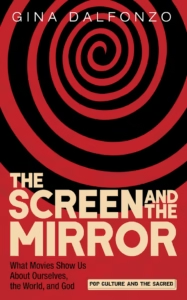
 The Screen and the Mirror: What Movies Show Us About Ourselves, the World, and God
By Gina Dalfonzo.
Cascade Books, 2026.
Paperback, 164 pages, $23.
Reviewed by Thomas Banks.
Like reading classic literature, viewing and studying classic film is a means of examining our consciences and safeguarding against the slough of moral complacency. So Gina Dalfonzo argues in The Screen and the Mirror.
Here Dalfonzo describes what she takes to be a common temptation to identify ourselves imaginatively with the heroic protagonists in the films we most enjoy—without pausing to ask if we do not bear, at least in our worst moments, an alarming resemblance to some of these same pictures’ villains. In this way, one of the book’s premises is that habitually imagining ourselves as the hero can swell the ego and distort our understanding of our own character.
To develop these and other ideas, the author brings a considerable stock of knowledge about cinema both as an art and an industry. Of the several films she scrutinizes in varying degrees of detail, I had seen most of them more than once. Chinatown, The Apartment, The Godfather, Vertigo, and others I have seen more than half a dozen times. Dalfonzo’s analysis of each of these brought to my attention something my eye had not seen or my critical sense had too quickly dismissed. She brings especially welcome insight to Network, finding more in it than simply a Juvenalian excoriation of mass media in the decade of malaise. It is that, and less observant critics have been content to explore the film’s enthrallingly cynical surface. Dalfonzo captures something less obvious and much sadder behind the curtain, namely that its characters are corrupted not merely by the nature of the business in which they earn their livings, but by a lack of honest self-knowledge that inhibits their capacity to detect the shallowness of their own poisoned ambitions. Without saying so directly, she also indicates the uncomfortable truth that it is nearly as easy to cheat an unsuspecting public by means of an artificial prophet as with any other bill of goods.
In the book’s few pages on David Lean’s Bridge on the River Kwai, we find at work the same sharp eye that is not easily satisfied with the exterior or the obvious. The author notes that, while the film has often been taken to be a sort of pacifist sermon, such a categorization is “a little facile.” With this I am inclined to agree, as I am with the remainder of her assessment. As a story it is almost unique, I believe, in its treatment of a chief character who descends into very real and alarming treason while remaining, from beginning to end, altogether sincere. Dalfonzo finally concludes that the story is about a man destroyed by genuine virtues devoted to a false cause, a betrayal so gradual that neither he nor we can say exactly when it occurs. And this is dramatically appropriate. The road to eternal loss need not include sudden precipices among its outstanding features.
This book is written in an informal manner that makes no unwarranted demands on its reader. I liked it both for the reasons already given, and for the greater enjoyment I hope to derive from whichever of these films I happen to watch in the near future. Having spent far too much of my life in front of the television, it is rare that I meet with or read anyone who knows film history better than I do, and to have made such an acquaintance here was both pleasant and instructive. This left me somewhat abashed at my resistance to Dalfonzo’s wish that viewers examine their own consciences more closely when watching classic films. More and more in recent years I have become convinced that one of the indispensable goods not only of film but of art generally is that in it we meet the almost infinite “Not I” and in so doing may evade for a brief while the limitations of our own private personalities and the concerns that attend them. Dalfonzo’s conception of film as a moral mirror that serves to reveal to us our lapses and failings is certainly founded on an honest and conscientious set of wishes—on that score I have no doubts. I nonetheless suspect that this hope emerges from a blurring of the formal and moral properties of art. That the latter exist as surely as the former I affirm.
As I read Dalfonzo’s book, it increasingly appeared to me that she excels chiefly in formal analysis, while the interest she brings to her work is fundamentally moralist (a word I use without any pejorative intention). To use film or any art as a touchstone against which to test the purity of one’s own conscience is to hold a false or incomplete understanding of its primary end. I wonder too if a cinephile who formed this habit would not soon lose much of the joy he took in the act of viewing. For most people, the movie theater does not serve as a vestibule of the confessional.
Dalfonzo writes that “Great art is supposed to teach us, to change us, to alter our whole way of seeing the world and ourselves…The ability to look at a film or painting or story and see reality in a new light is one of the great gifts that art gives us. And that reality includes our own flawed human nature.” Assuredly, a chance meeting with the right book or play or film at a propitious moment can and does have a transfiguring effect on the reader or viewer. Most of us have probably had such an experience, and would pity someone who had not. The error may lie in expecting such epiphanies to occur whenever we approach art with the right intention, or in assuming that a film’s truths must apply directly to our own lives.
However much I might take issue with one of this work’s principal motives, I found myself at the end of the last page wishing that Dalfonzo had written a thicker book. Since she has not done so, I will simply hope that she writes another one, and that before long.
Thomas Banks lives in North Carolina and teaches online at the House of Humane Letters. His writings have appeared in First Things, Quadrant, Touchstone, the New Oxford Review, and elsewhere.
Support the University Bookman
The Bookman is provided free of charge and without ads to all readers. Would you please consider supporting the work of the Bookman with a gift of $5? Contributions of any amount are needed and appreciated!


