
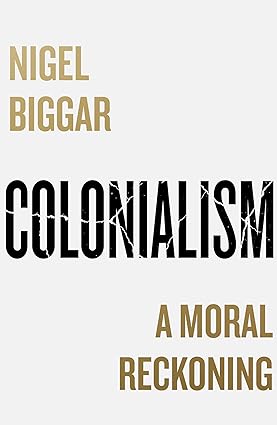
 Colonialism: A Moral Reckoning
By Nigel Biggar.
William Collins, 2023.
Hardcover, 480 pages, $34.99.
Reviewed by Daniel J. Fischer.
The urge to write history can strike almost anyone. Authors of major works of history in recent decades include people with graduate degrees in history, of course, but they also include novelists, journalists, a foreign-service officer, a presidential advisor, a Librarian of Congress, a lawyer, an investor, a minister, and even (according to the book-cover bio) a “retired personnel manager and politician.” Now, the ranks of historians also include at least one ethicist: Nigel Biggar, recently retired from Oxford University.
Biggar picked a tempestuous time to take up history writing. Western cultural leaders increasingly depict their history through jeremiads against their own people. They are challenged by insurgents who call for a less corrosive reading of the past. Biggar walked right into this firefight with Colonialism: A Moral Reckoning, which evaluates the legacy of the British Empire. Biggar argues that the history of the British Empire “is morally complicated,” so the British should remember it with not only “lament and shame” but also “admiration and pride.” While Biggar demonstrates plenty of nuance, his book amounts to a defense of the British Empire. He succeeds at giving the reader ample reasons not to hate his home country, but also misses an opportunity to use his unique training to pioneer a more innovative form of history.
Biggar knows what he’s up against. He organizes his book into eight chapters, each built around one criticism of the British Empire. The British Empire was a coordinated effort to seek riches by exploiting nonwhite people. The British built the Industrial Revolution on the brutal enslavement of Africans in British imperial territory, an evil the British only outlawed once its profitability began to decline. The British committed crimes against indigenous peoples by stealing their land, strangling their economies, repressing their political participation, misgoverning their domains, and exterminating their populations or at least committing “cultural genocide,” which sometimes meant confining native children at abusive residential schools where large numbers died. And the British kept people down to suffer all this mistreatment through the use of illegitimate, unrestrained warfare.
Biggar makes his defense by showing that the empire was not as bad as the critics say, not uniquely evil when it did err, and even a force for good. Officials and individuals built the empire to pursue a wide range of goals, usually “innocent,” from national security to altruistic projects like preventing conflict in Africa to individual improvement through moving up the social ladder or escaping poverty. When the British acquired land from natives, they usually did so through treaties, which restrained rapacious settlers and gave native peoples the means to win compensation for unjust treatment later. And, anyway, the land on which the British settled was often not land that, as critics of the British Empire often claim, had belonged to its occupants “since time immemorial” but was, rather, land that its occupants had conquered from someone else.
Coming under British rule was not necessarily a catastrophe for natives. The British sometimes brought progress. “We Habe wanted them [the British] to come,” recalled an early-twentieth-century Nigerian woman, because the British protected the Habe from being impressed into slavery or concubinage by the neighboring Fulani. British economic policies inflicted pain on natives but also brought benefits. Many Africans willingly adopted wage work, for example, because their incomes offered higher social status and the opportunity to afford things they wanted, such as a bride price. The British tried to assimilate native peoples out of a belief in human equality. The residential schools were part of this effort, and although they were often squalid, they did offer training in agriculture and other skills necessary to survive in an inescapably industrializing world, skills natives often sought. Britain often governed with skill and liberality, granting suffrage to some natives, including blacks in the Cape Colony of southern Africa in 1853, and winning “the widespread acquiescence, participation and cooperation of native peoples” by offering “security, the rule of law and the honesty of officials.”
British colonial warfare emerges from Biggar’s scrutiny looking worse than almost any other feature of British imperialism. Biggar’s survey reveals that it was often unjust or excessively violent. But Biggar also finds that it was often defensible—the Second Anglo-Boer War (1899-1902) and the war in Benin (1897)—and that even where the British wrongfully used force, there is much to be said to mitigate the blame. Furthermore, the use of the military might of the British Empire benefited the whole world. “The empire at its most violent” fought the just world wars against Germany and Japan.
Perhaps Britain’s greatest sin as a colonial power was profiting from slavery, but even here Biggar produces some exculpatory evidence. Neither slavery nor the slave trade was the main cause of British industrialization. And when Britain banned the slave trade in 1807 and slavery in 1833, it did not hold back. Biggar concludes, after reviewing the literature, that these policies did not target an outmoded form of labor. They cost something. They hindered Britain’s economic growth, and Britain spent another 1.8 percent of its economic output between 1808 and 1867 on battling slavery around the world by means such as capturing slave ships by force.
Biggar mainly focuses on how the relentlessly negative reading of the British Empire fails as history, but he closes with a plausible explanation of what drives those who adopt this perspective and what makes their work so pernicious. Not only simple self-interest but also latent theology drives negativity. “Typical academics,” says Biggar, “just want to get on in life” and see “that anti-colonialism is fashionable.” Those who write negative history also feel pride in their own goodness. Warped Christianity drives critics of the empire to fall “from genuine humility into a perverse bid for supreme self-righteousness, which exaggerates one’s sins and broadcasts the display of repentance.” Interests aligned only with writing negative history degrade historical practice. “The anti-colonialists want the worst to be true,” and they “make history no longer an authority that constrains what may be claimed, but merely an armoury to be ransacked in the interest of rhetorical advantage.” Self-righteousness feeds authoritarianism when wedded to a belief that everything is permissible if it is done for those one sees as oppressed.
Biggar leaves room for more work to be done in the vein of the British Empire’s “moral reckoning.” If one knew nothing about Biggar’s background, one would think this book was written by a historian. Biggar does use ethical theory. For example, he explains what makes racism wrong and how racism differs from rating cultures—which demonstrate “characteristic strengths and weaknesses”—against each other, and he holds British uses of force up to the light of just-war theory. But his main mode of argument is to reconstruct and analyze the past. His work invites another writer to someday write an ethical history less intent on reconstructing the past than on showing how past actors hold up to a particular ethical approach.
Biggar also could have set himself a harder task if he had really put the British Empire on trial. He certainly admits the sins of the imperialists: adopting a patronizing attitude, destroying the economy of Bengal in the mid-eighteenth century, burning slaves in the West Indies alive as punishment for rebellion, and stealing so much land from the Māoris that New Zealand had to pay out hundreds of millions of New Zealand dollars in reparations between 1975 and 2000. Instead of setting the strongest case for and against the Empire against one another as in a courtroom, Biggar devotes most of his space to defending the Empire against criticism.
These suggestions for where future writers might go by no means imply that Biggar has failed to compose a work of great value. His mountain of historical examples casts a shadow over the completely critical reading of the British Empire. He has mastered and summarized a vast amount of material. Indeed, one way to enjoy Biggar’s book is as a tour of world cultures and how the British interacted with them. Ethicists can write history, too.
Daniel J. Fischer is a writer and copy editor who specializes in working with historians. He has a PhD in history from the University of Arkansas, Fayetteville. He is writing a book titled “The War on Winter: The Settlement of the Northern West and the Dawn of Modernity.” He keeps a Substack called the A La Carte Scholar.
Support the University Bookman
The Bookman is provided free of charge and without ads to all readers. Would you please consider supporting the work of the Bookman with a gift of $5? Contributions of any amount are needed and appreciated!

