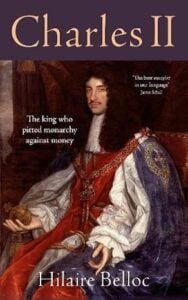
 Charles II
By Hilaire Belloc.
Mysterium Press, 2026.
Hardcover, 252 pages, $24.95.
James II
By Hilaire Belloc.
Mysterium Press, 2026.
Hardcover, 264 pages, $24.95.
Reviewed by Thomas Banks.
Hilaire Belloc penned an impressive cycle of historical biographies, which includes lives of Cromwell, Charles I, Richelieu, and Louis XIV. Of the art of historical narration Belloc had an outstanding command—few writers have described battlefields and the death-scenes of great men more memorably—as well as a pronounced set of biases. Prussia, parliamentary government, and the banking industry were a few of his most frequently anathematized betes noires. Mysterium Press recently brought out attractive new editions of Belloc’s twin studies of the Brothers Stuart, Charles II and James II, the last two Stuart kings, both characteristically delightful and enlightening to read.
In 1660, when Charles Stuart received the applause of the London people who came to greet their long-exiled sovereign, it may have been unknown to both the monarch and the crowd that his restoration was and would remain precarious and incomplete. Though he would reign for twenty-five years, Charles II found himself almost from his coronation surrounded by uncooperative and frequently inimical parliaments, and was at first handicapped by the enormous national debt which had accumulated during the years of the Interregnum. That his reign would not be untroubled and his policies not unopposed appeared from the outset, when Charles’s Declaration of Breda was frustrated by the Cavalier Parliament. By this declaration he had intended to secure toleration for all Catholics and Protestant Dissenters who recognized the rights of the Crown. His first parliament however, in which sat many members who had suffered dispossession and punitive taxation during the rule of the Puritans, was in no mood to treat these offences as forgivable bygones. The king’s intentions were overruled, and not for the last time.
The country over which Charles ruled was, in the year of the Restoration, in a financial pit. War at home and abroad and the maintenance of a large army had driven Cromwell to the device of forced exactions and loans, and the nation’s debts had piled up predictably. Such was the predicament which Charles inherited when he established himself in Whitehall. As things stood, the king was no longer an independent ruler but simply an exalted piece of the constitutional framework to whose making many hands and events had contributed.
If the national treasury was in a bad state, the state of religion was scarcely in a happier condition. The average Englishman was a confirmed Protestant, but what manner of Protestantism would win the loyalty of the nation and secure a controlling influence in the councils of state was not yet definitely settled.
Charles’s own stance on questions of Church and State was, from his return till his life’s end, an ambiguous one. He was the son of a French Catholic mother and a father who had suffered martyrdom for the prerogatives of kingship and the English Church by law established. He had evidently inherited none of his father’s strict devotion to any faith, but his Roman connections were sufficient to raise concerns in many to whom the memories of Mary Tudor and Smithfield were a source of lasting fear and prejudice against Rome and her votaries. Charles was conscious of these concerns and of the dangers they presented, and so tried to steer a middle course in the matter of religion.
Charles’s younger brother James, Duke of York was of an altogether different cast of mind and spirit: impatient and determined, with none of Charles’s caution or capacity for subterfuge. James had been won to the Catholic faith by the overtures of his first wife, Anne Hyde, the daughter of Clarendon. Henceforth his Catholic beliefs became the determining agent in all of his public doings and in all that was done against him both before his elevation to the throne and after. Midway through the reign of his brother Charles, James was removed from command of the Royal Navy by the passage of the Test Act of 1673, aimed specifically at him and designed to bar all non-Anglicans from rank and high office.
There followed during the next dozen years an often violent game of maneuver and counter-maneuver between the court and its allies on the one hand and the leaders of the aristocratic and Parliamentary interests on the other. The bitterest campaign within this wider contest broke out in the so-called Popish Plot, an outbreak of popular hysteria and organized persecution that swept the country after the ominous death of the magistrate Edmund Berry Godfrey in 1678. Two confirmed knaves and petty criminals, Titus Oates and Israel Tonge, used the opportunity supplied by the judge’s suspicious death to stir up the already strong anti-Roman superstitions of the London mob with rumors of a Jesuit conspiracy against the liberties of England. The hue and cry went up: arrests and trials, or the semblance of trials, succeeded in due course. Soon the government stood in danger of losing all control of the situation. The result of this eruption of religious frenzy was the judicial execution of more than thirty Catholic priests and laymen.
After the popular furor was spent, a widespread reaction against the architects of the plot drove many of them into hiding or exile. King Charles managed to spend the last of his years in relative peace. Having no legitimate children of his own, he was able to leave his crown and country to his Catholic brother, having by political wire-pulling succeeded in preventing an Exclusion Bill from stripping the younger Stuart of his claim to the throne. He died early in 1685, having received the last rites of the Catholic Church on his deathbed.
Charles had guessed that his brother’s term of rule would be a short one, and events soon justified his prediction. Within four months a rebellion rose in the south of England with Charles’s illegitimate son the Duke of Monmouth raised up as the figurehead of English liberties and the Protestant Creed. Monmouth, in the event, proved a weak reed, and the rebellion collapsed in a rout before the royal army at the Battle of Sedgemoor. A wiser man than James would have taken this rising as a providential suggestion that a hasty pursuit of his designs would only provoke stronger resistance. James gave no thought to this. Nor did he make secret his intention to secure for his fellow Catholics all of the rights and freedoms enjoyed by their Protestant fellow-subjects.
To fortify himself against further treasons and rebellions, he garrisoned within the precincts of London a considerable standing army, raising in much of the citizenry unpleasant memories of Cromwell’s dictatorship and the rule of the major-generals. James’s political objectives and his reckless pursuit of them alienated a growing number of his ministers and members of the governing class. The birth of a crown prince to his second wife drove still others into the camp of the opposition, some of whose members were by now engaged in treasonable negotiations with the Dutch Staadholder William of Orange with the intention of overthrowing James and Popery in Britain once and forever.
Against an enemy armed even with less of William’s talent for intrigue, James might easily have been at a disadvantage. Against the Prince of Orange in allegiance with many of his own counselors and commanders (the future Duke of Marlborough deserted to William after the Prince’s landing at Torbay), James was utterly outmatched. Nearly as soon as William’s forces set foot in England, James’s sense of command failed him altogether. After some dithering and indecision and the effective disintegration of his army, he returned to London where he fell into the hands of the Dutch.
The royal captive was soon permitted to escape, as William had no wish to make a political martyr after the model of James’s father, and his parliamentary allies were unsure of what to do with the constitutionally inconvenient prisoner. And so James, with a few attendants, made for the Thames and thence for France. It is generally accepted that he tossed the Great Seal of the Realm into the river as he made his departure. After an attempt at gaining a strategic foothold in Ireland suffered a decisive reversal at the Boyne, James remained for the last dozen years of his life as a pensioner of Louis XIV in the Chateau of St. Germane-en-Laye. To his son and grandson he bequeathed the damnosa hereditas of Jacobitism with its tragicomic intrigues, brave loyalties, and doomed hopes.
Even with his occasional missteps and argumentative tangents, Belloc remains a draught of fresh air and a happy antidote to the official version of English national history, with its idealized tale of public-spirited reforms and liberal advances broadening down to the happy present. His books are no less instructive today than they were in his lifetime, and Mysterium Press deserves our thanks for restoring a small piece of what otherwise might have been lost.
Thomas Banks lives in North Carolina and teaches online at the House of Humane Letters. His writings have appeared in First Things, Quadrant, Touchstone, the New Oxford Review, and elsewhere.
Support the University Bookman
The Bookman is provided free of charge and without ads to all readers. Would you please consider supporting the work of the Bookman with a gift of $5? Contributions of any amount are needed and appreciated!

