
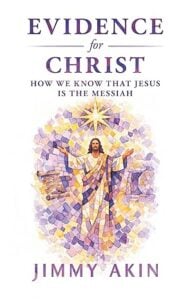
 Evidence for Christ: How We Know That Jesus is the Messiah
By Jimmy Akin.
Catholic Answers Press, 2026.
Paperback, 183 pages, $16.95.
Reviewed by David Weinberger.
Christianity proclaims Jesus the messiah, but many Christians have a hard time explaining why—specifically, which messianic prophecies Jesus fulfilled. A new book by senior Catholic Answers apologist Jimmy Akin supplies those answers. In Evidence for Christ: How We Know That Jesus is the Messiah, Akin explores the ancient Jewish idea of the Messiah, along with the historical evidence for Christ, arguing that Jesus is indeed the anointed one foretold in the Old Testament.
Akin begins by considering what the term “Messiah” means. As he explains, the word translates to “anointed one” and refers to the ancient practice of spreading oil over something or someone to consecrate them to the service of God. Accordingly, “there were many individuals who could be described as a mashiakh or Messiah.” Examples include Old Testament kings like David and Saul, as well as high priests like Aaron, prophets like Elisha, and even pagan rulers like Cyrus the Great, who liberated the Jews from the Babylonian exile and allowed the Temple to be rebuilt.
Later, however, there arose an expectation that a final unique Messiah would be sent by God, although interpretations differed on what precisely this figure would do. On the one hand, there was a “Kingly” expectation that the future Messiah would be a righteous ruler who descended from David and who would initiate religious renewal and preside over an everlasting kingdom. On the other hand, there was a view of the future Messiah as a “suffering servant” who would give his life as a sin offering for others and later be raised back to life. However, as Akin stresses, “there are Jewish sources that interpret the Servant here as the Messiah. But there are also Jewish sources that do not.” There were also other messianic expectations reflected in non-biblical Jewish writings such as the Dead Sea Scrolls. These texts, discovered in the 1940s near the Dead Sea, describe a coming figure who “will perform marvelous acts such as have not existed, just as he said. For he will heal the badly wounded and will make the dead live, he will proclaim good news to the poor.”
Having surveyed these differing messianic expectations, Akin then turns to the question of why Old Testament prophecy could give rise to such varied interpretations in the first place. One reason, he explains, is that Biblical texts possess both a “literal” and a “spiritual” sense. While the literal sense conveys what the human author intended, the spiritual sense refers to deeper meanings providentially intended by God beyond the awareness of the human author. These deeper meanings often do not become evident until years or even centuries later.
A classic example is Isaiah 7:14, which says, “Behold, a virgin shall conceive, and bear a son, and shall call his name Emmanuel.” In its immediate historical context, this prophecy likely had a meaning tied to a political crisis facing King Ahaz in eighth-century BC Judah. Scholars believe it referred, on the literal-historical level, to a child born in that era as a sign that God would preserve Judah. But as Akin notes, “this does not stop the prophecy from having a spiritual sense that could point forward to the Messiah, and [to] Jesus.” Centuries later, the Gospel of Matthew explicitly identifies this prophecy as fulfilled by the virgin birth of Christ. In this way, God providentially guided history toward Christ, even though Isaiah himself may not have been aware of it.
After bringing the reader through all of this, Akin turns to the historical record to assess the messianic credentials of Jesus. While there is no shortage of views today concerning the identity of Christ, Akin makes a persuasive case that the orthodox presentation of him in the New Testament is accurate. He also shows why alternative views ultimately fail.
For example, critics of Christianity sometimes allege that the resurrection of Jesus is nothing more than an updated version of pagan myths in which gods rise from the dead. But as Akin argues, these parallels collapse under closer examination, since no pagan gods were said to have resurrected in any meaningful sense of the term. As he explains, “The sources [for the claim that pagan gods rose from the dead] describe two classes of deities,” he writes. “The first were gods who disappeared and returned; but disappearing and returning are not the same thing as dying and rising. Members of the second class of gods would die and then stay dead. Even the reanimated Osiris could not return to the world of the living, so he became the lord of the dead.”
Second, even if it were true that pagan myths taught that their gods rose from the dead, that is irrelevant to whether Jesus in fact did so. The latter must be assessed based on the evidence. And there, as Akin lays out, the evidence is strong. While we do not have space to examine it here, readers will find full chapters dedicated to it in the book. One thing worth briefly noting, however, is that much of the force of that evidence will depend on one’s prior commitments. If, for example, one believes there is no God and that miracles are categorically impossible, then any naturalistic explanation—no matter how strained—will seem more reasonable than the idea that Jesus rose from the dead.
Beyond the historical case for the resurrection, Akin also devotes considerable attention to the ways in which Jesus fulfills major messianic prophecies. Take, for instance, the prophecy of the Suffering Servant. In the Old Testament, Isaiah prophesies that “He was pierced for our transgressions…and by his wounds we are healed.” Isaiah also describes this figure as rejected by men, suffering innocently, bearing the sins of others, remaining silent before his accusers, and ultimately bringing healing and justification to many. Moreover, he goes on to say that “the eyes of the blind shall be opened, and the ears of the deaf unstopped; then shall the lame man leap like a deer and the tongue of the mute sing for joy.” All of this, of course, fits Jesus eerily well. According to the gospels, Jesus performs precisely the kinds of acts Isaiah associates with the coming servant: giving sight to the blind, healing the deaf, making the lame walk, and restoring speech to the mute. Akin explores these connections in greater detail throughout the book, along with numerous other prophecies Christians believe culminate in Christ. “All of this evidence,” he concludes, “combines to make a compelling case that Jesus really did fulfill messianic prophecy, that he really did rise from the dead, and that he really is the messiah.”
For Christians who struggle to articulate why they believe Jesus is the Messiah, Evidence for Christ provides accessible and engaging answers. The result is a work that is both historically informed and theologically rich, offering readers a deeper understanding of why Christians have long believed Jesus to be the promised Messiah.
David Weinberger is a freelance writer and book reviewer on topics related to philosophy, culture, Christianity, and economics. Follow him on Substack here and X @DWeinberger03.
Support the University Bookman
The Bookman is provided free of charge and without ads to all readers. Would you please consider supporting the work of the Bookman with a gift of $5? Contributions of any amount are needed and appreciated!


