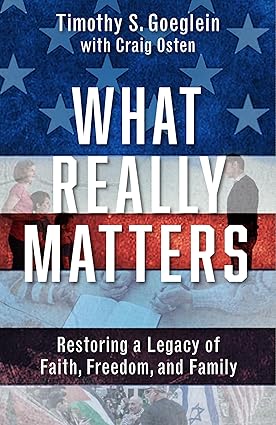
 What Really Matters: Restoring a Legacy of Faith, Freedom, and Family
By Timothy S. Goeglein with Craig Osten.
Fidelis Publishing, 2026.
Hardcover, 264 pages, $28.00.
Reviewed by Cory Andrews.
In an age when so many of our inherited institutions seem to be unraveling under the pressures of a restless, self-regarding individualism, it is a rare and welcome thing to encounter a book that speaks with quiet conviction about the things that have long sustained the American republic. Timothy S. Goeglein’s What Really Matters is just such a volume. Collected from columns written over several years for The Washington Times and other venues, these essays do not pretend to offer a grand philosophical system or a partisan manifesto. Instead, they unfold like a series of thoughtful conversations around the hearth—conversations that return again and again to the enduring sources of human flourishing: marriage, family, ordered liberty, religious faith, and a lively sense of the past.
As one who loves his country, Goeglein writes not with the brittle zeal of the ideologue but with the steady affection of a man who has seen both its promise and its perils up close. Having served for nearly a decade in senior positions in the United States Senate and nearly eight years at the White House—and for the past 18 years as the vice president of government and external relations at Focus on the Family—he brings to these pages a combination of personal witness, statistical clarity, and scriptural depth that is all too uncommon in our polarized moment.
The result is less a polemic against the present than a gentle yet firm invitation to remember what we have nearly forgotten—that the good life is not a solitary pursuit of personal authenticity but a shared enterprise of commitment, sacrifice, and mutual regard. What makes the book so especially resonant is its refusal to treat these themes as abstract ideals. Yes, ideas have consequences, but they also have antecedents. Goeglein grounds his observations in the concrete realities of American life today—the quiet erosions that have left so many adrift, yet also the persistent undercurrents of renewal that still flow beneath the surface.
The book’s opening chapters on marriage and family are especially compelling in this regard. Goeglein does not merely lament the decline of these institutions; he shows, through careful attention to the data and to lived experience, how their weakening has left so many Americans—particularly the young—adrift in loneliness and discontent. Drawing on the work of scholars such as W. Bradford Wilcox and the late James Q. Wilson, he reminds us that cohabitation is no adequate substitute for the covenantal bond of marriage, and that the “soulmate” quest, so often celebrated in our therapeutic culture, can become an excuse for endless postponement.
Yet these pages are never dour. As a confessional Lutheran, Goeglein writes with evident warmth about the quiet joys of faithful wedlock, the irreplaceable gifts of fatherhood and motherhood, and the ways in which prayerful households become schools of virtue and reservoirs of hope. One senses here a Tocquevillian appreciation for the family as the seedbed of democratic habits—the place where we first learn to subordinate self to something larger, whether it be God, family, or the common good. In an era when the very language of obligation has come to seem oppressive, Goeglein gently insists that such bonds do not diminish us; they enlarge us, offering the only reliable path out of the isolation that now haunts so much of our public life.
Equally perceptive are his reflections on the American male, the necessity of a well-ordered society, and the role of religious faith in sustaining both. Goeglein is no stranger to the cultural headwinds—declining church attendance, the retreat from history, the elevation of autonomy over obligation—but he refuses to meet them with despair. Instead, he points to the quiet work of restoration already underway in countless homes and congregations: the young couples choosing commitment over convenience, the fathers rediscovering their calling, the communities that still gather to worship and remember.
His trenchant take on the American male avoids the caricatures that so often mar such discussions. Rather than romanticize or condemn, he recalls the older ideal of masculine responsibility—not as domination but as protective stewardship, the sort of ordered strength that undergirds families and communities alike. This is no call for a return to some mythic patriarchy but a grounded recognition that healthy societies have always depended on men who are formed for something beyond themselves, capable of sacrifice and self-mastery in service to wife, children, and neighbor.
The chapters on a well-ordered society and the importance of religious faith deepen this vision further. Goeglein understands, as Edmund Burke once did, that liberty untethered from moral order quickly devolves into license, and that the “little platoons” of family, church, and local association are the true guardians of freedom. Faith, in his telling, is not a private hobby but the animating spirit that makes ordered liberty possible—the source of the habits of heart that Tocqueville observed among early Americans. Goeglein’s reflections here carry a quiet historical resonance, echoing the ways in which earlier generations, from the Puritans to the Framers, saw religious conviction not as an obstacle to freedom but as its indispensable foundation. In our own time, when so many seem to have traded transcendence for therapeutic self-expression, these essays remind us that faith has always been the great teacher of limits and hope—the very qualities our fractious republic needs most.
No less salutary is Goeglein’s treatment of history itself. In an era when the American story is too often reduced to a catalog of grievances or a pageant of progress, he recalls us to its larger meaning: a land of hope, imperfect yet aspirational, whose freedoms were purchased by the sacrifices of those who came before. He does not shy away from the nation’s failings, but neither does he allow them to eclipse its achievements or its capacity for self-correction. This is history as remembrance rather than indictment—a living conversation with the dead that equips us to face the future with gratitude and realism alike. One cannot read these pages without sensing how much our present discontents stem from a severed connection to the past, and how any renewal must begin with its patient recovery.
What makes What Really Matters more than a collection of occasional pieces is the coherence of its vision. Goeglein understands that faith, freedom, and family are not isolated ideals but interlocking pillars of a humane social order. When one weakens, the others tremble. The foreword by Jim Daly and John Stonestreet rightly notes that the book offers no overnight panacea, only the patient work of “small corrections”—the sort of moral and cultural reorientation that has always marked genuine renewal. Readers will find here no trace of nostalgia for a mythical past, but rather a clear-eyed appreciation for the best of our inheritance and a hopeful realism about what can still be recovered. Even in its concluding thoughts, the volume maintains this tone of measured hope, pointing not to policy fixes or cultural crusades but to the ordinary virtues practiced in everyday places.
In the end, Tim Goeglein has given us something better than a diagnosis of our ills. He has offered us a reminder of who we have been and, with God’s help, who we might yet become. For anyone weary of the shouting matches that pass for public discourse, What Really Matters will come as a refreshing companion. It deserves a wide and attentive readership—not least among those who still believe that the American story, rightly understood, remains a story worth telling, and a legacy worth restoring. In a culture that too often mistakes noise for insight and indifference for liberation, Goeglein’s voice stands as a model of what thoughtful public reflection can still accomplish. Rather than bombard us with certainties, he invites us back into the ancient conversation about what it means to live well together. That invitation, extended with such grace and clarity, is one we would do well to embrace.
A former Wilbur Fellow at the Russell Kirk Center for Cultural Renewal, Cory Andrews lives and worships in Alexandria, VA.
Support the University Bookman
The Bookman is provided free of charge and without ads to all readers. Would you please consider supporting the work of the Bookman with a gift of $5? Contributions of any amount are needed and appreciated!


