
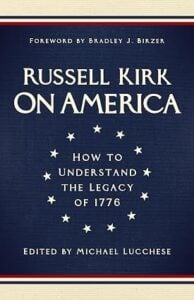
 On America: How to Understand the Legacy of 1776
By Russell Kirk. Edited by Michael Lucchese.
Creed & Culture, 2026.
Hardcover, 234 pages, $28.
Reviewed by Christopher J. Scalia.
There’s no such thing as a bad time to read Russell Kirk, but America’s 250th year is an especially good one. Kirk—the founder of this journal—helped place American conservative thought in a broader intellectual tradition and provided intellectual ballast to the movement that would shape American politics and culture for generations. For On America: How to Understand the Legacy of 1776, Michael Lucchese has gathered 17 essays in which Kirk discusses not only the Founding, but also the nation that the Revolution created, the distinctive nature of the people who imagined and developed it, and the traditions they inherited and adapted.
Lucchese, an associate editor of Law & Liberty and contributing editor to Providence, has organized his selections into three sections and a postscript. “American Roots” comprises six essays about the Founding and its origins. It is followed by “American Statesmanship,” in which we encounter Kirk’s meditations on significant Americans both great and obscure, and finally “American Letters,” which showcases Kirk’s abiding belief in the importance of a nation’s literary culture.
As distinct as the sections are, several common themes and ideas recur. The first is that America has been, from its founding, an essentially conservative nation. Kirk’s interpretation of the Revolutionary War, offered most thoroughly in “A Revolution Not Made but Prevented,” is that the Founders did not seek a revolution in the way we understand the word today; their aim was not to innovate, but “to preserve an old constitutional structure for the most part.” This perspective, displaced by scholarship that emphasizes the revolution’s radical consequences (most famously by the recently departed Gordon S. Wood), is bracing to encounter again.
This vision of the Founding is in keeping with Kirk’s broader understanding of America’s conservative nature. “Americans have known no political revolution, either violent or accomplished with bloodshed, for two centuries,” he boasts, “nor have we consciously swept away old ways of living in community so that we might conform to some brave new ideological design.” Indeed, as Kirk notes in the postscript, the most aggressive push toward innovation and novelty has been “large scale constitutional alteration by a judicial aristocracy” in the form of a wayward Supreme Court.
America’s conservatism is grounded in restraint, both personal and governmental. Kirk articulates “the traditionalists’ understanding of the American mission: that is, to maintain and improve a republic in which the claims of freedom and the claims of order are balanced and reconciled—a Republic of liberty under law, endowed with diversity and opportunity.” Or, as “America the Beautiful” puts it, “confirm thy soul in self-control / Thy liberty in law!” Kirk applies this restraint to America’s attitude toward other nations. Although he wants America to be “an example to the world,” he insists on doing so modestly, as “the U.S. has not been appointed the keeper of the world’s conscience. The toleration we practice at home extends also to our foreign policy.” Of course, this attitude put him in conflict with his conservative peers who favored a more aggressive foreign-policy stance.
Restraint is also important for statesmen if the republic is to stay true to its principles. That comes through in Kirk’s disdain for President Lyndon B. Johnson, the “Caesar from Texas” he calls “evil” and “hard, coarse-fibered, eager for the main chance, utterly unimaginative.” (If you think that’s rough, wait until you hear what Kirk thinks about the “vindictive, unscrupulous, lustful” Robert F. Kennedy.) LBJ is a template for a president grasping at imperial powers: Kirk speculates that “should such an American Caesar stride forward, he would be a vulgar autocrat, as Lyndon Johnson was.” Responding to an historian’s observation, he foresees the possibility of “Caesarism veiled by humor and incongruity!” Reading those descriptions, you don’t have to suffer from Trump Derangement Syndrome to wonder what Kirk would have made of the current president.
The counterpart to a restrained traditionalist vision is an ambitious “humanitarian, or social-democratic, understanding of the American mission,” which seeks “to destroy the old order in all the rest of the world, the old faiths, the old governments, the old economies, the old buildings, the old loves and loyalties.” Kirk singles out Nathaniel Hawthorne’s fables for depicting “the catastrophe of well-intentioned humanitarianism between moral blinkers.” Recent Democratic primary results and the new mayor of New York City’s praise for “the warmth of collectivism” show these warnings are worth republishing.
Closely related to this recurring restraint is Kirk’s belief in man’s fallen nature. He praises men who understood that even in a New World, original sin obtains. Hawthorne’s greatest accomplishment was “impressing the idea of sin upon a nation which would like to forget it.” Similarly, “Lincoln knew the savagery that lies close beneath the skin of man, and he saw that most men are good only out of obedience to routine and custom and convention.” And the elder Adams understood that “only religious faith, stable institutions, and candid recognition of his own failings can withhold man from the spiritual destruction that lurks at the back of such appetite.” In a poignant essay about Adams’s great-grandchildren, Henry and Brooks Adams, we learn that their departure from their ancestor’s religious beliefs led them toward a much darker, more materialistic vision of America.
And then there’s the literature. Kirk’s most important contribution to American conservative thought may have been his serious engagement with poetry and fiction. He did not reserve this emphasis for his many discussions of poets and novelists. In “Ronald Reagan and the Virtue of Audacity” (originally published in 1982), Kirk meditates on the virtue of politicians who use poetic language. “All truth lies in poetry,” he declares, “the poet’s maxims being sounder and more enduring than the party leader’s.” Kirk has no truck with Mario Cuomo’s advice to campaign in poetry but govern in prose. Poetry is all: “The more poetic imagination possessed by an eminent public man, the better for the Republic. . . . Poetry tends to draw people to humane politics, as against ideological politics.”
This love for poetry helps explain Kirk’s surprising esteem for his occasional debate partner, the Democratic senator and occasional presidential aspirant Eugene McCarthy, whom he calls “the only poet among recent public men.” Kirk even imagines, given McCarthy’s admiration for Burke and Tocqueville, that the senator “might have turned the most imaginatively conservative of presidents.” So impressed was Kirk by this poetry and inchoate conservatism, in the 1976 presidential election Kirk voted for McCarthy instead of Gerald Ford, who was both a Republican and a fellow Michigander.
As his esteem for McCarthy makes clear, Kirk saw a distinctively conservative element to the poetic temper. Conventional wisdom associates the artistic temperament with progressive or radical views, which is why you will occasionally encounter an enlightened bigot declare that conservatives cannot make good art. Kirk rejected this humbug. In an essay about T.S. Eliot and Robert Frost, he declares that “the enduring themes of serious poetry have been those of order and permanence.” The poet, seeing what is askew with his time, seeks “to set time right . . . by rallying in his art to permanent things.”
Lucchese has not shied away from including essays in which Kirk goes against the grain of American conservatism as it exists today or praises an idea of America that is a distant memory. Kirk’s preference for the agrarian is clear in his regret that John Adams did not triumph over Alexander Hamilton and John Marshall. Marshall imposed “the Federalists’ vision of an expanding, united, commercial nation” that, while demonstrating “conservative tendencies” in some regards, “opened the way for illimitable changes of industrialization and consolidation.” In the same essay, Kirk also claims that Thomas Jefferson “was a sounder conservative than Hamilton: for the latter was eminently a city-man, and veneration withers upon the pavements.” Kirk’s belief that the farmer was “that great and stable element of society” is why he so admired John Randolph of Roanoke, an emblem of “the conservative nature of agricultural interests, which had little to gain from change, while the commercial, financial, and industrial interests were full of youthful vigor and rapacity.” Kirk’s rural preferences are also on display in an essay about his home in Mecosta County, Michigan.
This collection is an excellent entry point for readers new to Kirk. Selections include passages from The Conservative Mind, America’s British Culture, and Rights and Duties. Kirkians may quibble at the absence of The Roots of American Order, but much of that book’s discussion of the Declaration of Independence is represented in the essay “A Revolution Not Made but Prevented,” first published in Modern Age. (Kirk re-used the title, taken from British historian E.J. Payne, as a section heading for Chapter XI of Roots.)
But the volume is not only valuable for Kirk tyros, as Lucchese includes two previously unpublished works: an essay about Huckleberry Finn and a speech about Abraham Lincoln. (The latter is available online.) Several have never been printed in this form since their original publications decades ago. For example, “Will American Caesars Arise?” includes material that Kirk adapted for The Sword of Imagination: Memoirs of a Half-Century of Literary Conflict, and the essay about Henry and Brooks Adams, first published in Dublin Review, was repurposed for The Conservative Mind. Kirk completists will enjoy the familiar ideas in new contexts. Lucchese also captures Kirk’s frequently quirky intellectual preferences by including an essay about Randolph and giving Orestes Brownson (“one of the more interesting of America’s political thinkers”) some attention. On the other hand, John C. Calhoun is absent—a prudent editorial decision.
On America, like so much of Kirk’s writing, is at once timely and timeless. It is a wonderful collection to celebrate both Russell Kirk and the semiquincentennial.
Christopher J. Scalia is a senior fellow at the American Enterprise Institute and the author of 13 Novels Conservatives Will Love (but Probably Haven’t Read) (Regnery, 2025).
Support the University Bookman
The Bookman is provided free of charge and without ads to all readers. Would you please consider supporting the work of the Bookman with a gift of $5? Contributions of any amount are needed and appreciated!
