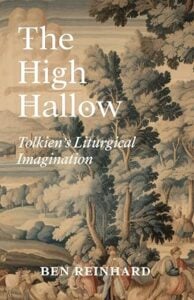
 The High Hallow: Tolkien’s Liturgical Imagination
By Ben Reinhard.
Emmaus Road Publishing, 2025.
Hardcover, 184 pages, $24.95.
Reviewed by Benjamin J. Volpe.
“My living room bookcase has an entire shelf filled with Tolkien’s works and works commenting on Tolkien’s works. What in Middle-earth do I need one more of these for?” Thus spoke my skepticism when I encountered Ben Reinhard’s The High Hallow. But perhaps this could be the one commentary to rule them all? Many Catholic writers have already delved deep into the Misty Mountains in search of precious deposits of theological mithril. But Reinhard makes a unique case that exploring Tolkien’s entire body of work through the lens of the Catholic liturgy as Tolkien experienced it turns up rich insights into both the man and the myths he wove.
Reinhard begins with a defense of this liturgical interpretation. He then provides a sketch of Tolkien’s life, highlighting the significance of Catholic liturgical worship in his routines and patterns of thought. The remainder of High Hallow offers insights into Tolkien’s fiction, showing how liturgical symbolism permeates the world he sub-created. Reinhard’s final result is a work whose premise and design is both novel and enlightening, and one which inspires the reader to return once again to Tolkien’s works.
The central interpretive lens of this book is liturgy, the formal public worship offered to God on behalf of the people. Priests of ancient religions offered animal sacrifices on altars to their gods, but the Catholic priest offers the perfect sacrifice of the Eucharistic Body of Christ on the altar to God for His glory and salvation of human beings. Catholic liturgy is rife with visible signs and symbols—not just words; the pre-Vatican II form of the ritual (which Tolkien attended and served at for most of his life) is even more steeped in symbolic language. Reinhard points this out to distinguish Tolkien’s religious experience from the common experience of Catholics today, and even more so from that of Protestants. To view Tolkien merely as a “Christian writer” overlooks the way that rich liturgical symbolism shaped his imagination and his literary style. As an interesting counterfactual, Reinhard asks whether a Protestant or a modern writer would have been able to write The Lord of the Rings. The answer is probably “no” for a number of reasons, one being that few people today are immersed in the older form of liturgy on a daily basis the way Tolkien was from boyhood to the end of his days.
I have read a lot of faith-based commentary on Tolkien’s work, and I was expecting to revisit familiar concepts in Reinhard’s book. There is of course some overlap between his arguments and others, such as Craig Bernthal’s in Tolkien’s Sacramental Vision: Discerning the Holy in Middle Earth. However, I was pleased to be treated to numerous insights that I had not yet observed. To give just one example, in his chapter on “paschal patterns” in The Lord of the Rings, Reinhard quotes the following from Return of the King. After the ring has been destroyed, a minstrel sings of the deeds of Frodo at a victory celebration and Tolkien describes the impact this has on the main characters: “Their hearts, wounded with sweet words, overflowed, and their joy was like swords, and they passed in thought out to regions where pain and delight flow together and tears are the very wine of blessedness.” I think many readers, myself included, might pass by such a moment without much regard. But its meaning became clear to me when Reinhard pointed out that “for anyone who has felt the full force of the transition from Good Friday to Easter, the emotion described is immediately recognizable.” As soon as I read this, I realized from my own experiences of Holy Week liturgies that this must be indeed the subtext of Tolkien’s triumphal victory celebration. But Reinhard further demonstrates the point by quoting Tolkien’s own words from one of his letters: “The Resurrection was the greatest ‘eucatastrophe’ possible in the greatest Fairy story—and produces that essential emotion: Christian joy, which produces tears because it is so qualitatively like sorrow, because it comes from those places where Joy and Sorrow are at one, reconciled.” The similarity between the passage from Return of the King and Tolkien’s own description of “Christian joy” would indicate that the heroes of The Lord of the Rings are therefore “partakers in the Christian joy,” leading Reinhard to claim with good reason that “at this point, the boundary between Tolkien’s fantasy and Tolkien’s faith becomes vanishingly thin.”
This book speaks to the fan of Tolkien who knows that there is religious significance to The Lord of the Rings but wants to gain a deeper understanding of how Tolkien’s work is imbued with his faith. Tolkien thought that Christianity was too obvious and therefore unbelievable in the works of C.S. Lewis. Lewis, on the other hand, thought that Christianity was so hidden in the works of Tolkien that no one would find it. If anyone has ever really succeeded at the task of finding all of God’s hiding places scattered throughout Middle-earth, it would have to be Ben Reinhard, who makes some bold claims, such as: “Middle-earth as a whole was borne out of the Advent liturgies of the Church.” However, he never fails to support his conclusions with evidence from Tolkien’s life, his letters, his works, and often all three. This book also piqued my interest to read some works outside Tolkien’s main legendarium, such as Smith of Wooton Major, which has even more obvious liturgical overtones than The Lord of the Rings. Finally, this book’s treatment of liturgy and symbolism is of spiritual benefit especially for Catholics in recalling the power of the liturgy and the signs and symbols God uses to make His presence felt. Tolkien fans will do well to add bookshelf space for just one more investigative adventure into Middle-Earth.
Benjamin J. Volpe is a teacher and choir director in New York.
Support the University Bookman
The Bookman is provided free of charge and without ads to all readers. Would you please consider supporting the work of the Bookman with a gift of $5? Contributions of any amount are needed and appreciated!
