
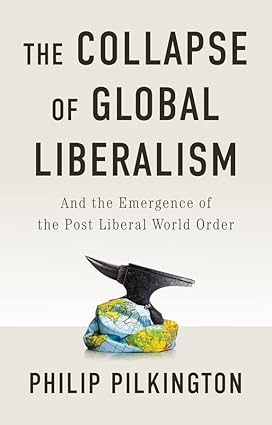
 The Collapse of Global Liberalism: And the Emergence of the Post Liberal World Order
By Philip Pilkington.
Polity, 2025.
Paperback, 240 pages, $22.95
Reviewed by Gene Callahan.
Philip Pilkington has written a very provocative and thought-provoking book, one that deserves to be taken seriously by anyone interested in the future of currently liberal polities. Quite naturally, he first turns his attention to the question of just what is this thing that is collapsing. His answer is: “We will consider liberalism to be the Enlightenment political ideology par excellence that sought to level and ‘rationalize’ social and political relationships. Liberalism’s target has always been hierarchical structures in politics and society at large.” Of course, many alternative definitions are possible, and definitions, by definition, cannot be wrong, only more or less informative. But in this case, I think Pilkington has provided us with a highly informative one.
As Pilkington tells it, liberalism began by attacking the privileges of the aristocracy, and then of the legally established churches. But the tearing down of hierarchies could not stop there: as with any ideology that promises to cure us of the world’s ills, liberalism has had to keep going, since all was not yet cured. The levelling had to continue: Cultures could not be deemed better or worse, with the exception that, as far as they were not liberal, they were worse. No “lifestyle” could hold itself superior to any other way of living. No sexual activity, so long as it is voluntary, could be regarded as better or worse than any other. All sources of “arbitrary” authority, such as parental control over their children, also had to be swept away.
Pilkington describes the many societal ills that this destruction of hierarchies entailed: plummeting birth rates, rising mental illness, increased drug addiction, soaring out-of-wedlock births, the de-industrialization of many liberal countries, wars taken on for ideological reasons rather than a prudential analysis, and so forth. While Pilkington’s diagnosis of liberalism as the source of these diseases seems sound, his confidence that global liberalism is collapsing rapidly and that the immediate future will be “post-liberal” leaves me uneasy. Even if we grant that liberalism is an inherently unstable way of organizing a polity, does that really allow us to predict just how rapidly that instability will lead to a downfall?
After all, let us consider the progress of the Roman polity: It was clearly already unstable by the late-second century B.C., with the rise of populism led by the Gracchi brothers, and with the brothers’ subsequent assassinations. Civil wars and various dictatorships followed, as did periods of renewed stability, such as the period of the “five good emperors.” Yet, in the West, the Roman polity survived another five centuries, while in the East it limped along until 1453 A.D. (The residents of what we today call “The Byzantine Empire” self-identified as Romans and understood the political unit in which they lived to be the Roman Empire.) Pilkington might respond that the Roman polity changed how government was organized several times over the centuries, and that is true. But even so, the Roman example shows that instability can persist for quite a while.
So, given that we know a polity can be in decline for a very long time, from whence comes Pilkington’s confidence that the demise of liberalism is nigh? He could well be correct, but I can also envision a future in which the death throes of liberalism extend over centuries.
One aspect of liberalism noted by Pilkington is its rationalism, in the pejorative sense of the term as used by Michael Oakeshott, among others. Indeed, liberalism’s reason for opposing hierarchy and involuntary relationships is that it deems them “irrational.” However, in Pilkington’s understandable desire to discredit forced rationalist revamping of customary practices, he makes a claim that I think is mistaken. In particular, he criticizes the attempt of the French revolutionaries to establish decimal timekeeping by claiming: “the 24-hour day and the calendar that grows out of it are based on lived reality of night and day as it occurs on earth.”
I contend that the correct argument against the 10-hour clock is that the French revolutionaries had been hypnotized by the fact that they counted in base-10 into thinking that measuring everything in multiples of ten was somehow more rational than using any other divisor, such as 12 or 24. And since that belief was mistaken, there was no reason to do away with dividing the day into 24 hours: it is, in truth, more “rational” to use the conventional divisor, and not disrupt everyone’s time keeping to switch to a different, and equally arbitrary, one. (For your consideration: it was the spread of mechanical clocks that led to dividing the day into twenty-four equal periods. So wasn’t this “natural” division already the result of society changing to meet the needs of a machine?)
Pilkington devotes an entire chapter to the mistakes liberal governments have been making in military strategy. Now this is an area in which I have no expertise, and so I am in no position to critique Pilkington’s case here. But I can (I hope) summarize it: liberal governments are bewitched by their belief in progress (so that later tech must always beat earlier tech), and their conviction that the price of something reflects its utility (so that a $100 million weapon must be better than a $90 million weapon).
As a result they have spent way too much on very high-tech equipment and far too little on building up large quantities of cheaper but still effective materiel. As an example of the strategic missteps possible due to this liberal bias, he cites the case of the Lancet drone, which costs around $35,000, but is very effective at taking out $11 million Leopard tanks. Pilkington estimates that, once we take into account purchasing power parity (a technical macroeconomic concept we needn’t dwell on here), “For every Leopard II tank Germany can produce, Russia can produce 683 Lancet drones.”
Along the way here, he claims, contra the liberal faith that higher prices mean commensurably higher quality, that “the market for military equipment is very likely not competitive.” However, this notable difference between government spending on the military and private spending is not something that would surprise any libertarian or public choice theorist. So is this really a case where liberal ideology leads people astray?
In perhaps just an overly all-or-nothing statement, Pilkington contends that, “The [advanced] technologies themselves were developed by the state…” Now, it is true that, for instance, the Internet began as a DARPA project, and that NASA has given birth to many technological advances. But what about the myriad of technologies developed by private companies, especially innovators such as Toyota, 3M, Bell Labs, or Xerox PARC? A free-marketer might well respond to Pilkington, “Imagine how much more the private sector might have developed if so much R&D energy wasn’t diverted to government use?” Pilkington may have a good answer to this question, but it is not in this book.
Turning to demographic matters, Pilkington notes that once liberalism thoroughly infects a society, that society’s birth rate begins to plummet, eventually falling below the replacement rate. This fact can hardly be disputed, since remarkably it has held without exception. Thus, liberalism is faced with the awkward reality that liberal societies always commit demographic suicide.
In most liberal nations, the response to the problem of declining native populations has been to import people to make up for the deficit in native births. But, as Pilkington points out, this solution both ignores the societal strains resulting from incorporating large numbers of immigrants who are not familiar with their new culture, and will lose out to liberal imperialism: once liberal values are exported to all nations, as is the liberal dream, then there will no longer be nations with above-replacement birth rates from which to import people.
Furthermore, importing workers to make up for low native birth rates also harms the countries they are being imported from. As Pilkington puts it:
Liberal Westerners were in effect utilizing economic incentives to break up families and communities in the developing world to provide cheap labour in the developed countries… Rather than seeing this for what it is – the outsourcing of raising children – liberals dressed this up as a form of altruism. Bizarrely, under late liberalism, support for biological imperialism became a test of one’s morality…
Aging Western societies with below-replacement birth rates also create internal conflicts in those societies. The interests of the older generations, who hold most of the assets and are happy to see the prices of those assets continuously rise, are at odds with the interests of the younger people, who, just starting out in their careers, have little in the way of savings and would like to purchase assets at lower prices. This problem is especially acute in housing, where, as Pilkington points out, wealthy seniors are purchasing second homes for vacations, while young people are unable to afford first homes.
In response to these problems, Pilkington recommends that post-liberal societies make family creation and support a priority in policy making; for example, he advocates state-subsidized housing for families.
When it comes to macroeconomics, Pilkington is scornful of the typical free-trader’s response to the disruptions free trade causes:
If the worker ends up in a depressed region of his country addicted to opiates for the rest of his life, all the liberal economist can do is try to further reduce the worker’s actual identity to equivalence by saying that the “average” worker’s “equilibrium living standards” have risen.
To address this problem with international trade, Pilkington interestingly revives a proposal by John Maynard Keynes for a planned system involving a notional trade currency called the “bancor” and a schedule of remedies for persistent trade surpluses, such as forced investment by the nation running a surplus in the nation experiencing the deficit.
Pilkington, unfortunately, does not present any argument as to why persistent trade deficits are worrisome. The standard response from advocates of free trade to such concerns is to present an analogy where I, a computer programmer, habitually run a “trade deficit” with my local grocer: I regularly buy his groceries, but he never purchases any of my software. And the point of the free trade case here is that there is no cause for me to worry about this situation. Of course, there may be reasons why scale matters here, and that my trade deficit with the grocer is a flawed analogy with one nation’s trade deficit with another, but Pilkington does not provide such reasons.
In a chapter entitled “Madness: Commercial and Civilizational,” Pilkington notes the very odd confluence of two contradictory ideas in liberalism: The first is that people should be able to do whatever they want so long as they are not directly attacking the person or property of another. So we should not involuntarily institutionalize people who quite obviously are not able to manage their own lives, nor should we ban the use of drugs that cause people to behave in an antisocial fashion. And yet, at the same time, liberal courts excuse horrific crimes committed by people suffering from some mental illness or under the influence of some strong drug.
Pilkington concludes his book by declaring the importance of teleology for post-liberal thought. By this, he means that post-liberals should recognize that living beings have ends that are inherent in their nature: a common example is that an acorn has the natural end of becoming an oak tree. And so too do individual human beings, human families, and polities. These ends are not a matter of choice or “individual preferences”: they spring from the very nature of these entities. The family, for instance, has the natural end of bearing and rearing the next generation of human beings. Recognizing this reality can guide post-liberal policies. For example, Pilkington writes:
A society that is organized against human nature will be a chaotic and unhappy society – if pushed too far against its nature, it will collapse. A society that organizes itself in line with human nature will never be perfect, but it will be more optimal in a society that is not organized in such a way.
And that all strikes me as correct. However, Pilkington seems to me overly sanguine when he follows the above by declaring that “Such a society will be stable, prosperous, and its inhabitants will be content and happy.” Was it not a society that was teleologically oriented (that of Medieval Christendom) that gave birth to the unstable and discontented society we live in today? Indeed, weren’t Adam and Eve living in accordance with their natural ends when the serpent slithered into the garden? And yet, nevertheless they ate the apple. Pilkington perhaps misses the tragic aspect of human existence that led someone like Plato to note that even if we could establish the perfect city, human nature would soon lead to its degeneration.
Pilkington then outlines a list of his recommended policies in many of the areas contemplated earlier in the book. In defense policy, the post-liberal polity “should favor quantity over quality, cheap over expensive.” (It is of note here that Pilkington is the first person I’ve encountered making this connection between liberalism and mistaken military tactics, as opposed to mistaken aims, like “make the world safe for democracy.”)
A concern I have about Pilkington’s recommendations is that they often seem to rely on states being more successful guides of economic activity than I suspect is likely. Here, I think any prudent post-liberal must recognize the genuine insights of such brilliant thinkers as Mises, Hayek, and Buchanan about the epistemic and motivational realities that lie between a state’s purported aims in undertaking some economic program and its actual ability to achieve those aims.
Incorporating the insights of such thinkers does not mean that all post-liberals must change their profiles and replace “post-liberal” with “libertarian.” Acknowledging the efficiency of markets is not incompatible with seeing that they are often very efficient at producing very bad results: just consider the blight of widespread porn addiction that has been spawned by “efficient” markets in pornography.
In any case, for such a slim work, Pilkington’s book is impressively packed with challenging ideas. This review, unfortunately, could only address a select few of them. The fact that some of them are not fully fleshed out or defended is probably more a result of the desire to keep the book short, rather than of the author’s inability to defend them if asked to.
In conclusion, this is an important new work, and anyone interested in what lies ahead for liberal societies would be well-advised to read it.
Gene Callahan is the author of Economics for Real People and Oakeshott on Rome and America, and co-editor of the books Tradition vs. Rationalism, Critics of Enlightenment Rationalism, and Critics of Enlightenment Rationalism Revisited. He has a PhD in political theory from Cardiff University and teaches at NYU.
Support the University Bookman
The Bookman is provided free of charge and without ads to all readers. Would you please consider supporting the work of the Bookman with a gift of $5? Contributions of any amount are needed and appreciated!

