
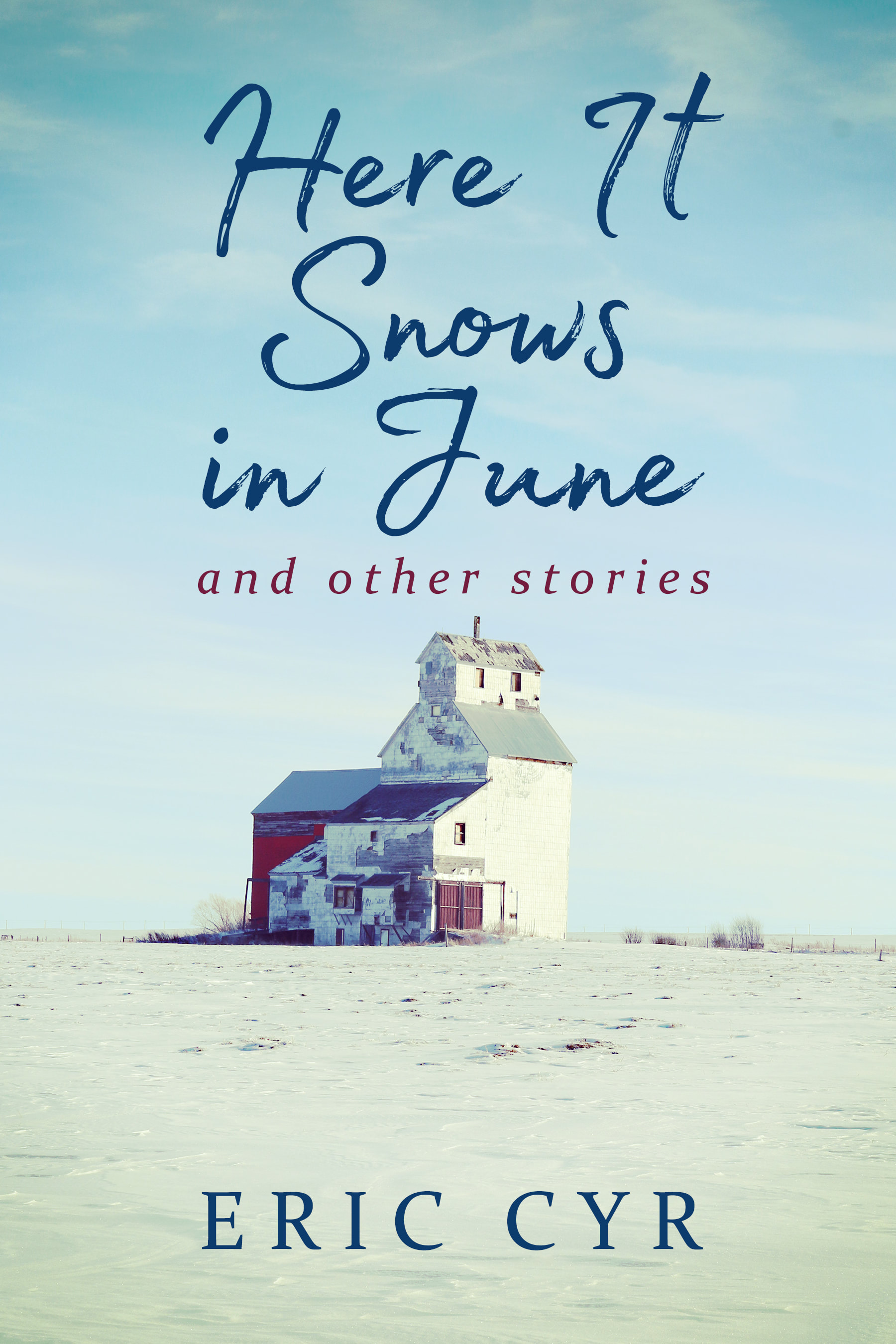
 Here It Snows in June & Other Stories
By Eric Cyr.
Wiseblood Books, 2026.
Paperback, 156 pages, $16.
Reviewed by Nadya Williams.
A driver on I-71 who takes the exit toward Ashland, Ohio, my home now for nearly three years, will be greeted with an oversized welcome sign, boldly proclaiming: “World Headquarters of Nice People.” Shortly after pulling off on this exit, a driver is also likely to find himself sharing the road into town with a horse and buggy—or several. Amish farms encircle the town as if embracing it in a gentle hug, their premises easily recognizable by the laundry billowing outside in the yard and chickens and children roaming freely. Hitching posts are available in the local Aldi parking lot. Everyone in town is connected to everyone else by blood or marriage or church membership. As a result, the crime rate is very low. And you plan for extra time when going to the grocery store or the public library because you will run into an acquaintance or several.
“Midwest nice” is a phrase I had heard before moving here but it took living here to fully understand it. People really are remarkably nice, welcoming to outsiders like my family. But the niceness has a solid steel backbone to it too, suitable for making it through the occasional two-foot snowstorm that may come through in January, or February, or maybe even March or April or May. Or, on rare occasions, in some parts of the Midwest, like Eric Cyr’s Minnesota, in June. Perhaps on prom night.
Deer hunts, baseball games, snowy morning distance runs, and a high school prom—these are just some of the scenes of ordinary Midwestern life that feature in Eric Cyr’s debut short story collection, Here It Snows in June, newly out from Wiseblood Books. It is an unabashedly Midwestern endeavor in every way—a collection of short stories set entirely in the Midwest, written by a Midwestern author, and published by a proudly Midwestern independent publisher that has been producing top-quality books since its inception in 2013.
And Cyr’s collection is no less Christ-haunted too, reminding us that this also is a Midwestern quality. Yes, Flannery O’Connor’s Southern Gothic tales showed the world a South populated by church-going hypocrites, serial killers who ponder the salvation of their souls, and souls deeply lost in ways they couldn’t explain but yearned to understand. You think you know how a story might turn out, or what the point of it is, yet a surprise awaits right at the end, yanking the proverbial rug from right under the careful reader’s feet, reminding: you are not in charge. The writer isn’t done with you yet—whether this writer whose work you are reading or the cosmic writer, the one who alone knows all of our stories and is writing them yet.
Turns out that these qualities, though, are not possible only in literature set in the Bible Belt. I was reminded of O’Connor’s Southern Gothic mode of seeing the world while reading Cyr’s Minnesota-set short stories. This is Midwestern Gothic at its most earnest and Christ-haunted. A young man held up at gun point doesn’t want to give up the keys to the church that he had borrowed for the evening. A priest doesn’t act quite so pastorally during a baseball game. A child fearlessly climbs up the roof of his family home, as his parents watch on with a mix of encouragement and terror. A prom night that ends in snow is a story that ends with unexpected, utterly unforeseen tragedy—but maybe not entirely. A teenage boy out hunting deer with his father finds a human finger in the snow, freshly shot off by someone—but who? It is an appropriate saintly relic for this world, so ordinary yet also not. Marriages struggle along, fathers and sons try as well, and people always stop to help someone on the side of the road or on the street—but may also fight a neighbor over the tree branches encroaching over the property line. Midwestern nice, back again, yet still sinful.
Cyr’s stories, through it all, are more overtly and positively speaking of matters of faith than O’Connor’s. Young men contemplate going into Catholic priesthood, and older priests play baseball. The sanctity of calling comes up again and again. At the same time, Cyr’s interest in portraying marriage and family at different stages and sets of circumstances shows a writer wrestling with the ordinary joys that are not given easily to many. If marriage is meant to be such a delight, why doesn’t it always seem so great, some characters wonder? And if parents are supposed to keep children safe and raise them well, why don’t they sometimes? And, from the parents’ perspective, if having children and grandchildren is supposed to bring you joy, why doesn’t it for some? Unhappy marriages and families are, yet again, each unhappy in its own way. Not every prayer for joy will be answered in the way we expect. But the desire of each of God’s image-bearers to be known fully does not relent.
In this regard fiction helps expand our imagination and our mercy for others. To read a collection like this one is to be taught to feel deeply and pastorally. I have not felt the desire to weep when reading O’Connor’s stories, yet Cyr’s invite such emotion more readily from us. Repeatedly the stories remind us that we are not our own, both theologically and practically, and this means that other people belong to us too, just as we belong to them. This is what dwelling in a family is, and that is what dwelling in a community is, especially in a small one like Ashland, Ohio, or Cyr’s small-town Minnesota.
There is much hope in viewing this broken landscape through its people, and in seeing this brokenness filled to the brim with God’s love. It is with this hope that Cyr leaves his readers—story after story. God is not done with any of us yet, just as he is not done with these fictional sinners who so desperately desire to be good—even if not all of them realize that what they want most is to be true saints.
Nadya Williams is interim director of the MFA in Creative Writing at Ashland University. She is books editor at Mere Orthodoxy and the author of Cultural Christians in the Early Church (Zondervan Academic, 2023), Mothers, Children, and the Body Politic (IVP Academic, 2024), Christians Reading Classics (Zondervan Academic, 2025).
Support the University Bookman
The Bookman is provided free of charge and without ads to all readers. Would you please consider supporting the work of the Bookman with a gift of $5? Contributions of any amount are needed and appreciated!

