 God, The Science, The Evidence: The Dawn of a Revolution
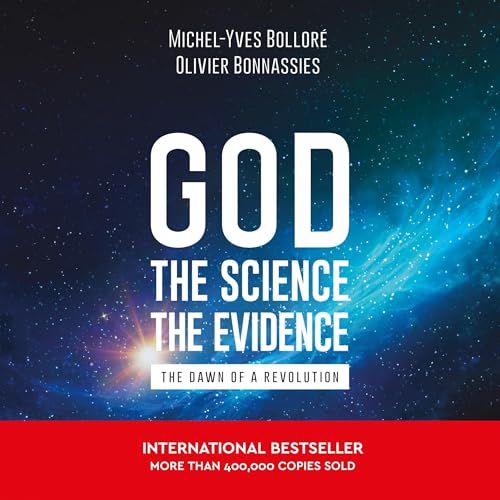
By Michel-Yves Bolloré and Olivier Bonnassies.
Palomar, 2025.
Hardcover, 562 pages, $28.00.
Reviewed by Thomas Griffin.
There has been a pendulum swing in the science world. The claims that most scientists are atheists and that those who have more knowledge of how the universe works know that God isn’t real now belong on the rejected pile of disproven theories.
Michel-Yves Bolloré and Olivier Bonnassies have produced a masterpiece in their work, God, The Science, The Evidence: The Dawn of a Revolution. This book, originally published in French and translated into English in 2025, argues from a multitude of past and present scientific evidence that the once famous materialist mindset of scientists is no longer tenable.
With Copernicus, Galileo, and Newton in the late sixteenth and seventeenth centuries, a worldview arose that erased the need for God. There seemed to be discoveries in science and theories of the laws of the universe that either contradicted a Biblical God or at least removed the need to rely on a God to know how the world works. However, the summaries and coherence of scientific data found in Bolloré and Bonnassies’s book reveal that there is, in fact, a scientific need for a creator God.
In their chapter on the nature of evidence in general, the authors state the purpose of their book. It is not to provide arguments that mandate universal agreement on the existence of God. “Rather, it seeks to present numerous, converging, and independent pieces of evidence that can inspire conviction beyond all reasonable doubt.”
They marshal this evidence against a primary target: materialism, the school of thought of most non-believers today that claims that matter is the only reality. Refutations of materialism are woven throughout the book; there is also a full chapter devoted to this crucial effort. Ultimately, materialism fails because matter cannot be the cause of its own existence—the authors go so far as to call it an irrational theory. The demonstrations drawn from science and other areas of study point to the overwhelmingly logical conclusion that there must be a source and Intelligence for the genesis of and sustaining of the universe. For this reason, Einstein noted that he believed there must be an “infinitely superior” being responsible for the world as it is.
A shining example of science revealing the need for a creator God is found in the understanding of the thermal death of the universe and the fine-tuning of the universe. In this 500-page work these two points stand out as decisive.
First, thermal death. The authors note that the universe is like a fire lit in a fireplace. As you watch the fire you can see that the flames are slowly consuming the wood that is fueling the fire. One by one the logs will be consumed and we know that the fire will go out (if not fed with more wood). Since we can measure the rate at which the fire is dwindling we can easily deduce that the fire has not existed forever. For if it existed infinitely into the past, the measurable rate of the fire would have caused it to burn out some time ago.
Whatever finite time we subtract from infinity, we are always left with infinity. Therefore, if the universe had been expanding its usable energy for an infinitely long time, it should already have exhausted it. However, this is not the case. The universe therefore must have had a beginning.
This leads one to conclude that since anything that begins has a cause, and since the universe had a beginning, then the universe must have had a cause, which we call God. This scientific evidence sheds light on and confirms the philosophical proposals of Aristotle and Aquinas concerning the need for an unmoved mover and uncaused cause. The science and the evidence point, overwhelmingly, to the need for God.
Second, fine-tuning. “At the instant of the Big Bang,” Bolloré and Bonnassies explain, “the universe already had a fixed quantity of energy and a precise, unchanging rate of expansion.” If the ratio between the expansion of the universe and the amount of energy present was minutely (up to the fifteenth decimal place) different, the cosmos would have collapsed under the force of gravity.
Furthermore, if the average density was minutely different (up to the twenty-fourth decimal place) in the first nanosecond (billionth of a second) after the Big Bang, life would not exist. Finally, if the mass density, which accounts for the absence of the curvature of the universe, had varied to the sixtieth decimal place, the universe would not exist.
The cosmologist Trinh Xuan said that the improbability of this number being randomly crafted (without order from a creator) can be compared with the improbability of an archer firing a bow and arrow and hitting a target that is 1 square centimeter in diameter at a distance of a cool fifteen-billion light years away. “In other words,” he said, “the probability is zero.” Therefore, both the science and evidence point overwhelmingly in favor of the need for God.
Bolloré and Bonnassies also spend time defending evidence for God’s existence by examining the Biblical witness and the miracle of the sun at Fatima, Portugal, in 1917. The Hebrew people came to know through the light of reason and the revelation of their texts that the universe came from nothing, that the world developed in stages, and that the magical beliefs of other contemporary religions regarding the divinity of celestial bodies was erroneous.
Meanwhile the historical facts noted by extra-Biblical sources attest to the divine actions of Jesus. Even more importantly perhaps, the details of his life force all human beings to make a decision on his divine claims. He either was God or he was a crazy man saying crazy things. The authors propose that the logic of the scientific findings which populate the majority of the text lead to the rational, but nevertheless courageous, choice to consider Jesus as that Divine Logic who came among us.
These are only a few of the many gems of scientific research that is contained and intelligibly explained inside of this masterpiece of demonstration for the existence of God. From the study of the universe to the study of the human cell and the irrational claims of materialism, this book can fortify one’s belief in God and show how that belief is, by far, the most rational one.
For a world filled with individuals who have lost a sense of meaning in their lives and are scattered in their pursuits, this work can serve as a spark to their faith. In a world that clings to science as the most definitive sector of truth-seeking, we can view the truth that God is real and that the evidence for Him is overwhelming. All we need to do is follow the science.
Thomas Griffin teaches in the Religion Department at a Catholic high school and lives on Long Island with his wife and son. He has a master’s degree in theology and is currently a master’s candidate in philosophy. He is the author of Let Us Begin: Saint Francis’s Way of Becoming Like Christ and Renewing the World.
Support the University Bookman
The Bookman is provided free of charge and without ads to all readers. Would you please consider supporting the work of the Bookman with a gift of $5? Contributions of any amount are needed and appreciated!
