
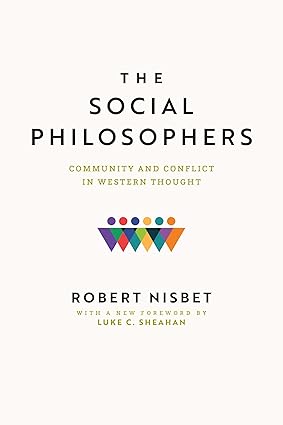
 The Social Philosophers: Community and Conflict in Western Thought
By Robert Nisbet, with a new Foreword by Luke C. Sheahan.
American Philosophical Society Press, 1973/2025.
Paperback, 440 pages, $26.95.
Reviewed by Lucía Vallejo Rodríguez.
On June 3, 1973, in a letter addressed to his friend Russell Kirk, Robert Nisbet confessed to experiencing a moment of intellectual and personal fulfillment, which he attributed, among other factors, to the stability achieved after his second marriage.[1] This maturity translated into a sustained output of books, articles, and lectures, which included The Social Philosophers: Community and Conflict in Western Thought (1973). Years later, the author himself highlighted this creative rhythm in his autobiographical notes.[2] The work was revised and updated in 1982 (Washington Square Press) and, almost half a century later, a new edition (The American Philosophical Society Press) brings it back into contemporary conversation. The return is not a nostalgic gesture. On the contrary, it confirms the validity of this great sociologist’s thesis: much of social theory can be read as an effort —often divergent in methods and assumptions— to seek community in the face of the weakening of intermediate bodies caused by centralizing powers. In this sense, The Social Philosophers recasts for a wider audience the central insight of his first and most important work, The Quest for Community (1953).
Readers of this work should be careful not to fall into one of two errors: considering The Social Philosophers as a simple manual of “great authors” or reading it as a linear historical sequence. In response to the latter conception, Nisbet warns in the preface that confusing a unilinear narrative—that “first this, then that” so common in certain historiography—with history itself “is to assume nonsense.”[3] Many of his most mature insights also follow in the footsteps of his professor Frederick Teggart, from whom he adopts a pluralistic—neither linear nor teleological—conception of historical development. On this basis, Nisbet takes a further step than his mentor and incorporates sociology as a method of historical analysis. In this work, our author shows himself to be not only a sociologist, but also a true historian of ideas, capable of finely tracing the influence of one thinker on another across generations, linking traditions and transformations without resorting to simplifications. In other words, he displays a remarkable capacity for drawing connections.
The study of community was not only the focus of Nisbet’s intellectual career, but also his most constant interest and concern. Nurtured from a young age by an intense experience of community life—especially in his grandparents’ family environment—he embarked on an intellectual journey that, perhaps without full awareness of its scope, led him to develop a body of work of inestimable value throughout a life dedicated to analyzing and understanding the social fabric.
Throughout his career—first in the Department of Social Institutions and later in the Department of Sociology—Nisbet aligned himself with the admired and alert sensibility of the great sociologists of the 19th century. For him, sociology operates as a response to a warning sign: the progressive weakening of the supports that shape communal life. In this diagnosis, community occupies a central place, both as an object of study and as an interpretive key from which to read the processes of centralization and uprooting characteristic of modernity.
The longing for community, in Nisbet’s reading, constitutes a system-idea that runs through the human condition. It is not a merely circumstantial inclination or a historical episode, but an intrinsic dimension of human nature. Even when it seems to be repudiated—as in the French Revolution—it persists. Following in the conservative footsteps of Burke, Nisbet argues that the greatest crime of the Revolution “was not those committed against individuals, but against institutions, groups, and personal status,”[4] that is, against the intermediate bodies of social bonds. Precisely because of its irrepressible nature, this impulse flourishes in very heterogeneous traditions and can be recognized, according to Nisbet, in authors of very different doctrinal backgrounds, even in those whose intellectual program would seem to be oriented towards opposite ends, such as Rousseau himself, who sought a substitute capable of mitigating the anguish of the lonely individual. Similarly, our sociologist observes this in figures as diverse as Kropotkin, Burke, Tocqueville, and Durkheim.
In The Social Philosophers, Nisbet points out that throughout the history of Western thought, community has been a central concern for those thinkers he identifies as social philosophers, beginning with figures such as Plato and Aristotle. Throughout the history of social thought, community has been conceptualized and expressed in various ways, as a political, military, religious, revolutionary, ecological, or plural community, reflecting the multiple ways in which human beings have sought a framework of meaning and cohesion. However, when community fades or is lost, an existential angst arises in the individual or, in Nisbetian terms, an alienation that can lead to an experience of anomie. To explore this notion further, Nisbet draws on various forms of artistic expression, such as literature, art, and music, citing authors such as the French writer Honoré de Balzac, who points out that the deepest fear of human beings is not limited to physical loneliness, but extends to the existential realm,[5] where emptiness and social disconnection take on a much more distressing dimension.
In The Social Philosophers, Nisbet offers perhaps the clearest and most pedagogical formulation of his conception of community, presenting it in a more accessible register than in his other works. In this work, he defines it in “its oldest and most enduring sense of relationships between individuals, characterized by a high degree of personal intimacy, social cohesion or moral commitment, and continuity over time.”[6] The subtitle of the work, “Community and Conflict,” display Nisbet’s view of the inseparable dimensions of social thought.
In The Social Bond (1970), Nisbet devotes several pages to exploring the notion of conflict, a concept that is fundamental to understanding the relationship with the idea of community in the work at hand. In this context, our author is particularly influenced by the German sociologist Georg Simmel,[7] who had already explored conflict and group affiliations. Although conflict has an undeniable psychological dimension, both Simmel and Nisbet focus on understanding it as social behavior, that is, as a dynamic process of interaction between individuals within a collective context.
Although conflict is often associated with negative connotations, with implications that can cause distress and destabilization in the individual, Nisbet presents it in The Social Philosophers as an element that, following Simmel’s proposal, can sometimes play an integrative role. Thus, in Nisbet’s reading, conflict fulfills a paradoxical function: it is, to a large extent, the experience of uprooting and rupture that most strongly awakens the need for community. In other words, the longing for community becomes more conscious and pressing where community has been lost or weakened. This insight, explicit in The Social Philosophers, also runs through his other works, where our author suggests that the authentic search for community begins precisely when it is lost.[8]
Nisbet’s work continues to be deeply relevant to contemporary debate. Despite having been written in the 1970s, his diagnoses of the weakening of intermediate bodies and the centralization of power remain overwhelmingly relevant today. At a time marked by the rise of individualism, the crisis of traditional institutions, and the proliferation of technologies that isolate individuals, Nisbet’s warning about the need to rebuild community ties resonates strongly.
The dynamics of community and conflict also resonate within the framework of this work.[9] Community, as sociologist Zygmunt Bauman pointed out with a happy expression, “has a sweet sound,”[10] or in the words of historian Raymond Williams, “Community is today another name for the lost paradise to which we long to return with all our might, so we feverishly seek the paths that can lead us there.”[11] Perhaps that path to restoring social bonds is the conflict and concrete tensions that beset us in the 21st century.
At the end of the book, Nisbet wonders about the fate that awaits community in the Western context. “The form and intensity of the search for community varies from one era to another. For generations, even centuries, it may remain silent, covered up and satisfied by the securities offered by other institutions such as family, village, class, or other types of association.”[12] The challenge embodied in the contemporary search for community reveals man’s permanent need to seek a community to belong to. It is a search that is renewed in every age and “is composed of elements as old as humanity itself, elements of faith and agonizing search that are alive in all great prophetic literature.”[13] It is time to take Nisbet’s warnings seriously and recognize that our bonds are becoming increasingly weak and that our communities—our little platoons, in Burke’s words—do not have much time left. This recognition could be precisely what drives the process of community rebuilding. Nisbet, in this sense, argues that, as in biological systems, where balance is not achieved in a static state but in continuous adaptation, authentic communities are those that constantly reconfigure themselves in the face of the dissonant forces that traverse them.
Lucía Vallejo Rodríguez is a professor at CEU San Pablo University.
[1] Robert Nisbet to Russell Kirk, Russell Kirk Papers, (Mecosta, Michigan: The Russell Kirk Center for Cultural Renewal).
[2] Robert Nisbet, The Making of Modern Society (Wheatsheaf Books/NYU Press, 1986).
[3] Robert Nisbet, The Social Philosophers (Philadelphia: The American Philosophical Society Press, 2025), p. xx.
[4] Robert Nisbet, The Quest for Community (Washington D.C: Regnery Gateway, 2010), p. 20.
[5] Nisbet, The Social Philosophers, p. 1.
[6] Nisbet, The Social Philosophers, p. 1.
[7] Although more associated with other aspects of social thought, Adam Ferguson also addressed the issue of conflict, highlighting its positive connotations in his work.
[8] See Robert Nisbet, The Sociological Tradition, (Basic Books, 1966).
[9] Nisbet delves into the notion of conflict from the tradition of Christian thought, specifically through the work of St. Augustine. Following this thinker, Nisbet argues that conflict is not only inherent in the interaction between individuals or social groups, but originates in human nature itself. Since the Fall, when Adam succumbed to sin, human beings have experienced internal conflict—fragmented by sin—and external conflict with others, fueled by selfishness. In this way, conflict becomes an endemic condition of the earthly community. This “first conflict,” from a Nisbetian interpretation, is also what could enable the restoration of the relationship between God and man. Thus, this dynamic in which conflict separates but also unites is evident once again. See Robert Nisbet, Social Change and History: Aspects of the Western Theory of Development (New York: Oxford University Press, 1969).
[10] Zygmunt Bauman, Community: In Search of Security in a Hostile World (Madrid: Siglo veintiuno, 2006), p. vii.
[11] Bauman, Community: In Search of Security in a Hostile World, p. vii.
[12] Nisbet, The Quest for Community, p. 51.
[13] Nisbet, The Quest for Community, p. 40.
Support the University Bookman
The Bookman is provided free of charge and without ads to all readers. Would you please consider supporting the work of the Bookman with a gift of $5? Contributions of any amount are needed and appreciated!
