
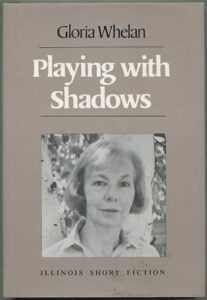
 Playing with Shadows
By Gloria Whelan.
University of Illinois Press, 1988.
Paperback, 160 pages, $12.95.
Reviewed by James E. Person Jr.
“You are undoubtedly the best writer of short stories ever to inhabit Michigan!” wrote Russell Kirk to his friend Gloria Whelan (1923-).
That was in 1990, and by then Whelan had already published a sizeable trove of fiction, including the National Book Award-winning Young Adult novel Homeless Bird and the National Outdoor Book Award-winning Jam & Jelly by Holly & Nellie, as well as a solid body of fiction for adults. But despite the praise of Kirk and other serious readers, Whelan’s corpus of short fiction for a non-YA audience has been the subject of relatively little attention by scholars and critics.
So, perhaps a belated patch of critical attention would be appropriate now, as Whelan approaches the age of 103, still living at her home in Mancelona, Michigan. If Kirk—himself a superb literary critic—considered Whelan “the best writer of short stories ever to inhabit Michigan,” it stands to reason that her works merit wider attention. The following short review-essay will focus on her short-story collection Playing with Shadows (1988), which contains the story “The Secret Meeting with Mr. Eliot,” so highly praised by Kirk in his 1990 letter.
In all, there are 14 stories in Playing with Shadows, and the perspective of almost each is that of hard-won wisdom acquired after a lifetime of maturing and learning. (More than half the stories in the volume are either concerned with or told in the first-person voice of retirees—both men and women.) The stories take place in a variety of settings: from the isle of Crete to central Mexico to Anchorage to the northern woodlands of Michigan, and elsewhere. They concern the doings of people from many walks of life, be they psychiatrists, waiters, department-store purchasing staff, university professors, homemakers, and several others. Each story is told compellingly with simplicity and grace—with unexpected passages that read like the purest poetry.
There is nothing message-driven or artificial about these stories; there is instead an effective melding of wisdom, feeling, depth, and honesty whose overall effect is somewhat reminiscent of the stories in Sherwood Anderson’s masterpiece, Winesburg, Ohio (1919): a bittersweet sense of lost opportunities, clumsily failed attempts at earnest communication, and frequent heartache resulting from the failings to which every human heart is heir. A reviewer for the Michigan Quarterly Review praised Whelan for “the assertiveness, knowledge, and power of her narrator” in each of these stories. That is to say that the author subtly but firmly demonstrates a sure-handed knowledge of a wide variety of places, occupations, and human foibles throughout Playing with Shadows.
In his poem “The Black Cottage,” Robert Frost writes:
I could devote and dedicate Forever
To the truths we keep coming back and back to.
Men and women—beloved and sought by God though tainted by sin in a fallen world—must recurrently relearn the hard lessons of life: that occasionally even the most seemingly trustworthy of companions turn out to be self-serving and treacherous; that each person mourns deep loss in a different way, with some choosing to embrace their loneliness and push away overly close relationships with others; that sometimes even one’s beloved elderly parents reveal themselves to be selfishly manipulative; that love and mutual annoyance can be first cousins, that co-dependency is real—even between a psychoanalyst and her favorite patient; that all too often the cynic’s observation that no good deed goes unpunished holds true; and many others.
Until such discoveries are made, we spend our lives playing with shadows—shades or substitutes for reality—while enduring the guilt, frustration, and pain that must be endured while pursuing these illusions: the ache of the eternal wound with which every human being is born.
One such learning is that though childhood is fleeting, infancy flies even swifter; and once those precious years and their irreplaceable milestone events have passed, parents who have outsourced the rearing of their babies to professional caregivers have missed something priceless that can never be recovered. The siren song of the modern world that children are a hindrance to self-fulfillment is a mocker. In “Children in the Park,” this lesson is learned with heartbreaking finality by a young academic who had hoped to attain a work-life balance with her career-absorbed husband but to no avail. Having given over her infant to the care of a cheerful young daycare provider, the mother discovers through notes left by the au pair that her young daughter is flying through her developmental milestones while she herself is not there to witness them. She finds herself periodically remembering the early years of her marriage, when she and her husband visited Mexico and took pictures of brightly clad children playing with carefree joy: “Sometimes I dream about the children in Chapultepec Park and their headbands, the pinwheels whirring, the children levitating, lifting lightly over the trees and drifting slowly out of sight.” As Kirk’s friend Ray Bradbury once wrote, And while we are dreaming, time flies.
The story “The Secret Meeting with Mr. Eliot” concerns a group of retirees who attend a weeklong series of classes (including a daily class on T. S. Eliot) at a nearby university, which would have been of particular interest to Kirk, considering his expertise on Eliot and his experience as a guest lecturer at colleges and universities throughout the world. When he wrote his 1990 letter to Whelan, Kirk told the author, “Your Professor Walley [sic] is too dreadfully real,” adding, “I think we would be better for it if practically all our colleges and universities became even as Nineveh and Tyre, and the owl and bat their revel would keep therein.”
The reason behind Kirk’s disdain for “Professor Wally” becomes clear in the story. Wallace Overton—who insists the class call him Professor Wally for informality’s sake—is a man trained in teaching literature but has decided that his class on Eliot for a group of “Senior Learners” is to be a daily hour of jolly fluff and filler: a waste of time to anyone interested in learning more than simply surface-level facts about Eliot and his work. Professor Wally’s flippancy and light touch is welcomed by most of the class—all but one woman, Dorothy, who signed up from an earnest desire to get beneath the surface and learn more about the works of the twentieth century’s greatest English-language poet. Dorothy knows, and Professor Wally is forcefully reminded, of a truth articulated by Kirk on one occasion:
The man of letters and the teacher of literature have no right to be irresponsible dilettantes or reckless iconoclasts; they are placed in their high dignity so that they may preserve the ideas which make all men one, not so that they may indulge an appetite for denigration and a taste for anarchic cleverness. . . . Literature is meant to rouse and fortify the living, to renew the contract of eternal society. And the scholar who treats literature as a mound of ashes—mildly profitable ashes—is false to his disciple and his age.
Instead of completing an assignment to write a poem on cats (after the example of Eliot), Dorothy writes a memorandum letting the professor know how deeply disappointed she is in him; and in the end, a chastened Professor Wally gives her an in-depth multi-hour tutorial on Eliot’s significance, with all tomfoolery cast aside. By returning to his calling, however briefly, he demonstrates that in this world there is the possibility of redemption for even the most unpromising candidates.
The title story, “Playing with Shadows,” tells of an episode in the lives of two elderly women whose friendship-love (storge) is hidden beneath a sense of tense, polite, relentless one-upmanship that might appear on the surface as mutual hatred. One of the women, Julia, is a well-off, self-absorbed American divorcee of many years who lives in a cottage in England. The other is her cook and housekeeper, Mona: a sly, tart-tongued Englishwoman who forever makes it clear to her employer that it is she who runs their shared household. The women share the cottage with a small, elderly dog named Marcus.
The plot takes place in one memorable day when Julia is awakened at daybreak by a disheveled, frightened Mona, who has suffered a debilitating stroke during the night and can barely articulate her distress. Julia initially perceives the stroke as simply a nuisance that promises to complicate her orderly life: Who will cook, clean, and go to the market for her now? Such a bother!
But Julia also intuits what she needs to do and sets to work putting Mona to bed, calling a doctor, and struggling to cook a simple meal for the stricken woman. In a heart-to-heart conversation—their first ever—Julia learns that Mona admires her because she is a fighter, a woman with grit. Pleased at first by this admission, she reconsiders Mona’s remark by the light of her own yet-unacknowledged selfishness:
Wasn’t there something ominous in it? Had Mona looked after her all these years, believing the day would come when Julia must care for her? The responsibility was unwelcome, was all wrong; Mona was paid to take care of Julia, and Julia would not see the world slip around to something else. . . .
The doctor had warned her that Mona might have another stroke, and Marcus was getting weaker each day. It appeared she was the only one with a talent for lasting. But she did not want to be the last one left. You could overdo survival.
You could overdo survival. That is the special touch Whelan brings to these stories, which tell summings-up often coming at the end of paragraphs that crescendo to the telling phrase. Indeed, the narrative voice that pervades these stories is at once comfortably familiar, like a knowing friend who is a master storyteller, making each story a carousel of insights on the human condition. Only connect, E. M. Forster famously wrote; but as demonstrated in this story and others, true connection, true fellowship is fleeting, elusive. But a further union, a deeper communion can be grasped, and it is precious when attained.
Or consider the following short passage from “The Mummies of Guanajuato,” concerning a retirees’ tour group visiting the key tourist spots in Mexico. The narrator’s focus within this story is upon a faintly insufferable man named Roy, who is the sort of person who insists on going through life meddling in the lives of others for the purpose of straightening out their personal problems:
There are forty of us in the tour, all from Florida retirement communities. Pleased and a little surprised still to be alive, we are ready for a good time and, with so many years of disappointments behind us, easy to please. We quickly broke down into smaller groups, depending on need or apathy. My husband, Fred, was drawn to Roy. Fred is quick to see the uselessness of trying to set things right, but he admires those who feel otherwise, and it amuses him to watch their struggles.
Roy is a widower, the only unattached man on the tour. Elaine is among four or five widows in the group. She is one of those women who tell you all about themselves the first time you meet them. Having been dragged so deeply into her life, I resigned myself to friendship; not to would have been a waste of time.
There it is again: I resigned myself to friendship; not to would have been a waste of time. That’s the tying-up statement that gives the reader something to chew over, reflect upon, agree with, and then proceed. Such seemingly casual summings-up are the hallmark of this collection.
“Undoubtedly the best writer of short stories ever to inhabit Michigan?” Perhaps Ernest Hemingway (who spent his summers as a young man at a family cottage on the shores of Walloon Lake near Petoskey) would care to differ. The prolific Joyce Carol Oates lived in Detroit for a time during the 1960s. And the gentlemanly Wizard of Mecosta—himself a lifelong resident of Michigan—was certainly a giant of short fiction. But if Whelan is not the best, she is most certainly in the top tier and deserves to be discovered and treasured by those who love well-crafted tales immersed in the moral imagination.
James E. Person Jr. is a Senior Fellow at the Kirk Center and the author of Russell Kirk: A Critical Biography of a Conservative Mind (1999) as well as Earl Hamner: From Walton’s Mountain to Tomorrow (2005). He has published over 200 essays, articles, and reviews in such venues as National Review, the Virginia Quarterly Review, Touchstone, and many others.
Support the University Bookman
The Bookman is provided free of charge and without ads to all readers. Would you please consider supporting the work of the Bookman with a gift of $5? Contributions of any amount are needed and appreciated!

