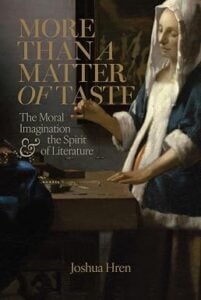
 More Than a Matter of Taste: The Moral Imagination and the Spirit of Literature
By Joshua Hren.
Word on Fire Luminor, 2026.
Paperback, 392 pages, $29.95.
Reviewed by Nadya Williams.
The year after Euripides died (406 BC), Athenian theater-goers who flocked to see Aristophanes’s new comedy, Frogs, were in for a surprise. That Aristophanes would choose to mock Euripides in death after mocking him abundantly in life was hardly surprising, to be clear. The surprise lay, rather, in the casting of a comedy as a literary contest—a contest of taste. More than that, the contest in question raised the question of the role of literary arts in forming moral citizens.
As the play opens, Dionysus, the patron god of drama, talks on stage of his all-consuming desire for Euripides—the last of the three great tragedians. There is simply nothing good to see at the theater now that Euripides is dead, Dionysus mourns with a true connoisseur’s grief. Too many playwrights, none of them worth their salt, he says—but using much stronger language than that, appropriate for the male-only audience of Athenian comedies. Only one thing to do to resolve this crisis, of course: go to the underworld and bring Euripides back!
The comedy only grows more absurd as the plot develops, culminating with a contest of the three great Athenian dead tragedians in the underworld. Sophocles refrains from participating, pronouncing Aeschylus the master of the genre. Euripides, though, challenges Aeschylus, and the contest grows quite intense, culminating with the weighing of words from the two tragedians’ plays—on scales. Aeschylus’s verses prove to be much weightier at the end, earning him the crown. And through this contest, the dead Euripides only comes across as an even more unlikeable character than the living version Aristophanes had mocked on stage before. He is cut-throat, spiteful, and a generally corrupting influence on others. He subverts the dead to support his cause, the play states, just as he had once subverted the living.
That the literary arts are important because they form the moral imagination of the citizen body was axiomatic for Athenians in the heyday of the Athenian democracy in the fifth century BC. Tragedies and comedies that all citizens got to see together for free as the perk of their citizenship in the democracy offered common experiences and a common language for all. Their quality, therefore, mattered for the well-being of the democracy itself. Good citizens, we can all agree, are better for the state than immoral ones, after all. And good citizens are formed both together and singly as they attend comedies and tragedies and absorb their lessons.
But this vision of good literature is, we could say, timeless rather than specific to one place and time. In his new book, More Than a Matter of Taste: The Moral Imagination and the Spirit of Literature, novelist and literary critic Joshua Hren argues that literature helps us see the world in a fuller way than anything else can: “literature, like other arts, helps us only to the extent that it first helps us to see. Any moral or emotional effect of literature (and a fully moral response is both rational and emotional) is secondary to, and consequent upon, literature’s great gift of vision.” With much of this the Athenian would agree, and much of Hren’s argument could indeed easily apply to Athenian stage drama and the vision Aristotle had for tragedy, in particular, as offering a “catharsis” of pity and fear, a sort of literary-wrought group therapy for the citizenry as a body.
So far so good. But as a Christian reader—and, of course, as a Christian novelist—Hren does not stop there. For Hren, a devout Catholic, reading literary works, including those of writers who were not believers themselves, is a search for the transcendent. The novel, a beleaguered genre today, is the key in this exercise, Hren insists, even as novels today do not hold the sort of “social significance” they had in the past. Few are the novels that everyone reads in our fragmented literary landscape. This affects the lives of both readers and writers in myriad ways. As both a publisher (of Wiseblood Books, a press that publishes novels too) and as a co-founder of the MFA in Creative Writing at the University of Saint Thomas-Houston, Hren certainly has spent much of his career thinking about the new challenges modern novelists face in finding readers, and the challenges modern readers face in trying to read virtuously, for their own moral formation.
Much of this has to do with the decline of reading in our society—and it has to do with what replaced reading as well. Doomscrolling and the passive entertainment of shallow TikToks retrains the imagination to be satisfied with the “junk food” equivalent of serious stories that unfold over hundreds of pages, as is the case in many classic novels. At the most extreme end of things, Proust’s six-volume masterpiece, In Search of Lost Time, hovers around or slightly over 4,000 pages total, depending on the edition. Definitely not written for the TikTok generation. But the good news is that those who have never practiced serious reading can retrain their attention still—turn it to matters of love and stories that unfold more slowly than we are used to in this fast-paced world of slop, of new novels that get (on occasion) pulled off the shelves after publication when an author’s AI usage has come to light, as was recently the case for one novel. Hren’s discussion of classic novels mostly from the nineteenth century, by contrast, gives a good taste of the rewards that await the patient reader who is not willing to settle for fast and easy.
Hren spends much of the book considering the ways of reading in such masterpieces as Proust, but also the (comparatively shorter) novels of Jane Austen, George Eliot, Flaubert, Turgenev, Joseph Conrad, Dostoevsky, and Joyce. The chapter on “Dostoevsky’s Apocalypse of Beatitude” was my personal favorite, but the book is filled with gems. Furthermore, in addition to the authors who form the focus of the book, many others, including Homer and the classics of early modern and modern philosophy, organically crop up in conversation as well—and “conversation” is indeed an apt term for the flow of this book, as Hren connects the dots across the history of Western philosophy and literary fiction, showing the ways people have sought truth and goodness and beauty in the form of novels. These novels, he shows us no less than tells, still help us find eyes to see, even now, in the age of AI. They may be the best and simplest tools for stewarding our imagination now—read on paper in print, of course, not on tablets or devices.
The selection of particular novels as case studies in this book is necessarily subjective, one could quibble. Every writer, after all, has his own favorites. Yet the overall argument would generally hold with any modern classics, I think. Not every experiment in the humanities can pass the replicability criterion of experiments in the laboratory sciences, but this one does.
Hren selects earnest classics that have stood the test of time—books that generations of readers have found edifying and moving. But also, in the introduction and conclusion alike, Hren returns to another key point of fiction: it doesn’t just help us see extraordinary truth, although it can. More important is that fiction gives us eyes to see the transcendence of ordinary lives, including our own. Thence the significance of the mid-twentieth-century literary critic Auerbach’s observation in his masterpiece, Mimesis, that it was the Gospels that first portrayed the everyday life of mere lowly fishermen as worth writing about in truth and love. And, Hren reflects in concluding the book, it makes all the difference that we have read of Christ himself living an ordinary life and performing the ordinary acts of such a life—eating food and drinking water.
There is one final note to make about the significance of this particular book. Its publication comes as part of this spring’s extended launch festivities for Luminor, the new literary imprint from Word on Fire publishers. Helmed by the talented Catholic fiction writer and editor Katy Carl, Luminor aims to publish new novels that will help us find eyes to see. We will never go wrong if we follow C.S. Lewis’s advice in his essay “On the Reading of Old Books,” where he recommended this cure for our modern condition: “The only palliative is to keep the clean sea breeze of the centuries blowing through our minds, and this can be done only by reading old books.” But as we read some new novels, in addition to the old, may we find fresh encouragement in our pursuit of beauty and goodness and truth, and voices that still speak the truth through fiction today.
Nadya Williams is interim director of the MFA in Creative Writing at Ashland University. She is books editor at Mere Orthodoxy and the author of Cultural Christians in the Early Church (Zondervan Academic, 2023), Mothers, Children, and the Body Politic (IVP Academic, 2024), and Christians Reading Classics (Zondervan Academic, November 2025).
Support the University Bookman
The Bookman is provided free of charge and without ads to all readers. Would you please consider supporting the work of the Bookman with a gift of $5? Contributions of any amount are needed and appreciated!

