 Of Rule and Office: Plato’s Ideas of the Political
By Melissa Lane.
Princeton University Press, 2023.
Hardcover, 480 pages, $49.95.
Reviewed by Jesse Russell.
In October of 1993, a trial took place in Colorado regarding Colorado Amendment 2, a ballot measure that Colorado voters had approved the previous November. This Amendment argued that homosexuals should not be granted “minority status, quota preferences, protected status, or claim of discrimination.” The amendment ultimately was given a permanent injunction by Judge Jeffrey Bayless on the grounds that it was unconstitutional. During the trial, one of the key arguments revolved around natural law and drew on conflicting interpretations of classical writers such as Plato and Aristotle. Various public intellectuals contributed to the discussion. On the right, Harvey Mansfield and Robert P. George argued for the amendment, and, on the left, Martha Nussbaum argued against it. The key issue was whether Plato and Aristotle offered rational arguments for or against homosexuality. The battle over Amendment 2 seems like something out of an entirely different era of American politics. Liberals were arguing for greater freedom and rights, while conservatives were arguing in support of natural law. In our contemporary milieu, things are much different. The left is about the business of restricting freedom and canceling, while the right is taking a much more authoritarian bent as well.
In the twenty-first century, the New Right drives much of the conversation, and both conservative and left-leaning liberals, as well as the radical left, play catch-up. For the New Right, following in the wake of Nietzsche and Julius Evola, Plato, along with Socrates, is a key marker, not in the progress, but the decline of Western civilization. The notoriously ugly Socrates and his student Plato were, in this reading, too esoteric and intellectual, taming the Greek polis as well as the inherited earlier brutal and aristocratic nobility of the Mycenaean period. Liberals, whether conservative or left-leaning, are attempting to reaffirm a humanistic Platonism, while the left, focused on race and gender, is attempting to purge Classical Greece of whiteness and implicit fascism. Adding to this discussion, in her recent work, Of Rule and Office: Plato’s Ideas of the Political, Princeton University philosopher and political theorist Melissa Lane explores Plato’s notion of rule and governorship, attempting to refresh the humanistic, liberal reading of Plato’s political theory.
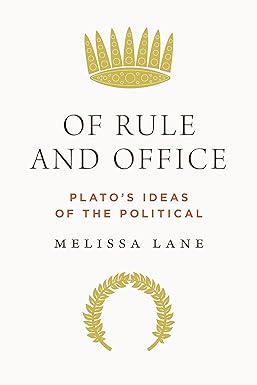
From her front cover, which bears a stylized image of the diadem of a Mycenean king (a figure idolized by BAPist wing of the New Right), Lane places her work in dialogue with contemporary postliberal debates about rule. Indeed, with perhaps a nod to the Trump administration and other contemporary populist governments, she notes that the question of unaccountable monarchs is a perpetual problem. She begins her work with a discussion of Greek writer Pausanias’s treatment of the transformation of kingship to the “accountable office” (arche hupeuthunos) in Athens. There was thus a movement from an archaic absolutism to a more moderate and restrained, and thus “liberal,” rule. Lane writes that the term arche would later be used by Plato for rule. Lane places this discussion in a wider one about how a ruler should serve the common good of the ruled. The ruler is thus “accountable” to the ruled. It is also a discussion about how constitutions and laws limit the ruler. Lane frames this discussion with the adage from the Roman poet Juvenal, “Who shall guard the guardians?”
Lane notes that, in his Republic and Statesman, Plato develops the notion of archon or office. Lane also notes that Plato’s image of the philosopher kings and queens is rooted in Homer’s image of the king as “shepherd of the people” as well as the “orderer of the people” (kosmetor laon), which would establish a kosmos or order. The notion of archon or office is also rooted in 7th BC Crete. The notion is that the ruler is the true servant of his people; thus, the archaic heroic ideal is not the rule of domination of Nietzsche and Evola, but the rule of service. Plato, further, in Lane’s reading, is not necessarily a conservative or traditionalist and discusses the possibility of reconfiguring office with law. Moreover, political rule is necessary for those who cannot rule themselves. In Book 8 of his Republic, Plato depicts those who hold office and who are accountable to a constitution. Lane places her work in conversation with Hannah Arendt, who attempted to create a divide between true democracy and Platonic rule; Arendt argues that in Platonic rule, some are “forced to obey.” Arendt further argues that Platonic rule is based upon a master’s rule of his household or something akin to slavery. This is a key issue, for, in our own post-liberal era, there is a new jettisoning of liberalism and increasingly support for authoritarian rule among the New Right. Lane gives the example of the euthunai or structured limits on authority, such as limits on eligibility.
During Plato’s own era, there were several real-world political efforts to establish a right rule rooted in service and the common good. In 4th-century Athens, there were appeals to the “ancestral constitution” (patrios politeia) as well as the Areopagus Council, which had the job of safeguarding the common good. After the rule of the Thirty Tyrants, there was a greater emphasis on making sure the office holders enforced the laws. Lane argues that these trends influence the Republic and the Statesman. According to Lane, rule is a “relationship between” the ruler and the ruled, guided by purpose (telos) and order (taxis). Lane further demonstrates that Plato does not hold that coercion is essential to rule. Plato is counteracting his contemporaries who discuss the phenomenon of a ruler ruling for his own benefit, placing these views in interlocutors such as Thrasymachus and Callicles in his dialogues.
Platonic rule is further tied to Platonic ethics. For Plato, as for Aristotle, living virtuously is tied to happiness. In order to be virtuous, one must have an ordered soul. The goal of rule is thus to order the souls in those who are not able to order them themselves through proper virtuous activity. If one is able to achieve virtue, then he or she is able to have true friendship and civic participation. Self-rule is not the same as political rule, but there are similarities. In self-rule, the rational part of the soul seeks its own good, while in political rule, the ruler seeks the good of the ruled. This shepherding of the people and serving their good is at the heart of Lane’s argument.
The underlying question behind Lane’s work is to whom Plato belongs. Key figures of the New Left and millennial left, influenced by Karl Popper and Hannah Arendt, see Plato as a fundamentally right-wing, totalitarian figure. Indeed, much of the left’s project since the Second World War has not been economic justice, but rather deconstructing the elements of Western civilization that led to the murderous regime of German National Socialism. For some thinkers, Plato is one of these thinkers. In our own contemporary milieu, the New Right has adopted Plato as a key architect of postliberalism. Melissa Lane is one of many left-liberal thinkers seeking a middle ground between “canceling” great thinkers and those in the New Right who seek to co-opt them for their postliberal vision.
Jesse Russell has written for publications such as Catholic World Report, The Claremont Review of Books Digital, and Front Porch Republic.
Support the University Bookman
The Bookman is provided free of charge and without ads to all readers. Would you please consider supporting the work of the Bookman with a gift of $5? Contributions of any amount are needed and appreciated!

