
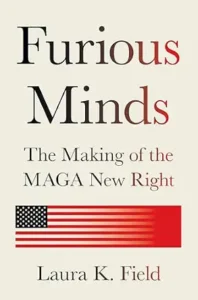
 Furious Minds: The Making of the MAGA New Right
By Laura K. Field.
Princeton University Press, 2025.
Hardcover, 432 pages, $35.
Reviewed by Chuck Chalberg.
This book could have been titled in the singular, as in “furious mind,” since it is more than an occasional autobiographical account of the author’s own intellectual journey. That journey would prove to be something other than a dramatic or even gradual shift in point of view. Rather, it is the on-again, off-again accounting of a young academic, a budding professor of political philosophy, whose curiosity about a conservative approach to matters political began by intriguing her, even fascinating her, before angering her, and finally repelling her.
On-again, off-again? Author Laura Field sprinkles her own thoughts, experiences, and reactions into her scholarship on the rise of the New Right. The result is not simply a straightforward, academic story of the “making of MAGA New Right,” but a sporadic story of the author making up her own mind about—and coming to terms with—the American right. In some respects, the intellectual and emotional evolution of this book can be reduced to the story of one mind: the mind of the author as she has undertaken the “long, slow process of extricating (herself) from the world of conservative intellectualism.” On the other hand, if a plural reference to her many subjects was to grace the title, a different adjective would have been better, not to mention more accurate. While Laura Field’s mind has apparently reached a stage that at least borders on fury, the minds of her subjects are largely something other than that. Concerned, even at times troubled minds, to be sure. But furious? Really?
Yes, her subjects also exhibit, well, conservative minds, but “conservative minds” is, well, quite conservative, not to mention perilously close to a book with a similar title. And to borrow slightly from Lloyd Bentsen debating Dan Quayle: I’ve read Russell Kirk, and Laura Field is no Russell Kirk. “Reactionary minds” might have been a possibility, since she assumes that many of her subjects are just that—and in the worst rather than best sense of that term. But few, if any, are really possessed of—or by—furious minds.
One also comes away from this book with the sense that her allegedly fit-to-be-tied subjects have had no legitimate reason to be concerned or troubled, much less furious, about anything at all in the American body politic. The reigning orthodoxy of liberal pluralism, however that has been packaged and repackaged, apparently had been—and deserves to continue to be—the prevailing story of life in America before, during, and well after what she hopes will soon prove to be little more than a briefly successful outburst on the part of the MAGA right.
Has there been anything approaching a long march through the institutions that might have led conservatives to be at all concerned about anything? Not insofar as Field is concerned. Well, maybe there is a little something to be worried about. Roughly two-thirds of the way through her story, Field finally does get around to offering a brief section within a chapter, which she titles “longmarcherism.”
For Field, the storyline put forth by the New Right essentially amounts to this: “For decades radical leftists had been engaged in a deliberate, top-down radicalization scheme to infiltrate and conquer American institutions.” Not so, she responds: “The Longmarcher story simply did not line up with reality.” Yes, the left had won “real victories,” such as “civil rights protections,” Roe v. Wade, and “marriage equality.” But there also had been “losses and claw-backs,” as evidenced by the “rise of mass incarceration” and Citizens United. In sum, the right has very little to be troubled by, much less to be furious about. And yet they are filled with fury. Or at least Field wants her readers to believe that they are.
Has there been anything else that might qualify as a “claw-back”? Not that Field bothers to mention. In any case, as far as she is concerned, whatever might come under the heading of “wokeness” has been nothing more than a “response to real life problems.” Besides, the phenomenon of wokeness “was not especially lasting or effective.” Yes, that would be “was,” not “is.” In other words, whatever this “ness” might once have been, it now is apparently long gone.
In sum, there has been nothing at all to be concerned about, much less to be furious about, that would justify, let alone explain, the rise and success of the MAGA right. And yet “furious” (to her) they have been, and electorally successful their movement has been (despite her). At least that is the conclusion of a mystified, dumbstruck—and, yes, at times furious—Professor Field.
Her search for furious minds takes Field down many a rabbit hole where she finds innumerable confirmed misogynists and not a few out-and-out racists. And no doubt such can be found. But to presume, as she does, that they are representative of the larger conservative movement is both unfair and mistaken. So is her presumption that they have had a great deal of influence. Moreover, to give them standing anywhere close to that of the Charles Keslers, Michael Antons, Larry Arnns, Patrick Deneens, and Christopher Rufos, among other serious, but far from furious, minds of today’s conservative intellectual world, is also unfair and mistaken.
In fairness, she generally reserves the terms “far right” and “hard right” for her unfavored, yet somehow favored, misogynists and racists. They are unfavored in the sense that she strongly opposes them, but they are favored in the sense that she uses them to lend credence to her larger story. And yet she opens by “Introducing the MAGA New Right” in this way: “Between 2016 and 2024, over the course of less than a decade, American conservatism capitulated to—and took part in fomenting—a far-right populist movement” that “catapulted” Donald Trump into power not once, but twice. That would be the Donald Trump “who obviously cared little for constitutional niceties,” as well as Trump the “adulterer, purported rapist, and obvious misogynist, who was also an anti-intellectual and failed capitalist….” No wonder she is so furious with those among her fellow countrymen who voted for him, as well as those among her brother and sister intellectuals, who saw virtues in him and perhaps even a need for him.
Curiously, she ignores an entire category of minds who likely have done more to advance the MAGA right than any conservative thinker or writer, including the aforementioned quintet listed above. Had she done so, she might even have discovered a few genuinely, or at least provocatively, furious individuals among them. Is she aware of such figures as Dennis Prager, Glenn Beck, Larry Elder, and Mark Levin, among others? If so, she doesn’t tell us. And at least Mark Levin among them can occasionally leaven things by sometimes becoming downright furious or at least feigning such a state.
If one is serious, as well as furious, about the rise and success of the MAGA right, and especially if one seeks to explain its “making,” one would have to put the minds behind the microphones under one’s microscope as well. But preoccupied as she is with matters of the academic and published mind, she is content to dismiss talk radio hosts as either mindless or insufficiently furious—or both.
Rush Limbaugh does make a cameo appearance, but only in the context of Michael Anton’s “Flight 93” essay, much of which Limbaugh read on the air shortly after it was published in September of 2016. The theme of that piece was that the hour is late. As Limbaugh put it to his listeners, the choice had come to this: either “charge the cockpit or die. You may die anyway . . . There are no guarantees. Except one: if you don’t try, death is certain.”
Limbaugh thought that Anton’s warning was great stuff, not to mention on target. He also understood that it was a metaphor. Field, however, treats it as both a revealing document and a representative example of a mindset that is very much over the top. Again and again, she has one or another of her subjects ask what time it is, historically speaking. Of course, she does so to confirm the need for fury on the part of her subjects, owing to the lateness of the hour, politically speaking.
But fury still doesn’t capture their state of mind. Instead, a sense of urgency certainly does. And a justifiable, entirely reasonable sense of urgency it essentially is. To think otherwise–and then to behave accordingly, whether that be lethargically and/or indifferently–would itself be evidence of madness.
The political philosopher that she was trained to be, Field repeatedly tries to take the high road by concentrating on the ideas of her subjects. But the method to her madness here is to portray her subjects as idea-driven ideologues, meaning ideologues divorced from everyday realities. Her target is what she calls “Ideas First thinking,” which she accuses the New Right—and apparently the New Right alone—of advancing. On the one hand, her New Righters agree with Richard Weaver that “ideas have consequences”; on the other hand, they do not practice what they preach. Too often, Field contends, “New Right thinkers find themselves in the awkward position of using intellectual abstractions to defend nativism, rootedness, and love of one’s own.”
In the first place, how and why do these three things belong together? In the second place, what does she mean by nativism and what’s wrong with rootedness or love of one’s own? In the third place, what abstract thought is at work here? And lastly, might this be a case of the pot calling the kettle black? Abstract thinking, she thinks, is uniquely a problem of the right? Really? For that matter, does abstract thinking really govern the intellectual approach of those on the right?
Much of the book is an indictment of the “Claremonters.” If their main idea is what it is, namely a defense of the American founding, what could possibly be abstract about that? And if the Claremont Institute could be said to have had a founding father, it would have to be Harry Jaffa. While his thinking does not necessarily infuriate Field, it does worry her. It is her contention that he “went very far . . . in asserting and defending what can only be called a dogma,” which held that there was a “singular moral core to the American regime.” That “core” was so “thick” that it “put a hard cap on actual religious pluralism, political liberty and contestation, and philosophical freedom.” Once again the only response can be reduced to that single word: “really?” For Field, such thinking “lends itself in obvious ways to political extremism.” Not quite finished, she detects a “desperation to the late Jaffa’s writing—an early glimpse of the kind of grasping monomania and insistence on political simplicity that we will see throughout this book . . .” Here her worrisomeness threatens to verge on fury.
A more than occasional glutton for punishment, Field dips into and out of conservative conferences, the better to enable herself to assert herself into this story. No doubt those on the left will be mostly pleased by what they read in these pages, while those on the right will find themselves flummoxed or angered—and perhaps furiously so.
John C. “Chuck” Chalberg writes from Minnesota and once performed as G. K. Chesterton.
Support the University Bookman
The Bookman is provided free of charge and without ads to all readers. Would you please consider supporting the work of the Bookman with a gift of $5? Contributions of any amount are needed and appreciated!

