
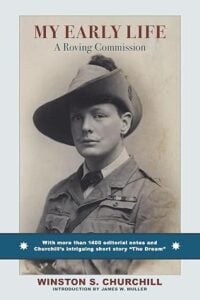
 My Early Life: A Roving Commission
By Winston S. Churchill. Edited by James W. Muller.
St. Augustine’s Press, 1930/2025.
Hardcover, 608 pages, $50.
Reviewed by Frank A. von Hippel.
Winston Churchill was a prolific and ambitious writer, for which he was rewarded with a comfortable income, international speaking engagements, an astonishing political career, and the Nobel Prize in Literature. Of his many books, including his multi-volume memoirs of the two world wars, what then explains why his most popular book was a winsome description of his early life well before his most important achievements in politics? Churchill published My Early Life: A Roving Commission in 1930, just one year into the Great Depression and the political sidelining of his “Wilderness Years”. The book has never been out of print. To help us understand why the book touched a nerve in generations of readers (in over 20 languages), Churchill scholar James Muller published a new edition in 2025 with St. Augustine’s Press.
Muller explained in the Editor’s Introduction why Churchill wrote about some topics but skipped over others. For example, Muller wrote:
…My Early Life might seem curiously silent about love. He is reticent, in contrast to current practice among celebrities in the public eye, maintaining gentlemanly discretion about his love life. In these early years he and his brother cadets at Sandhurst frequented the Empire Theatre of Varieties in London’s Leicester Square, a haunt for high-class prostitutes, where he gave his first public speech, bidding fellow theatre-goers to demolish barricades between the seats and the bar recently erected by ‘Prudes on the Prowl’ to discourage fraternization with these ladies. The crowd of onlookers surely included them, for Churchill began his speech, ‘Ladies of the Empire, I stand for liberty…’, but there is no evidence that he consorted with them.
Churchill learned a valuable lesson from this first political speech as he wrote, “It seems even more difficult to carry forward a revolution than to start one.” On a practical level, as a young cadet he fretted about disciplinary consequences of his behavior. “Although always prepared for martyrdom,” he wrote, “I preferred that it should be postponed.”
Despite having read many books by and about Churchill, I did not know that his first venture into speech-making took place in a bordello, nor that the first political cause that caught his eye was to battle prudes. Such anecdotes make this scholarly edition of My Early Life rich with context—we see Churchill’s development as he wished us to see it, while also observing key events that he neglected to include and perspectives that were not his own. I read My Early Life many years ago, but I learned as much about Churchill from this second reading as I did from the first.
In addition to Muller’s research on the book that is expressed in the introduction and many footnotes, Muller included materials that could only previously be found in certain editions. For example, a 1939 American edition came to print after Churchill emerged from his political exile to resume the position of First Lord of the Admiralty due to the outbreak of World War II. The eminent American journalist Dorothy Thompson (whose husband at the time was the Nobel laureate Sinclair Lewis) wrote the introduction to that edition, and began it with, “It is not often that the First Lord of the Admiralty of any nation is also a writer of fine prose. Winston Churchill is one of the finest living writers of English prose. He is a stormy petrel of politics. For the past decade he has been the most pugnacious, eloquent, and scathing critic of British policy. He happens to have been right, and that is the reason he is again in the Cabinet at last.”
Thompson was well positioned to know that Churchill was right. She interviewed Hitler in Munich in 1931 and then wrote a book about the peril of Hitler gaining power. This led to her being the first American journalist whom the Nazis expelled from Germany. Thompson was therefore the perfect person to introduce Churchill’s book, and yet readers of all but one edition of My Early Life were deprived of her words until now:
Of a scintillating and sometimes devastating intelligence, a political maverick, a viveur with a gusty love of life and an unmitigated passion for England, Mr. Churchill is one of the most colorful figures on the international scene. Although he is now sixty-five years old, he seems cast in the mold of youth and is younger than the generation who could be his sons. It would be impossible to imagine England without him.
Perhaps her impression of Churchill as youthful derived from having just read about his youth.
Thompson’s introduction to My Early Life is an intriguing example of how a successful book can be robbed of some of its gems when publishers exclude extras provided by their competition. Muller undoes this injustice by bringing together all the extras of all the editions into a single volume—a formula that provides a portrait of Churchill prior to his rise to leadership.
In My Early Life, Churchill recounts adventures of his youth and early years as a journalist and soldier. It is the story of the making of Winston Churchill, starting as far back as his school days struggling with math, which, unlike letters and words, did not show the young Churchill their natural logic:
But the figures were tied into all sorts of tangles and did things to one another which it was extremely difficult to forecast with complete accuracy…In some cases these figures got into debt with one another: you had to borrow one or carry one, and afterward you had to pay back the one you had borrowed. These complications cast a steadily gathering shadow over my daily life.
He would not, therefore, become a mathematician, or indeed follow the usual path of England’s nobility into Oxford or Cambridge. Instead, he joined the army. And to do so he learned enough math to pass the entrance exam to the Royal Military College at Sandhurst. “I had a feeling once about Mathematics,” he wrote, “that I saw it all—Depth beyond depth was revealed to me—the Byss and the Abyss. I saw, as one might see the transit of Venus—or even the Lord Mayor’s Show, a quantity passing through infinity and changing its sign from plus to minus. I saw exactly how it happened and why the tergiversation was inevitable: and how the one step involved all the others. It was like politics. But it was after dinner and I let it go!”
In fact, mathematics laid low the young Churchill much less than did Latin, where his performance was so bad that his teachers pressed him to focus on English instead. This demotion was a great blessing, for Churchill’s love of the English language grew into an occupation. “Naturally I am biased in favor of boys learning English,” he wrote. “I would make them all learn English: and then I would let the clever ones learn Latin as an honour, and Greek as a treat. But the only thing I would whip them for is not knowing English. I would whip them hard for that.”
In the preface to the book, Churchill wrote,
When I survey this work as a whole I find I have drawn a picture of a vanished age. The character of society, the foundations of politics, the methods of war, the outlook of youth, the scale of values, are all changed, and changed to an extent I should not have believed possible in so short a space without any violent domestic revolution. I cannot pretend to feel that they are in all respects changed for the better. I was a child of the Victorian era, when the structure of our country seemed firmly set, when its position in trade and on the seas was unrivaled, and when the realization of the greatness of our Empire and of our duty to preserve it was ever growing stronger.
This backward look at his youth during the inter-war period is part of the appeal of My Early Life. We are brought along on Churchill’s roving commission, full of innocence and honor, but with the perspective of a man who has already served as First Lord of the Admiralty during World War I. The book makes adventure feel essential and struggle necessary to get there. It makes one nostalgic for a time when politicians were tested by battle before they had standing to engage in political debate.
Perhaps the adventures that fill these pages are what made the book so popular over the past century. It is easier to read than his great books on the world wars, especially with the many chuckles experienced along the way. Churchill’s humor reminds me of Mark Twain, as when he writes about his lack of religious observance and notes, “It might well even be that I should find an overdraft.” His attitude toward religion was refreshing. “It seemed good to let the mind explore so far as it could the paths of thought and logic, and also good to pray for help and succour, and be thankful when they came,” he wrote. “I could not feel that the Supreme Creator who gave us our minds as well as our souls would be offended if they did not always run smoothly together in double harness.”
Churchill as a charming giver of advice courses through the book, as when he encourages parents to give their sons horses rather than money: “No one ever came to grief—except honourable grief—through riding horses. No hour of life is lost that is spent in the saddle. Young men have often been ruined through owning horses, or through backing horses, but never through riding them; unless of course they break their necks, which, taken at a gallop, is a very good death to die.” Muller connects such gems to Churchill’s personal life by telling the reader what is not in the book, such as how Churchill gave money to his daughter in 1943 so that she could buy a horse; apparently the advice applied to girls as well as boys. Indeed, Churchill’s memory of his mother seemed most poignant when she sat atop her steed. “My picture of her in Ireland,” he wrote, “is in a riding habit, fitting like a skin and often beautifully spotted with mud.”
Muller wrote about his extensive editorial notations that appear on nearly every page: “Often I wonder if Winston Churchill…would have been sorry to find his memoir weighed down by editorial notes equal in length to what he had written himself.” I think Muller need not worry about that, as readers interested in both the larger context of Churchill’s life and Churchill’s ghost will undoubtedly appreciate the rich interpretations and historical background that Muller provides. For example, the footnotes often clear a haze before the text, as when Churchill wrote, “Polo, pig-sticking, pony-racing, horse-racing, together with shooting big game of every kind, had played a constant part in his affairs.” Pig-sticking, according to the associated footnote, is a form of boar-hunting with the participant “on horseback and armed with a nine-foot lance, with which he attacks the wild pig.” This was, we learn, a popular sport among British cavalry officers as it facilitated military training.
Churchill wrote, “I wonder often whether any other generation has seen such astounding revolutions of data and values as those through which we have lived. Scarcely anything material or established which I was brought up to believe was permanent and vital, has lasted. Everything I was sure or taught to be sure was impossible, has happened.” He wrote of a vanished empire, of bygone comportment associated with society balls and faraway battlefields, and of a governing class that suddenly found themselves among the governed. As astonished as Churchill was at the pace of change during his lifetime, I think modern readers can perfectly relate to this sentiment. The pace of change has not diminished. Nor has the relatability of a young Winston Churchill.
I learned from Muller’s editorial notes that Churchill died on the 24th of January, 1965, exactly seventy years to the day of the death of his father Lord Randolph Churchill. This is just the final coincidence of many that punctuate Churchill’s extraordinary life, one that he reflected on as a series of musical scores:
I have got tunes in my head for every war I have been to, and indeed for every critical or exciting phase in my life. Some day when my ship comes home, I am going to have them all collected in gramophone records, and then I will sit in a chair and smoke my cigar, while pictures and faces, moods and sensations long vanished return; and pale but true there gleams the light of other days.
Frank A. von Hippel is the author of The Chemical Age (University of Chicago Press) and the host of the Science History Podcast.
Support the University Bookman
The Bookman is provided free of charge and without ads to all readers. Would you please consider supporting the work of the Bookman with a gift of $5? Contributions of any amount are needed and appreciated!


